
A long warranty can sound reassuring, but its value depends on what it covers and who stands behind it. When comparing a home renovation warranty London homeowners may be offered, it’s important to distinguish a contractor’s workmanship commitment from a structural warranty.
Before committing to a major renovation, check the written terms carefully. They may exclude particular work, materials or types of damage. A contractor’s commitment and a third-party structural policy are not interchangeable, and neither guarantees that every defect will be covered.
This guide explains the differences and what to check before work begins, including the provider, covered work, exclusions and claims process. It also covers the project documents that help define responsibilities from planning through to handover. Daniels Contractors has operated in London since 2001, with projects across London, Surrey and Essex. Ask which warranty applies to your project and confirm its terms in writing.
Key Takeaways
- A home renovation warranty London homeowners are offered can mean different things. Check whether the document is a contractor’s workmanship commitment or a structural warranty.
- Compare the written warranty schedule with your project scope and technical design to see which work is included.
- Before appointing a contractor, check who provides the cover, what it excludes, how to make a claim and who is responsible for responding to defects.
- Keep the contract, warranty documents and project records together. Ask for unclear terms to be explained in writing.
- Fixed-price contracts and milestone-based payments set out project arrangements, not warranty benefits. Confirm any cover separately.
Home renovation warranty in London: what does it actually mean?
A major renovation is a substantial commitment, and warranty language can be confusing. A home renovation warranty London homeowners are offered is best understood as written cover with a defined scope. The exact document determines which work, defects or responsibilities it addresses. The word “warranty” alone doesn’t tell you what will happen if a problem arises.
For a general explanation of what a warranty means in contract law, distinguish the written promise from the practical arrangements for making a claim. In a building project, those arrangements may be set out in a contractor’s agreement, a separate insurance-backed document or a structural warranty policy. Read the wording itself rather than relying on a verbal description.
What can a renovation warranty refer to?
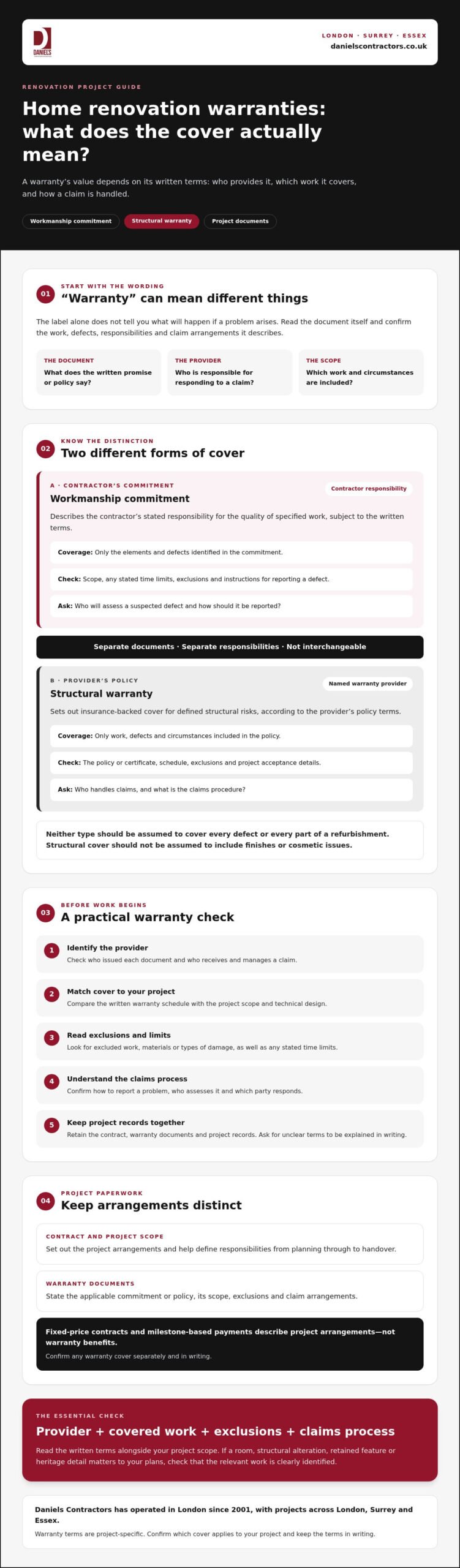
A contractor’s workmanship commitment may explain how the contractor will respond to defects in the work they carried out. A structural warranty is a separate form of cover, usually set out in a policy from a warranty provider, with its own eligibility, scope and claims process. The two are not interchangeable. The first concerns the contractor’s stated responsibilities, while the second depends on the provider’s policy terms.
Neither should be assumed to cover every part of a refurbishment. For example, a document may relate to specified structural work without covering all finishes, fittings or other project elements. Check who issued each document, which work it names, and who receives and manages a claim. If the contractor, administrator and provider are different parties, ask what each is responsible for.
Why London homeowners should check project-specific terms
London properties range from period houses to contemporary homes, and renovation scopes vary just as widely. If work involves original features or heritage details, clarify what is included, which materials or areas the documents refer to, and who is responsible for addressing an issue. Don’t assume cover described for another project applies to yours, whether you’re renovating in London, Surrey or Essex.
Read the warranty documents alongside the written project scope. If a particular room, structural alteration or retained feature matters to your plans, check that the relevant work is clearly identified. For wider context on planning a detailed refurbishment, read our high-end home refurbishment guide.
The document, provider and covered work determine what protection applies. Before work begins, confirm those details, along with the claims contact and process. Clear answers help you understand the arrangement without mistaking a broad description for a promise of cover.
Workmanship guarantee or structural warranty: what is the difference?
These documents serve different purposes, so treat each as a separate part of your project paperwork. A contractor’s workmanship commitment sets out the contractor’s stated responsibility for specified work. A structural warranty is a policy whose cover depends on its provider, terms and acceptance of the project. Neither label, by itself, confirms which parts of your renovation are protected.
Workmanship commitment
Purpose: Describes the contractor’s commitment regarding the quality of specified work.
Responsible party: The contractor, subject to the written terms.
Covered work: Only the elements and defects identified in the commitment. Scope and any time limits can vary.
Documents to request: The written commitment, relevant contract clauses, exclusions and instructions for reporting a defect.
Structural warranty
Purpose: Sets out insurance-backed cover for defined structural risks, as specified in the policy.
Responsible party: The named warranty provider handles claims according to the policy process.
Covered work: Only the work, defects and circumstances included in the policy. Don’t assume it covers finishes or cosmetic issues.
Documents to request: The policy or certificate, schedule, exclusions and details of project acceptance and claims procedures.
What to ask about workmanship commitments
Ask which completed elements the contractor’s commitment applies to, how to report a suspected defect and who will assess it. Check the project documents for stated time limits, exclusions or steps you must follow. If an answer is given verbally, ask for it in writing so the commitment is clear alongside the agreed scope of work.
What to check in structural warranty documents
Read the actual policy to identify the provider, covered work, duration, exclusions and claims process. Ask whether the provider has accepted your particular project and whether any conditions apply. A provider name mentioned in general discussions does not confirm that the policy applies to your renovation. Check the documents before work begins.
A home renovation warranty London homeowners consider should also be understood alongside their other rights. A written warranty doesn’t replace statutory consumer protections. The Consumer Rights Act 2015 requires services to be carried out with reasonable care and skill. Citizens Advice explains your consumer rights for home improvements.
Clear paperwork makes responsibilities easier to follow from appointment through to handover. You can review Daniels Contractors’ renovation approach as part of considering how a contractor communicates about project arrangements.
Does a home renovation warranty cover every defect? Check the exclusions
No. A warranty should not be treated as a promise to cover every defect, repair or part of a renovation. Its scope depends on the contract or policy wording, including exclusions and any responsibilities placed on you. When reviewing a home renovation warranty in London, compare the terms with the actual project rather than relying on a general description of the cover.
Use this checklist to organise your review:
- Confirmed cover: Identify the planned structural work and refurbishment elements named in the documents. Check that the policy schedule matches the written project scope.
- Exclusions: Look for items or circumstances the policy leaves out. Depending on the wording, exclusions may relate to wear, maintenance, cosmetic damage, accidental damage or materials supplied by the homeowner.
- Maintenance duties: Check whether the documents require you to maintain particular elements or follow specific steps to preserve cover. Don’t assume what those responsibilities are.
- Unresolved questions: Note anything unclear, including differences between the contract and policy, and request a written explanation before work starts.
Compare the promised work against the policy schedule, item by item, before signing. This can show whether a planned alteration, finish or retained feature is described in the documents, or whether you need clarification.
Common coverage questions to resolve before work starts
Ask whether the proposed structural work and refurbishment elements fall within scope. Check how the documents treat pre-existing conditions, later alterations and work carried out after the renovation. If the contract says one party is responsible for an issue but the policy appears to assign responsibility elsewhere, ask the contractor and provider to clarify the position in writing. A clear answer is more useful than an informal assurance.
How project quality and compliance relate to warranty terms
Compliance with UK building regulations and warranty cover are separate matters. Meeting applicable technical standards does not, by itself, confirm that a defect is covered by a particular policy. Ask how relevant compliance evidence and technical design information will be recorded, who will provide it, and how you’ll receive the project documents at handover.
For work that may affect an adjoining property, clarify who is coordinating the relevant project records and which documents you should retain. This is a practical question, not legal advice. You can also review TrustMark’s information on Government-endorsed quality schemes to understand the types of consumer protection and support that may be available through a scheme. Confirm which arrangements apply to your specific contractor and project.
How to check a renovation warranty before appointing a London contractor
Review the warranty alongside the project documents, not as a separate promise. A home renovation warranty London homeowners can assess clearly should name its provider, define its scope and explain how to make a claim. Use this five-step check to identify gaps while there’s still time to ask questions, whether your project is in London, Surrey or Essex.
- 1. Identify the provider. Establish who issues the warranty, whether it is a contractor commitment or a policy from a separate provider, and who to contact with a concern.
- 2. Read the scope. Compare the warranty schedule with your written project scope and technical design. Check that the elements being altered or refurbished are described, rather than assuming broad wording includes them.
- 3. Check exclusions and conditions. Read the relevant clauses and ask which circumstances or work fall outside cover. Confirm any stated requirements that could affect eligibility or a claim.
- 4. Confirm responsibilities. Ask who reports, assesses and responds to a defect. Make sure the route is clear if the contractor and warranty provider have different roles.
- 5. Retain the documents. Find out which records will be provided at handover and keep them with your signed contract and agreed project scope.
Questions to put to the contractor and warranty provider
Ask directly: who issues the warranty, and who should you contact if a concern arises? Which renovation elements are included, and what exclusions or conditions apply? What records will be handed over, and how should you keep them? Clear answers help you understand the process and identify a contact for project questions. If your home has period features, the Victorian house refurbishment guide offers further context on planning work in an older property.
Documents to review and keep
Keep the signed contract, agreed scope, warranty documents and relevant completion records together. Check that the property details, named parties and description of the work are consistent across the paperwork. If the contract and policy appear to assign responsibility differently, or any wording is unclear, ask for an explanation in writing before appointing the contractor. A single project contact can make it easier to direct questions, but confirm who handles warranty matters specifically.
For a refurbishment, you can discuss your project with Daniels Contractors and ask how the proposed scope, warranty documents and project responsibilities will be set out.
How Daniels Contractors approaches renovation warranties and project assurance
Daniels Contractors has worked in London since 2001, delivering residential projects across London, Surrey and Essex. For homeowners comparing a home renovation warranty London option, clear project arrangements matter alongside the policy itself. Understand what work is planned, who is responsible for each part, and which documents set out any cover.
Fixed-price contracts and milestone-based payments are project arrangements, not warranty benefits. They help define how the agreed project and payments are organised, but they don’t determine what a warranty covers. Structural warranty providers, including NHBC, may be relevant to some projects. Check availability, provider, duration, scope and exclusions for the specific property, and confirm them in the policy documents.
What to clarify during an initial project discussion
Use the early conversation to establish how the proposed scope, technical design and any warranty arrangements will be documented. Ask who your project contact will be and where to direct questions during delivery. If your home has heritage features, planned structural changes or work that may affect a neighbour, raise these considerations early so they can be reflected in discussions about the scope and project records.
Useful questions include:
- Which documents will describe the agreed work and any warranty cover?
- Who is the named contact for project queries, and who handles warranty questions?
- What information or records should you expect to receive at handover?
From planning to handover: keep responsibilities clear
As decisions develop, clear communication helps you track what has been agreed and who is responsible for each item. Keep the project scope and technical design aligned with the warranty schedule. Before work begins, check that the documents describe the same property and relevant work. At handover, compare the final agreed scope with the warranty documents and ask for any difference to be explained in writing.
Careful record-keeping supports clarity, but it doesn’t extend or guarantee cover. The provider’s policy wording determines the terms, while the project documents help show what was agreed and who to contact. Confirm any structural warranty arrangements directly for your project rather than assuming a provider or policy applies automatically.
If you’re planning a refurbishment, extension or conversion, you can discuss your renovation project and ask how its scope, documentation and responsibilities would be set out.
Make warranty clarity part of your renovation plan
A clear renovation agreement begins with knowing which document applies, what work it names and who handles questions or claims. Before appointing a contractor, compare the warranty wording with your agreed scope, check exclusions and responsibilities, and ask for unclear terms to be confirmed in writing. These steps help you assess a home renovation warranty London contractors may discuss without mistaking a general assurance for specific cover.
Daniels Contractors has delivered bespoke construction in London since 2001, with projects across London, Surrey and Essex. Fixed-price contracts and milestone-based payments set out project arrangements; they are separate from warranty terms, which should be checked for your individual project.
If you’re planning a refurbishment, extension or conversion, discuss the proposed work and its documentation with a team that values clear communication and careful project management. Discuss your renovation project with Daniels Contractors and take the next step with a clearer understanding of the decisions ahead.
Frequently Asked Questions
What does a home renovation warranty cover in the UK?
A home renovation warranty covers only the work, defects or risks set out in its written terms. For a home renovation warranty London homeowners are considering, a contractor’s workmanship commitment may relate to specified completed work, while a structural warranty may cover defined structural risks under an insurance policy. Check the schedule, exclusions, claims route and responsible party, then compare those details with your agreed project scope.
Is a structural warranty the same as a workmanship guarantee?
No. A workmanship guarantee is a contractor’s written commitment about specified work, and its scope and conditions depend on the contract. A structural warranty is a separate policy issued by a named provider, with cover and claims handled according to its wording. One doesn’t automatically replace or include the other. Ask for both documents, where applicable, and confirm which party is responsible for each type of concern.
How long does a home renovation warranty last?
There isn’t one duration that applies to every renovation warranty. Structural policies are often described as lasting 10 years, and 12-year policies are also available, but the term depends on the specific policy. A contractor’s workmanship commitment is project-specific, so don’t assume a standard period. Check the start date, duration and any time limits in the actual documents before accepting the arrangement.
Can I get a structural warranty for a renovation in London?
A structural warranty may be available for some London renovation projects, but availability depends on the project and the provider’s terms. Ask whether the provider has accepted your particular property and work, and confirm any conditions, inspections or eligibility criteria in its documents. NHBC is one provider identified in Daniels Contractors’ materials, but that doesn’t mean it applies to every renovation in London, Surrey or Essex.
What should I check before accepting a renovation warranty?
Identify who issues the document and who handles a claim. Read the covered work, duration, exclusions, conditions and reporting process. Then match the warranty schedule to your written project scope and technical design, checking that the property details and described work are correct. Ask for unclear or conflicting terms to be explained in writing before appointing the contractor, and keep the signed contract and warranty paperwork together.
Does a renovation warranty cover cosmetic defects?
Not necessarily. Cosmetic issues may be excluded, or covered only under particular terms, so don’t assume a structural policy includes them. Check the wording for finishes, visible damage and any relevant reporting conditions. If the concern relates to workmanship, review the contractor’s written commitment as well as the structural policy. Ask the responsible party to clarify any uncertainty in writing before work begins.
Who do I contact if a defect appears after renovation work is complete?
Start with the document that relates to the defect. For a workmanship concern, contact the contractor using the reporting route in the contract or guarantee. For a possible structural claim, follow the named provider’s policy instructions. Describe the issue in writing, include relevant photographs and retain copies of correspondence. If responsibility is unclear, ask the contractor or provider to confirm who will assess it and what happens next.