
Minimizing disruption during construction depends less on rushing and more on thoughtful sequencing, clear communication and disciplined site management. A carefully planned project can be easier to live through than one that simply moves quickly.
It’s reasonable to have questions about noise, dust, access and how work will affect your daily routines. Poorly coordinated tasks can prolong inconvenience, while uncertainty about who to contact can make small issues harder to resolve. Construction can’t be made disruption-free, but many practical details can be discussed and planned before work begins.
This guide explains what to agree with your contractor, from working arrangements and access to protecting existing finishes and keeping neighbours informed. It also covers how a clear sequence of work and regular updates can help you plan around the project. Daniels Contractors has delivered residential projects across London, Surrey and Essex since 2001, with a focus on considered project management and clear communication. With the right preparation, you can maintain a better sense of control while your home takes shape.
Key Takeaways
- Assess how noise, dust, access and household routines may be affected, so you can raise practical needs before work begins.
- Minimizing disruption during construction starts with a considered work sequence and coordination between trades.
- Compare site protection, phased work and temporary arrangements to decide which approaches may suit your home.
- Agree who to contact, how updates will be shared and how changes and decisions will be recorded.
- When choosing a contractor, ask how they manage site care, coordination and accountability, including whether you’ll have a single project contact.
Minimizing disruption during construction starts with understanding what affects daily life
Noise and dust are only part of the picture. Deliveries, restricted access, work areas and temporary interruptions to household services can all change how you use your home. Minimizing disruption during construction begins with identifying the routines that matter most to you, then discussing how the project can account for them. The impact will depend on the property, the scope and sequence of the work, and whether you remain at home.
Some effects are foreseeable: a room may need to be cleared, a route may be temporarily restricted, or a service may need planned work. Other issues can emerge once work is under way, particularly if existing conditions differ from what was visible beforehand. These may require a timely decision. Good planning and communication help manage avoidable disruption, but they can’t remove every impact of building work.
Which parts of a construction project can affect home life?
Consider how people, materials and trades will move through the property, and which areas need to remain usable. An occupied home has different access and routine needs from a vacant property. For example, if the hallway is the only route between the front door and the kitchen, agree how it will be kept clear or protected while work takes place nearby. This practical detail can help prevent a work area from becoming an unexpected barrier.
Discuss deliveries and planned service interruptions in advance, including what notice you can expect and who will explain any changes. The principles of professional construction management include coordinating project activities, helping homeowners understand how decisions about sequence and access fit together.
Why London-area properties may need a tailored plan
Site conditions vary across London, Surrey and Essex. A period home may have different access or protection considerations from a more recently built property, while a narrow entrance or close neighbouring properties can affect how materials are brought in and work areas are arranged. These are factors to assess, not assumptions about a particular home or its status.
Ask the contractor to consider your property and household specifically, including access routes, adjoining homes and finishes that need protection. A considered plan connects these details to the order of work, helping you understand what to expect and where flexibility may be needed. Careful management supports a more predictable experience, without suggesting that construction can happen without inconvenience.
How planning and work sequencing can reduce construction disruption
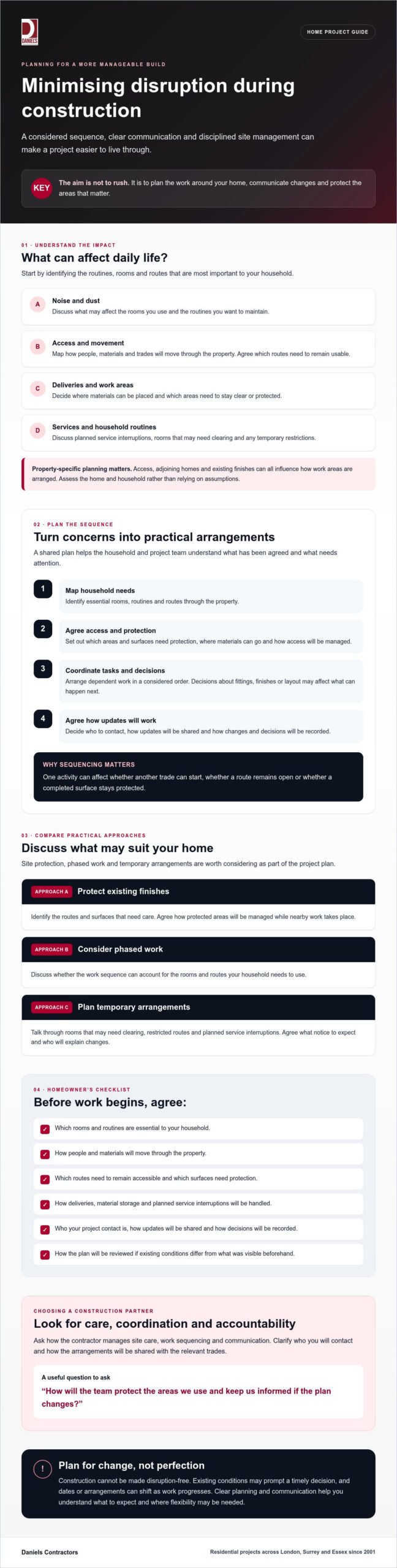
A clear plan gives you and the project team a shared reference point before work begins. Start by identifying household needs, then map out work areas and access, agree how updates will be handled, and decide how proposed changes will be reviewed. This turns general concerns into practical arrangements that trades can follow.
For an overview of the coordination involved, the Construction Management Association of America explains the role of a construction partner who manages disruption. In a home project, coordination should cover access, deliveries, materials storage and protected areas. Agree which routes and surfaces need protection, where materials can be placed, and how you’ll hear about changes that could affect the plan.
Agreeing a workable construction plan before work starts
Tell the project team which rooms and routines are essential, and identify the routes people need to use through the property. Ask for the arrangements to be recorded and shared with relevant trades, so everyone understands what must remain accessible and which areas need particular care. Discuss foreseeable changes as part of the planning conversation, while recognising that dates and conditions can shift as work progresses.
Sequencing trades and decisions with care
Sequencing means arranging dependent tasks in a considered order. This matters because one activity can affect whether another trade can start, whether a route remains open, or whether a newly completed surface stays protected. Coordinating work before finishes are installed, for example, can help avoid unnecessary disturbance to completed areas.
Your decisions are part of the sequence too. If a choice about a fitting, finish or layout is needed before the next task can proceed, agree how the question will be raised, what information you’ll receive and when a response is needed. Prompt decisions can help the team plan the next stage. If you need more time, say so early, so the sequence can be reviewed rather than assumed.
Structural and technical decisions should be coordinated by the appointed professionals. Ask who is responsible for clarifying these matters and how any effect on the work plan will be explained to you. Careful coordination supports minimizing disruption during construction while keeping quality and sound decision-making ahead of speed.
If you’re considering a home refurbishment or extension, you can learn more about Daniels Contractors’ residential projects and how clear planning supports considered delivery.
Construction disruption strategies: compare site protection, phasing and temporary arrangements
Different measures address different pressures on daily life. Physical protection can help safeguard retained finishes and define agreed routes. Phasing can limit how much of the home is affected at once, while temporary arrangements may help you adapt when a room or service is unavailable. None removes the impact of construction, and each needs to suit the property, scope, access and agreed project plan.
| Approach | May help with | Cannot prevent |
|---|---|---|
| Site protection | Reducing the risk of damage to retained finishes and keeping agreed access routes defined. | Noise, dust at the work area, or the need to restrict access while specific tasks take place. |
| Phased work | Limiting the number of areas affected at one time, where the project sequence allows. | All overlap between activities, or the need to access a space for connected tasks. |
| Temporary arrangements | Helping household routines continue when a room or service is temporarily unavailable. | Replacing safe, coordinated work or removing the inconvenience of adapting to a changing home. |
When site protection or phased work may help
Ask which floors, doorways, fixtures and finishes will be retained, and how agreed routes through the home will be protected. Protective measures need checking as work progresses, since materials and movement around the site can affect them. Phasing means dividing work into coordinated areas where the project permits, rather than assuming every room can remain available throughout.
How to choose an approach without compromising quality
Weigh your essential routines against the rooms and access the work requires. Consider whether a temporary change to how you use the home is practical, and ask the contractor to explain the limits of each arrangement before you agree to it. A proposed phase may not suit tasks that depend on access across several areas, and protection cannot take the place of sound workmanship or safe site coordination.
Planned disruption is explained and prepared for; avoidable disruption is reduced through careful coordination. Keep that distinction in view as you discuss options. The right approach should support daily life where practical without compromising the quality or order of the work.
A homeowner’s checklist for minimising disruption during construction
A written checklist gives you a practical way to track arrangements as the project moves from preparation to handover. Confirm who your main project contact is, how updates will be shared and how you should raise a concern. A clear route for questions helps you reach the right person and understand what happens next.
Questions to settle before the site is set up
- Preparation: Which rooms and routes will remain accessible? How will agreed routes and retained finishes be protected? Discuss dust control, storage locations, deliveries and how waste will be managed at the property.
- Active work: How often will you receive updates, and will these be shared by email, in person or another agreed method? Confirm who to contact if access, dust or protection arrangements need attention.
- Changes: If something affects the agreed plan, who will explain the practical impact and ask for any decision needed from you? Agree how decisions and revised arrangements will be recorded.
- Handover: Ask how outstanding points will be listed, who will review them with you and how completed areas will be checked before the project is handed back.
These questions are especially useful if you’ll remain at home during a refurbishment. For more context on planning an occupied project, read this high-end home refurbishment guide.
What to do when the plan needs to change
Construction conditions can prompt a change to the agreed arrangements. Raise concerns promptly with your project contact, then ask for the change, its effect on access or household routines, and the person responsible for the decision to be recorded. This creates a shared reference, helping you understand what has changed and which arrangements now apply.
Keep updates and decisions together in the agreed communication channel. If you’re asked to make a choice, clarify what information you need and when the team needs your response. Clear, timely communication can help the project team review next steps and explain revised arrangements. It can’t remove every inconvenience, but it can reduce uncertainty. That’s a practical part of minimizing disruption during construction.
For a project where communication and site coordination matter, read about Daniels Contractors’ home refurbishment projects, delivered across London, Surrey and Essex.
Choosing a construction partner who manages disruption with care
What to ask a contractor about disruption management
Use your discussions to understand how the arrangements will work in practice. Ask:
- Who will coordinate the trades and act as your main project contact?
- How will access, deliveries, storage and protection for retained areas be agreed and checked?
- How will you be told about changes that could affect household routines, and how will decisions be recorded?
- Where relevant, how will the team consider the property’s heritage, structural integrity and neighbours?
A considered route from initial discussion to handover
Start by explaining your brief, how you use the home and which routines or areas need particular consideration. The project team can then discuss the work, planning, communication and site arrangements with you. As the project progresses, ask how updates and decisions will be handled, and how outstanding items will be reviewed before handover. Clear stages help you understand what is being decided and when, while leaving room to address changes as they arise.
Daniels Contractors has operated in London since 2001 and delivers projects across London, Surrey and Essex. Its approach includes transparent project management and working closely with clients and other professionals. These details can help you frame questions about who will coordinate your project and how the team will keep you informed. For homeowners planning an extension, the bespoke house extensions guide offers further context for considering the project brief and your home.
Every property and household has different requirements. Discuss your project with Daniels Contractors to talk through your plans and the practical considerations of carrying out work in your home.
Plan your project with greater confidence
Noise, dust and changes to daily routines may be part of building work, but thoughtful preparation can help make the experience more manageable. Start by identifying the household needs that matter most, then agree how work areas, access and retained finishes will be managed. A considered sequence, clear updates and a known contact can reduce avoidable uncertainty, even though no project can remove every disruption.
For homeowners, minimizing disruption during construction is about more than temporary protection. It means understanding how decisions and changes will be communicated, and knowing who is responsible for coordinating the work. Daniels Contractors has operated in London since 2001, delivering projects across London, Surrey and Essex, with transparent project management and a focus on working closely with clients and other professionals.
If you’re planning a refurbishment, extension or other home project, a conversation about your household’s needs is a practical place to begin. Discuss your project with Daniels Contractors to explore how careful planning can support your plans.
Frequently Asked Questions
How can I minimise disruption during construction?
Minimizing disruption during construction starts with discussing household routines, work sequencing, site access and protection before work begins. Agree a clear route for updates and ask who will explain changes that affect access or daily life. For example, confirm whether a route to essential rooms will remain usable during nearby work. Every project and property is different, and some disruption is unavoidable. Careful planning aims to reduce avoidable impacts without rushing the work.
Can I stay in my home during construction?
Whether you can stay at home depends on the project scope, the areas affected, access and your household’s needs. Some work may be manageable while you remain in the property, but that won’t suit every project. Before work begins, discuss which rooms will be available, how people will move through the home and whether any practical limitations affect your routines. Ask the contractor to explain the arrangements and any points that need further consideration.
What causes the most disruption during a home renovation?
Common sources include restricted access, noise, dust, deliveries, rooms that are temporarily unavailable and changes to planned work. Their effect depends on the property and the specific work involved. A delivery may affect access at one home, while a room closure may matter more at another. Identify your main concerns early and explain how you use the spaces. The project team can then consider suitable arrangements as part of planning the work.
How should a contractor communicate construction updates?
Agree a named project contact, how updates will be shared and how you should raise questions or decisions. Clear records help you and the team understand what has been agreed, what has changed and what happens next. The right approach depends on the project, so discuss a suitable update arrangement with your contractor rather than assuming a fixed schedule. Ask how you’ll be told about changes that could affect access or household routines.
Can construction work be phased to reduce disruption?
Phasing may help if the property layout and work allow separate areas or stages to be completed in a considered order. It isn’t suitable for every project. The contractor should explain how phasing relates to trade coordination, access and the technical requirements of the work. Ask which tasks could be carried out in stages, which depend on access to other areas, and what practical limits might affect the proposed arrangement.
How can I protect existing finishes during building work?
Before work starts, agree which finishes, rooms and routes need protection. Ask who will put protective measures in place and check them as work progresses, and discuss how access and material storage will be managed nearby. Protection can reduce the risk of avoidable damage, but it can’t remove every risk during construction. If you notice a concern, raise it promptly with your project contact so the team can review the arrangements.
How do I keep neighbours informed about construction work?
Discuss potential effects on adjoining properties with your contractor and agree who will share relevant project information. Where access, noise or deliveries may affect neighbours, clear and respectful updates can help them understand what to expect. The right communication will depend on the project and its setting, including properties across London, Surrey and Essex. Don’t assume a particular notice is required; ask the appropriate professional to confirm any project-specific obligations.