
Most property renovation projects in London don’t fail because of poor taste or lack of ambition. They fail because of inadequate planning. Whether you’re transforming a Victorian terrace in Islington or modernising a period flat in Kensington, the gap between a vision and a finished result is where budgets unravel, timelines stretch, and frustration sets in.
If you’ve found yourself overwhelmed by the sheer complexity of property renovation in London, you’re not alone. The process involves far more than choosing finishes and hiring a builder. It requires a clear understanding of planning permissions, realistic budgeting, reliable contractors, and a project management approach that keeps everything on track from the first consultation to the final coat of paint.
This guide is designed to change that. Drawing on over two decades of bespoke renovation expertise, we’ll walk you through every stage of the process: from establishing your vision and setting a workable budget, to finding skilled contractors and understanding realistic timelines. By the end, you’ll have the clarity and confidence to approach your renovation not as a daunting undertaking, but as a well-orchestrated transformation of your home.
Key Takeaways
- Successful property renovation in London demands thorough upfront planning – understanding each stage of the process, from initial design through to completion, is what separates seamless transformations from costly overruns.
- Bespoke renovation options allow homeowners to tailor every detail to their personal vision, delivering spaces that are as distinctive as they are functional – a significant advantage in London’s competitive property market.
- Dedicated project management is one of the most overlooked factors in renovation success; having a single point of accountability keeps timelines, budgets, and contractor communication firmly on track.
- Choosing the right contractor requires more than comparing quotes – verifying credentials, reviewing past projects, and assessing genuine craftsmanship are essential steps before any work begins.
- Sustainable design and emerging trends are reshaping renovation priorities for 2026 and beyond, offering homeowners smarter, more future-proof ways to invest in their properties.
Understanding the Property Renovation Process in London
Property renovation is, at its core, the process of improving, updating, or reconfiguring an existing building to better serve the needs of those who live in it. In London’s property market, where space is at a premium and period architecture is abundant, a well-executed renovation does far more than refresh aesthetics. It enhances structural integrity, improves energy performance, and adds measurable value to what is often a homeowner’s most significant asset.
Understanding how the process unfolds, from the earliest conversations through to the final snagging list, is what separates a project that runs smoothly from one that spirals into delays and overspend. Each stage builds on the last, and skipping ahead or compressing timelines rarely ends well.
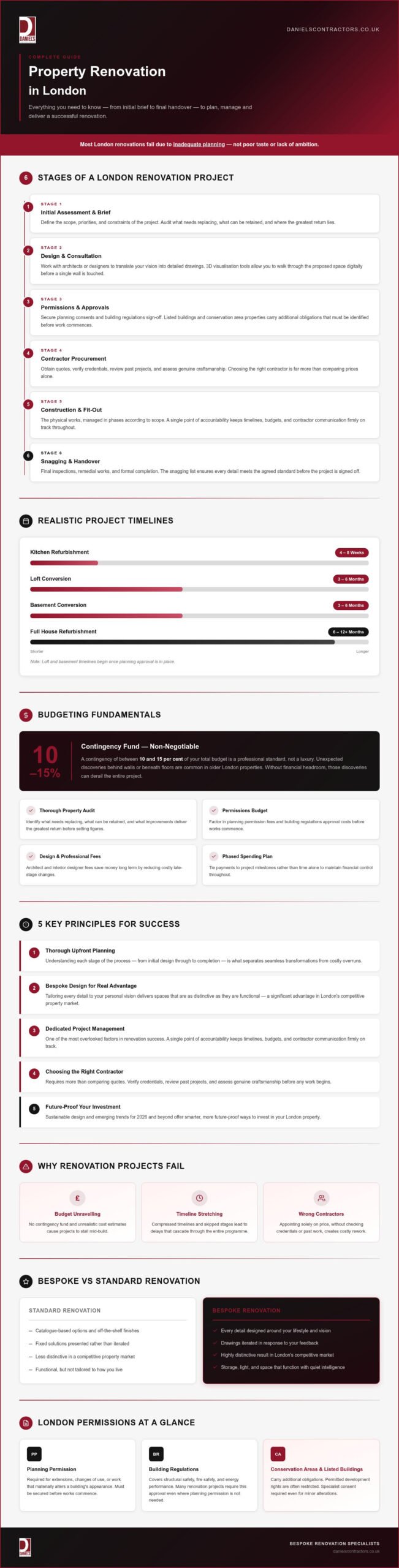
The broad stages of a typical Property Renovation London project follow a consistent sequence:
- Initial assessment and brief: Defining the scope, priorities, and constraints of the project
- Design and planning: Working with architects or designers to translate your vision into detailed drawings
- Permissions and approvals: Securing any necessary planning consents or building regulations sign-off
- Contractor procurement: Obtaining quotes, reviewing credentials, and appointing the right team
- Construction and fit-out: The physical work, managed in phases depending on the scope
- Snagging and handover: Final inspections, remedial work, and formal completion
Timelines vary considerably depending on the type of work involved. A kitchen refurbishment might take four to eight weeks; a full house refurbishment across multiple floors could run for six to twelve months or longer. Loft conversions and basement conversions typically sit somewhere in between, often spanning three to six months once planning approval is in place.
Initial Planning and Budgeting
Honest budgeting is the foundation of every successful renovation. Begin by auditing your property thoroughly: what needs replacing, what can be retained, and what improvements will deliver the greatest return. A contingency fund of between ten and fifteen per cent of your total budget is not optional; it’s a professional standard. Unexpected discoveries behind walls or beneath floors are common in older London properties, and having financial headroom prevents those discoveries from derailing the entire project.
On the permissions side, many London renovations require either planning permission or building regulations approval, and some require both. Works to listed buildings or properties within conservation areas carry additional obligations. Your contractor or architect should identify which consents apply before any work commences.
Design and Consultation Phase
Engaging an architect or interior designer early transforms a vague ambition into a deliverable plan. The design phase is where your practical requirements and aesthetic preferences are reconciled with structural realities and budget constraints. Client feedback at this stage is genuinely formative; experienced designers will iterate drawings in response to your input rather than presenting a fixed solution. Many practices now use 3D visualisation tools that allow you to walk through a proposed space digitally before a single wall is touched, which significantly reduces costly late-stage changes and gives you genuine confidence in the direction of your Property Renovation London project.
Bespoke and Luxury Renovation Options
There’s a meaningful difference between a renovation that simply updates a property and one that genuinely transforms it into something singular. Bespoke renovation is the latter: a process built around your specific lifestyle, aesthetic sensibility, and long-term vision, rather than a catalogue of standard options. In London’s most sought-after postcodes, this level of personalisation isn’t a luxury reserved for a select few; it’s increasingly the standard that discerning homeowners expect.
High-End Finishes and Materials
Material selection is where bespoke renovation makes its most immediate impression. Natural stone, whether honed limestone for a kitchen worktop or book-matched marble for a bathroom feature wall, brings a depth and character that manufactured alternatives simply can’t replicate. Solid hardwood flooring, reclaimed or freshly milled, adds warmth and longevity that improves with age rather than diminishing. These choices carry weight beyond appearance: high-quality materials perform better, last longer, and contribute to the overall integrity of the finished space.
Sustainability is increasingly central to luxury material choices. Many London homeowners are specifying reclaimed timber, low-VOC finishes, and responsibly sourced stone as standard, rather than as afterthoughts. This reflects a broader shift in how quality is defined: the finest renovations are now expected to be both beautiful and considered in their environmental impact.
Custom Layouts and Designs
Urban properties present particular spatial challenges, and bespoke design is the most effective tool for resolving them. Clever layout decisions, such as removing non-structural walls to create open-plan living, repositioning staircases to reclaim square footage, or introducing roof lights to draw natural light deep into a floor plate, can fundamentally change how a home feels without altering its footprint.
Smart home technology is now a natural component of high-end property renovation london projects. Integrated lighting control, underfloor heating systems managed via smartphone, and whole-home audio wired discreetly into the fabric of a building all contribute to a living experience that feels effortless. The key is integrating these systems during the design phase, not retrofitting them as an afterthought.
- Open-plan reconfiguration: Removing internal walls to create generous, light-filled living spaces
- Bespoke joinery: Fitted cabinetry, window seats, and shelving designed precisely for the space
- Integrated technology: Smart lighting, heating, and security systems built seamlessly into the design
- Considered material palettes: Cohesive selections that carry a consistent quality from room to room
Daniels Contractors has been delivering this calibre of work across London since 2001, combining technical precision with a genuine commitment to craftsmanship. If you’re considering a bespoke transformation of your property, explore their refurbishment services to understand what a truly tailored approach can achieve.
Effective Project Management for Renovation Success
Even the most carefully designed renovation can unravel without disciplined project management holding it together. A dedicated project manager serves as the single point of accountability across every trade, every delivery, and every decision point. They translate your vision into a working programme, coordinate the sequence of works so that each trade follows logically from the last, and absorb the day-to-day complexity that would otherwise fall on you. For any serious property renovation London project, this role isn’t optional; it’s the mechanism through which quality is protected and timelines are held.
The value becomes most apparent when problems surface, and in older London properties, they invariably do. When a structural engineer’s findings require a redesign, or when a specialist material is delayed, a skilled project manager already has contingency thinking in place. The project adapts rather than stalls.
Communication Strategies
Clear, consistent communication is what keeps a renovation from drifting. Structured weekly progress meetings, whether on-site or remote, give you a regular opportunity to review completed works, confirm upcoming stages, and raise concerns before they compound. Between those meetings, a shared project management platform, whether a simple shared document or a more structured tool, creates a transparent record of decisions, variations, and outstanding actions. Nothing erodes trust faster than a client discovering a change was made without their knowledge. Open dialogue, actively encouraged rather than merely permitted, prevents that erosion entirely.
Managing Expectations and Changes
Unexpected discoveries are a feature of property renovation, not an exception. Concealed pipework, substandard previous repairs, or materials that don’t perform as specified are all realities that experienced contractors anticipate. The difference between a project that handles these moments well and one that doesn’t lies in how changes are processed.
A formal variation process, where any deviation from the agreed scope is documented, costed, and approved before work proceeds, protects both parties and keeps the budget traceable. Flexibility is genuinely important in high-end projects, but it should be structured flexibility rather than reactive improvisation.
- Establish clear milestones: Break the programme into defined phases with agreed completion criteria at each stage
- Document every variation: Written sign-off on changes prevents disputes and keeps the budget accurate
- Build in review points: Scheduled client walkthroughs at key stages catch issues early, when they’re still straightforward to resolve
- Maintain a decision log: A running record of choices made ensures nothing is revisited unnecessarily
Daniels Contractors has refined this approach across more than two decades of delivering complex renovations throughout London. Their client-centric model means you’re never left wondering where your project stands; accountability and transparency are built into how they work, not bolted on as an afterthought.
Choosing the Right Contractor for Your Renovation
Selecting the wrong contractor is the single most avoidable cause of a property renovation london project going wrong. A compelling website and a competitive quote tell you very little about whether a firm will deliver the quality, communication, and accountability that a high-end renovation genuinely demands. The vetting process requires patience and rigour, but it’s time well spent before a single contract is signed.
Client testimonials and reviews deserve more weight than they’re often given. Look beyond star ratings and read the substance of what previous clients describe: did the contractor communicate proactively when problems arose? Were variations handled transparently? Did the finished result match what was promised at the outset? A pattern of detailed, positive responses to those questions is a far more reliable indicator than a polished showroom or a persuasive sales pitch.
Evaluating Contractor Credentials
A contractor’s portfolio should demonstrate range and depth, not just aesthetics. Look for evidence of projects comparable to yours in scale, property type, and finish quality. Period properties, for instance, require a working familiarity with traditional construction methods that not every firm possesses. Industry memberships, such as the Federation of Master Builders or the Chartered Institute of Building, provide a baseline of professional accountability, though they should supplement rather than replace your own due diligence.
During initial consultations, ask direct questions:
- Who will be on-site daily? Understand whether you’re engaging the firm’s own skilled tradespeople or a network of subcontractors
- Can you speak with recent clients? A confident contractor will welcome this without hesitation
- How do you handle unforeseen structural issues? Their answer reveals how they think under pressure
- What does your snagging and handover process look like? This signals how seriously they take completion quality
Negotiating Contracts and Terms
Never proceed on a verbal agreement or a loosely worded estimate. A properly drafted contract should specify the agreed scope of works, materials, payment schedule, and programme of works in precise terms. Fixed-price contracts offer budget certainty but require a thoroughly detailed specification upfront; milestone-based contracts suit more complex projects where phased sign-off is practical. Neither model protects you adequately without a clearly documented variation process built in.
Payment schedules should reflect progress, not convenience. Releasing large sums in advance of completed stages weakens your position considerably if disputes arise. Retain a meaningful proportion of the total fee until snagging is resolved and you’re genuinely satisfied with the finished result.
Daniels Contractors has built its reputation since 2001 on exactly this kind of transparency: clear contracts, honest timelines, and a commitment to craftsmanship that clients can verify through their portfolio and project history. Explore their refurbishment services to see how a principled approach to contractor accountability translates into exceptional finished results.
The Future of Property Renovation in London
London’s renovation landscape is shifting in ways that will fundamentally reshape how homeowners approach their properties over the coming years. The forces driving this change aren’t abstract: tightening energy regulations, maturing smart home technology, and a genuine cultural shift in how quality is defined are all converging to create a renovation environment that rewards forward-thinking decisions made at the planning stage.
Sustainable Renovation Practices
Sustainability has moved well beyond a design preference into something closer to a professional standard. For any serious property renovation London project in 2026 and beyond, energy performance is now a central design consideration rather than an optional upgrade. Practical measures include:
- High-performance insulation: Upgrading wall, roof, and floor insulation to reduce heat loss in older properties, where draughts and thermal bridging are common
- Heat pump systems: Air source and ground source heat pumps are increasingly viable alternatives to gas boilers, particularly in properties undergoing full refurbishment where pipework can be reconfigured
- Mechanical ventilation with heat recovery (MVHR): Particularly relevant for airtight new builds and basement conversions, where controlled ventilation is essential
- Responsible material sourcing: Reclaimed timber, recycled glass worktops, and low-embodied-carbon structural materials are now routinely specified by clients who understand that quality and environmental responsibility aren’t mutually exclusive
Technological Innovations in Renovation
Technology is changing not just how homes function after renovation, but how renovations are planned and delivered. Virtual reality walkthroughs and detailed 3D modelling now allow homeowners to experience a proposed design at full scale before any physical work begins. This capability reduces late-stage design changes significantly, which is where costs and delays most commonly accumulate.
Smart home integration continues to evolve rapidly. Whole-home energy management systems, adaptive lighting that responds to natural daylight levels, and remote monitoring of heating and security are now designed to be invisible within the fabric of a building rather than bolted on as visible additions. The distinction matters: technology that’s integrated during the design phase performs better and looks considerably more refined than systems retrofitted afterwards.
Planning regulations are also evolving. London’s local authorities are placing growing emphasis on heritage protection, biodiversity net gain requirements, and energy performance standards as conditions of approval. Understanding these obligations early, and working with contractors who are already familiar with them, is what keeps a project moving rather than stalling in the permissions process.
Daniels Contractors has been navigating these complexities across London since 2001, bringing the kind of considered, future-aware approach that ensures your renovation remains relevant and valuable for years to come. Explore their refurbishment services to begin a conversation about what’s possible for your property.
Your London Renovation Starts With the Right Partner
A successful property renovation london project doesn’t happen by accident. It’s the result of clear planning, honest budgeting, skilled craftsmanship, and a contractor who takes accountability as seriously as aesthetics. Those four elements, working together from the earliest design conversations through to final handover, are what transform a well-intentioned project into a home you’re genuinely proud of.
The decisions you make at the outset carry the greatest weight. Choosing a contractor with a verifiable track record, insisting on transparent contracts, and building sustainability into your design brief from day one are the choices that protect your investment and future-proof your property.
Daniels Contractors has been delivering bespoke, high-end renovations across London since 2001, combining meticulous craftsmanship with a client-focused approach that keeps every project on track and every homeowner informed. Their portfolio speaks clearly to what’s possible when experience and integrity work in step.
If you’re ready to take the next step, contact Daniels Contractors for a bespoke renovation consultation today. Your property has genuine potential; the right team will help you realise every bit of it.
Frequently Asked Questions About Property Renovation in London
What are the typical costs associated with property renovation in London?
Renovation costs in London vary considerably depending on scope, specification, and property type. A bathroom refurbishment might run from £8,000 to £25,000, whilst a full house refurbishment can range from £60,000 into six figures for high-specification work. London’s labour market and the complexity of period properties both push costs higher than national averages, which is why thorough specification and honest contractor quotes are essential before committing to a programme of works.
Always treat initial estimates as a starting point rather than a fixed figure. Material upgrades, structural discoveries, and design refinements all influence the final cost. A contingency reserve gives you the financial flexibility to handle those variables without compromising the quality of the finished result.
How long does a property renovation project usually take?
Timelines depend directly on the scale and complexity of the work. A kitchen or bathroom refurbishment typically takes four to eight weeks once work is underway. A loft conversion generally runs three to five months, whilst a full multi-storey house refurbishment can extend to twelve months or beyond for high-specification projects. Planning permission, if required, adds further time before construction can begin.
The most reliable way to establish a realistic timeline is to work from a detailed programme of works agreed with your contractor before signing contracts. Vague timelines are one of the most common sources of client frustration, so insist on milestone-based scheduling from the outset.
What permits do I need for a renovation in London?
The permits required depend entirely on the nature of the work. Internal alterations such as redecoration or kitchen replacements often fall within permitted development rights and require no formal consent. Structural changes, extensions, loft conversions, and basement conversions typically require either planning permission, building regulations approval, or both. Properties in conservation areas or those with listed building status carry additional obligations that apply even to minor alterations.
Your architect or contractor should identify the relevant consents during the design phase, before any work begins. Proceeding without the correct approvals can create serious complications when you come to sell the property, so this isn’t a step to shortcut.
Can I live in my house during the renovation?
Whether you can remain in your home during a property renovation London project depends on the scope of works and which areas are affected. Cosmetic refurbishments to individual rooms are usually manageable to live around. However, full house refurbishments, basement conversions, or projects involving significant structural work, utility disconnections, or hazardous material removal often make temporary relocation the more practical and comfortable choice.
Discuss this honestly with your contractor during the planning stage. A good project manager will give you a candid assessment of which phases are genuinely disruptive and help you plan around them, rather than offering reassurance that proves optimistic once work begins.
How do I choose the right style for my renovation?
Start by considering how you actually live rather than how you’d like a finished photograph to look. Collect references from architecture and interiors publications, visit showrooms, and pay attention to the materials and spatial qualities that genuinely appeal to you across multiple examples. A pattern will emerge. Sharing that reference material with your designer early gives them a clear brief to work from rather than an abstract aspiration.
It’s also worth thinking about the character of your property. Period features in a Victorian or Georgian home often reward sympathetic restoration rather than wholesale replacement. The most successful renovations tend to respect the architectural DNA of a building whilst introducing contemporary comfort and quality, creating a result that feels both considered and timeless.
What should I do if unexpected issues arise during my renovation?
Don’t panic, and don’t make hasty decisions under pressure. Unexpected discoveries, whether concealed structural problems, substandard previous repairs, or outdated services, are a normal part of renovating older London properties. The right response is to pause, assess the situation properly with your contractor and any relevant specialists, and agree a documented variation before additional work proceeds.
How can I ensure quality workmanship throughout my renovation?
Quality is protected through consistent oversight, not occasional inspection. Scheduled client walkthroughs at defined milestones allow you to review completed work whilst remedial action is still straightforward. Ask your contractor how snagging is managed: a rigorous snagging process before handover is a reliable indicator of a firm that takes completion quality as seriously as the work itself.
Beyond site visits, choosing contractors with a verifiable portfolio of comparable projects is the most reliable safeguard. Speaking directly with previous clients, reviewing finished work in person where possible, and confirming that the tradespeople on your project are the firm’s own skilled workforce rather than unfamiliar subcontractors all contribute to a result you can be genuinely proud of.