
What if the most critical tool on your building site isn’t a laser level or a structural beam, but the document sitting in your solicitor’s inbox? For many, seeking construction contract advice for homeowners UK feels like a defensive manoeuvre against the fear of hidden costs, yet in the luxury market, a well-crafted agreement is far more than a legal shield. It’s a precision instrument that translates bespoke architectural visions into tangible, high-end reality.
We understand that embarking on a major renovation or basement conversion brings a natural sense of anxiety regarding structural risks and shifting timelines. This guide provides the clarity you need to move forward with confidence. You’ll master the essentials of residential contracts, from navigating the nuances of JCT and RIBA forms to implementing milestone payments that protect your investment. By the end, you’ll have a robust framework to ensure your 2026 project is delivered with the transparency, integrity, and meticulous detail your home deserves.
Key Takeaways
- Understand why a formal, legally binding contract is the only way to secure your investment against structural risks and ensure total project transparency.
- Learn how to specify every bespoke finish and material within your scope of works to prevent ambiguity and maintain the highest craftsmanship standards.
- Access essential construction contract advice for homeowners UK regarding the benefits of fixed-price models for large-scale extensions and basement conversions.
- Master the formal variation process to manage design changes and unforeseen site conditions without losing control of your budget or delivery timeline.
- Discover how milestone-based payment structures provide financial protection and ensure the final build aligns perfectly with your architectural vision.
The Importance of a Formal Construction Contract for UK Homeowners
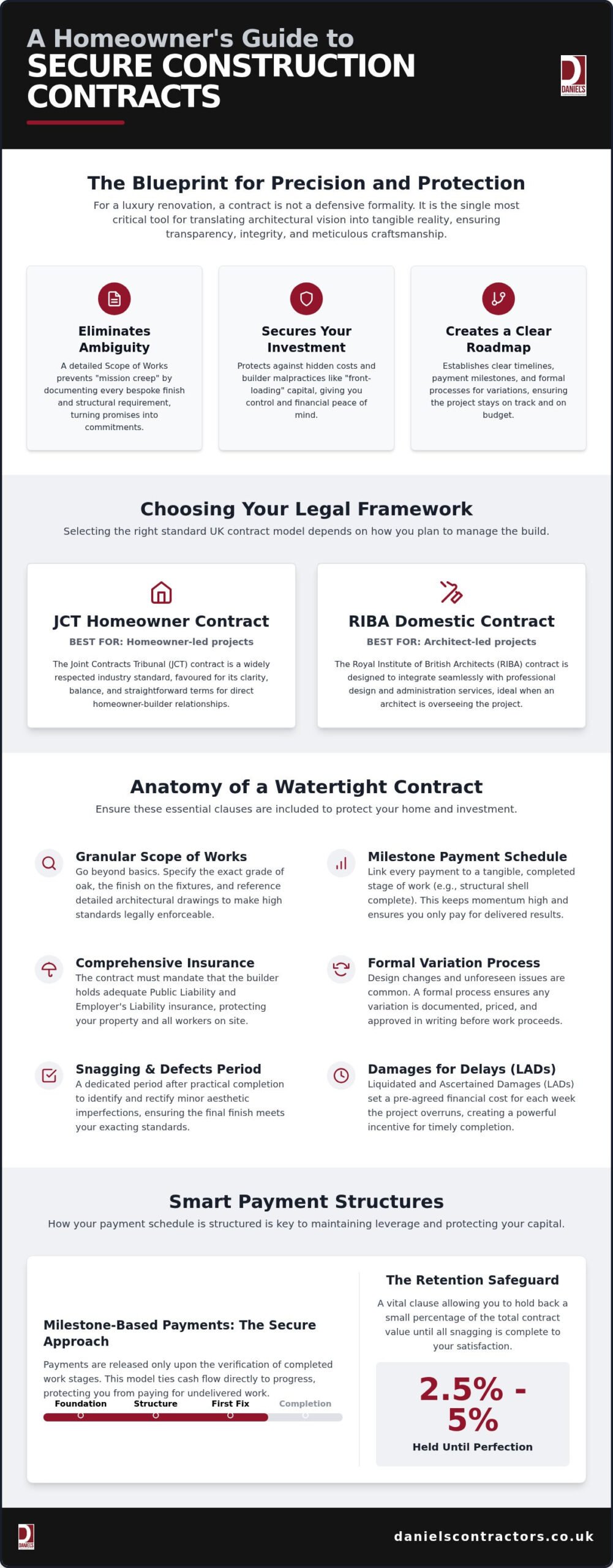
A construction contract isn’t just a piece of paper; it’s the architectural blueprint for your relationship with your builder. Relying on a handshake or a two-page quote for a complex project is often a recipe for disaster. Understanding what is a construction contract helps you see it as a legally binding roadmap that defines every detail. Without this structure, “mission creep” occurs, where small changes snowball into significant budget overruns. A formal agreement establishes a definitive Scope of Works, ensuring every bespoke finish is documented and every structural requirement is accounted for from day one. It transforms a vague promise into a professional commitment.
Protecting Your Capital in High-End Renovations
The Legal Framework: JCT vs RIBA Domestic Contracts
Choosing the right framework depends on how you plan to manage your build. The Joint Contracts Tribunal (JCT) offers a standard Homeowner Contract that is widely respected for its clarity and balance. It’s often the preferred choice for those who want a straightforward, industry-recognised agreement. Conversely, if you’ve engaged an architect to oversee your project, a Royal Institute of British Architects (RIBA) contract might be more suitable. These are designed to integrate seamlessly with professional design services. They’re ideal for a bespoke house extension where architectural integrity is paramount. Selecting the right model ensures the legal structure supports the specific complexities of your site. It provides the peace of mind that your investment is protected by a framework that values accountability as much as craftsmanship.
Essential Clauses Every Residential Building Contract Must Include
Building a luxury home extension is a complex choreography of trades and materials. To ensure the performance matches your vision, the contract must go beyond basic generalities. When seeking construction contract advice for homeowners UK, the most critical element is a granular Scope of Works. This document shouldn’t just list ‘flooring’; it should specify the exact grade of oak, the finish, and the installation pattern. By referencing detailed architectural drawings, you eliminate ambiguity and ensure the craftsmanship you expect is legally enforceable. Finally, ensure the contract specifies comprehensive insurance coverage. This includes Public Liability and Employer’s Liability, protecting your property and the people working on it throughout the build.
Payment schedules are another pillar of project security. Avoid calendar-based payments. Instead, link every pound spent to a tangible milestone, such as the completion of the structural shell or the first-fix electrics. This approach keeps the builder’s momentum high and ensures you never pay for work that hasn’t been delivered. For those planning a bespoke house extension London, this milestone model provides the ultimate financial transparency.
Defining Standards for Bespoke Craftsmanship
Precision is the hallmark of high-end refurbishments. Your contract should include a dedicated ‘Snagging Period’ to address minor aesthetic imperfections after the main works conclude. In a bespoke project, standard construction terminology often fails to capture the nuance of luxury finishes. Explicitly stating that work must meet the highest industry standards or referencing specific mock-ups helps maintain the aesthetic integrity of your design. It’s about ensuring the final build matches the vision you’ve spent months perfecting.
Liquidated and Ascertained Damages (LADs)
Delays are a common source of anxiety, especially if you’re renting alternative accommodation whilst your home is a building site. Liquidated and Ascertained Damages (LADs) are a pre-agreed sum paid by the contractor to the homeowner for every week the project overruns without a valid reason. It isn’t a penalty; it’s a genuine pre-estimate of your loss. Including a fair LAD clause balances accountability with realism, giving you a financial safety net if the completion date slips. It’s a standard tool for professional delivery.
Managing these intricate details requires a partner who values your project as much as you do. You might find it helpful to speak with a specialist about how these clauses apply to your specific site conditions.
Fixed-Price vs. Milestone-Based Contracts: Choosing the Right Model
Choosing the right financial model is a pivotal decision for any major residential project. For many, a fixed-price contract is the gold standard. It offers a definitive figure for the work described, providing essential peace of mind. This is particularly true for bespoke house extensions London, where architectural complexity requires strict budget control. However, cost-plus contracts have their place. They’re often used in high-end refurbishments of heritage properties where structural surprises are likely. In these scenarios, you pay the actual costs plus a management fee. It’s a transparent way to handle uncertainty, provided the oversight is rigorous.
When you seek construction contract advice for homeowners UK, you’ll often encounter “Provisional Sums”. These are placeholders for items not yet fully specified, such as a bespoke Italian kitchen or specialist lighting systems. It’s vital to ensure these sums are realistic. Underestimating them leads to budget strain later. A milestone-based approach complements this by ensuring you only pay for value delivered. Instead of monthly cheques, you pay when the roof is watertight or the first-fix plumbing is complete. This keeps the project’s momentum aligned with your financial outlay.
Ensuring Transparency in Project Costing
Transparency is the foundation of trust between a homeowner and a builder. It’s helpful to distinguish between a “Fixed Price” and a “Guaranteed Maximum Price” (GMP). While a fixed price is set, a GMP ensures that if the project costs less than expected, you share in those savings. At Daniels Contractors, we’ve refined our quoting process over 25 years to eliminate hidden surprises. We provide a meticulous breakdown of labour and materials. This level of detail allows you to see exactly where your investment is going, reinforcing the integrity of the build from the very first invoice.
Managing Cash Flow During the Build
A well-structured payment schedule keeps the project moving without putting your capital at undue risk. For significant undertakings like new builds or basement conversions, we often use “Valuations”. A professional assesses the work done to date, and you pay based on that specific valuation. It’s a methodical way to manage cash flow. You should never pay the final 5-10% until “Practical Completion” is reached. This retention acts as a final assurance that every detail meets the bespoke standards you expect before the project is officially handed over.
Navigating Variations, Delays, and the Party Wall Act
Complex residential projects rarely follow a perfectly linear path. As work progresses, you may decide to refine a design detail or upgrade a material choice. These shifts, known as variations, must be handled with formal precision to avoid budget friction. In the context of a luxury basement conversion London, variations often arise from unforeseen ground conditions or structural requirements that only become apparent once excavation begins. Professional construction contract advice for homeowners UK emphasises that your agreement should include a clear mechanism for documenting these changes. This ensures that every adjustment to the scope is mirrored by an agreed adjustment in price and timeline.
Legal obligations extend beyond the boundaries of your own soil. The Party Wall etc. Act 1996 is a critical piece of legislation for urban homeowners. It governs how you interact with shared structures and neighbouring boundaries. Your contract must respect the terms of any Party Wall Award, ensuring the builder operates within the agreed parameters to protect both your property and your neighbours’ peace of mind. Should a disagreement arise, modern contracts favour mediation or adjudication over lengthy court battles. These methods are designed to resolve disputes swiftly, allowing the build to continue whilst maintaining professional relationships.
The Complexity of Urban Construction in London
Building in restricted London boroughs requires more than just technical skill; it demands meticulous logistical planning. Your contract should explicitly address site access, parking permits for trades, and the management of skips. In densely populated areas, structural monitoring is often a requirement of the Party Wall Award to track any minute movements in adjacent buildings. We also ensure that working hours and noise restrictions are strictly observed. This respectful approach to the local community is part of our commitment to being a “gentleman builder,” ensuring your project doesn’t create unnecessary friction with those living amongst your site.
Formalising the Change Management Process
To maintain financial control, we utilise a robust “Change Order” system. Every variation, no matter how minor it seems, must be documented in writing and signed by both the homeowner and the contractor before the work commences. This document details the specific change, the associated cost, and the impact on the completion date. This level of rigour prevents “scope creep,” where small additions slowly erode your contingency fund. It allows for design flexibility whilst ensuring the final contract sum remains transparent and predictable.
If you are planning a significant structural project and want to ensure your legal framework is as solid as your foundations, you can book a consultation with our team to discuss your specific requirements.
Ensuring Peace of Mind: The Daniels Contractors Approach to Project Management
Daniels Contractors was founded in 2001 with a simple yet profound mission: to bring transparency and elite craftsmanship to the residential market. Over the last quarter-century, we’ve refined an approach that prioritises your peace of mind through fixed-price contracting and meticulous project management. When you’re seeking construction contract advice for homeowners UK, the most valuable tip is to choose a partner who views the agreement as a tool for collaboration rather than a point of conflict. We operate under a “Gentleman Builder” ethos, where professional conduct and mutual respect are as important as the structural integrity of the build.
Working with a dedicated main contractor simplifies the administrative burden that often overwhelms homeowners. Instead of managing disparate trades and individual agreements, you have a single point of accountability. We organise our projects around specific, tangible milestones. This structure ensures that every phase of your high-end home refurbishment London is executed with the precision your architectural plans demand. It’s a methodical way of working that provides a seamless transition from the initial demolition to the final bespoke finish.
25 Years of Quality Craftsmanship in London
Our history in London, Surrey, and Essex has allowed us to build an extensive portfolio of luxury developments. This deep experience is vital when navigating the unique architecture of the capital, where period properties require a sensitive, bespoke touch that standard builders often overlook. Our clients favour our steady and reassuring communication rhythm. We don’t rush the process; we take the time to explain the value of our approach, building a narrative of trust that lasts long after the scaffolding is removed. It’s about delivering a result that matches the high standards of the original design.
Starting Your Journey with Daniels Contractors
The path to a successful build begins with a thorough consultation. We move from your high-level vision to a detailed project quote that leaves no room for ambiguity or hidden surprises. Our team works closely alongside your architects and surveyors to formalise a contract that reflects the true scope of your ambitions. This collaborative spirit ensures that the legal framework supports, rather than hinders, the creative process. If you’re ready to transform your space with a team that values integrity as much as design, contact Daniels Contractors to discuss your bespoke luxury project today.
Build with Confidence and Precision
Securing the right construction contract advice for homeowners UK is the foundation upon which every successful luxury renovation is built. By prioritising a detailed scope of works and a transparent milestone payment structure, you eliminate the ambiguity that often leads to delays. A robust agreement doesn’t just protect your capital; it ensures the bespoke craftsmanship you envision is delivered with absolute integrity and legal security.
With over 25 years of luxury residential experience, Daniels Contractors specialises in high-end London refurbishments and extensions through a methodical, fixed-price approach. We handle the administrative and structural complexities so you can focus entirely on the transformation of your space. Discuss your bespoke construction project with the experts at Daniels Contractors to begin your journey toward a home that reflects your highest standards. Your vision deserves a partner who values quality and transparency as much as you do.
Frequently Asked Questions
Do I really need a written contract for a small home refurbishment?
Yes. Even for smaller refurbishments in London or Surrey, a written contract provides essential protection. Verbal agreements lack clarity on scope and costs. A formal document ensures both parties understand the finishes and timelines, preventing disputes over “handshake” deals. It’s the only way to guarantee accountability for craftsmanship and budget. Relying on a simple quote leaves you vulnerable to hidden costs and structural risks.
What is the difference between a JCT and an RIBA building contract?
The Joint Contracts Tribunal (JCT) contracts are industry-standard forms often used for straightforward domestic projects. RIBA (Royal Institute of British Architects) contracts are typically favoured when an architect is formally managing the site and the design. Both provide robust construction contract advice for homeowners UK, but your choice depends on whether you have professional design oversight or are working directly with a main contractor like us.
Can a builder change the price after the contract is signed?
Only if the contract allows for variations or if you request changes to the original scope. In a fixed-price contract, the builder is committed to the agreed sum for the specified work. However, “provisional sums” for items like high-end kitchens or unforeseen structural issues in basement conversions may lead to price adjustments. Every change must be documented through a formal “Change Order” signed by both parties to ensure transparency.
What happens if my building project overruns the agreed completion date?
This depends on the “Liquidated and Ascertained Damages” (LADs) clause in your contract. This clause sets a pre-agreed weekly sum that the builder pays you for delays without a valid reason, such as poor planning. It’s designed to cover your actual losses, such as the cost of renting alternative accommodation in Essex or London whilst the works continue beyond the deadline. It keeps the project’s momentum aligned with your needs.
How much should I pay as a deposit for a major construction project?
There is no legal fixed percentage, but a deposit should generally be minimal and cover initial mobilisation costs or bespoke materials. We recommend avoiding large upfront payments. Instead, set up a milestone-based schedule where you pay for value delivered at specific stages. This protects your capital and ensures the builder remains motivated to achieve the next project target, such as reaching the structural shell stage or first-fix plumbing.
What is a retention fee and why is it important for homeowners?
A retention fee is a percentage of the contract sum, usually 2.5% to 5%, that you hold back from the final payment. This sum is only released once the “snagging” period is over and all minor defects are rectified. It’s a vital safeguard for high-end refurbishments, ensuring that the builder returns to perfect every detail of the craftsmanship before the project is officially closed and the final balance is paid.
How does the Party Wall Act affect my construction contract?
The Party Wall etc. Act 1996 applies if you are building on or near a boundary, which is common in London’s terraced streets. Your contract must reflect the requirements of the “Party Wall Award,” such as specific working hours or structural monitoring. Failure to follow these legal obligations can lead to work being halted, so your contractor must be fully compliant with these neighbouring property rights to maintain professional conduct.
What should I do if my builder stops following the contract specifications?
You should immediately issue a formal notice of non-compliance as outlined in your contract terms. This documentation is essential for resolving the issue through mediation or adjudication. Professional construction contract advice for homeowners UK suggests keeping a clear paper trail of all communication and site photos. If the breach is significant, the contract provides a legal mechanism for termination or seeking damages to rectify the work to the required standard.