
A luxury loft conversion in London is an architectural statement that should feel like a natural evolution of your home rather than a secondary addition. You likely recognise that your attic holds untapped potential, yet the complexities of navigating London planning permissions and finding builders who appreciate high-end finishes can feel overwhelming. It’s natural to seek a partner who values craftsmanship as much as you do, especially when the construction market feels unpredictable.
This guide offers the clarity you need to move forward with total peace of mind. We’ve curated the most sophisticated luxury loft conversion ideas london has to offer, paired with an expert look at the investment scales and design trends defining 2026. You’ll discover how to achieve a seamless, architecturally stunning new floor that significantly increases your property’s valuation. We’ll preview the latest in wellness-focused design, smart home integration, and the structural practicalities that ensure your project remains a stress-free transformation from first sketch to final handover.
Key Takeaways
- Explore the transition from basic storage to primary lifestyle suites that integrate seamlessly with your home’s existing architecture.
- Discover bespoke luxury loft conversion ideas london homeowners are using to create vaulted master retreats and soundproofed sky studios with panoramic views.
- Learn why the Mansard profile remains the preferred choice for high-end London residences and how to maximise internal volume through intelligent design.
- Gain clarity on the 2026 investment landscape, including how London’s specific labour and material requirements influence the total project cost.
- Understand the essential steps for a stress-free build, from navigating complex planning permissions to utilising the RIBA Plan of Work for meticulous execution.
Redefining the London Attic: The Evolution of Luxury Lofts in 2026
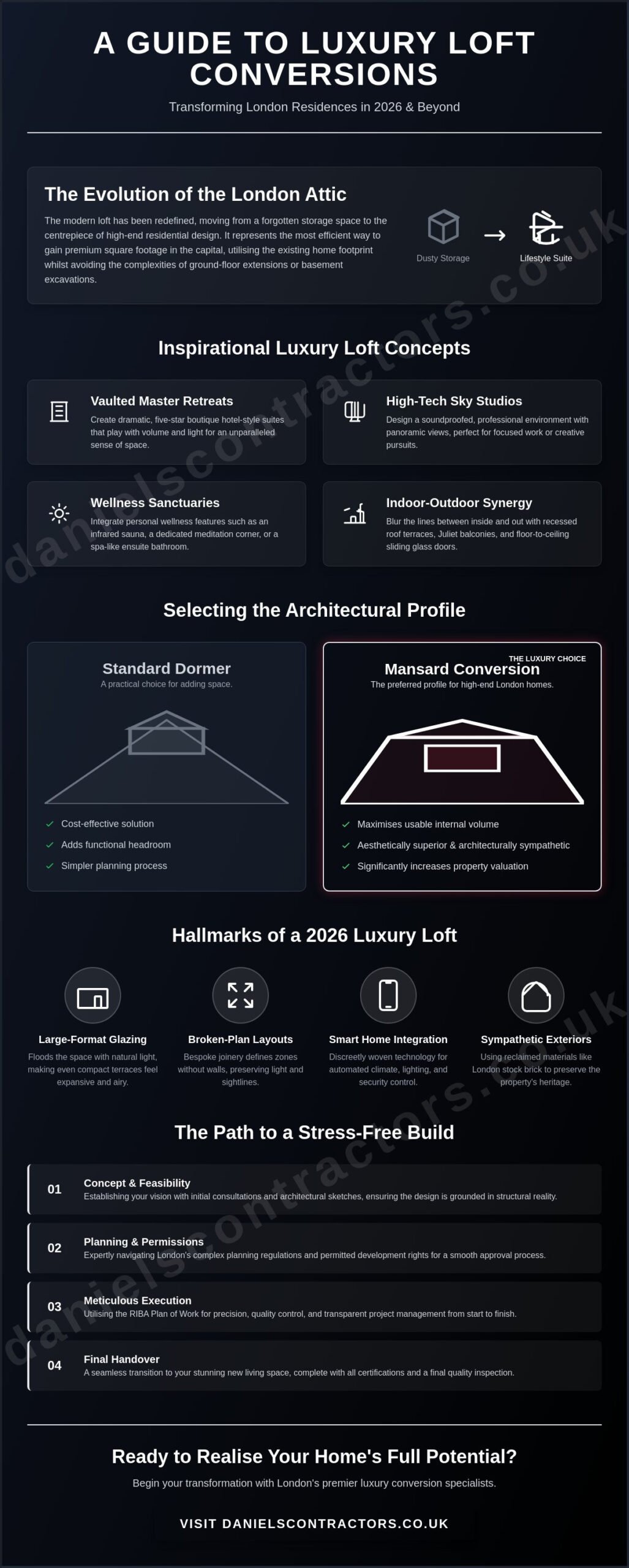
The London attic has undergone a radical transformation. No longer just a dusty repository for suitcases; it’s now the centrepiece of high-end residential design. As we move into 2026, homeowners are prioritising the creation of primary lifestyle suites that rival five-star boutique hotels. This Evolution of Luxury Lofts reflects a broader desire for sanctuary within the city. Converting the attic is the most efficient way to gain square footage in the capital. It utilises the existing footprint whilst bypassing the significant logistical hurdles and structural risks often associated with basement excavations or complex ground-floor extensions.
The Rise of the Multi-Functional Sanctuary
Modern designs are moving away from rigid room definitions. We’re seeing a surge in “broken-plan” layouts where bespoke joinery and floor-to-ceiling shelving define different zones without blocking sightlines or natural light. A master suite might now include an integrated infrared sauna or a dedicated meditation corner to support personal wellness. Smart home technology is discreetly woven into the fabric of the build. This allows for automated climate control and layered lighting schemes that adjust based on the time of day, all controlled via a central interface or smartphone. These features ensure the space remains comfortable and intuitive, regardless of the season.
Architectural Integrity in Period Residences
Inspirational Luxury Loft Conversion Ideas for London Residences
Transforming an attic into a high-end living space requires a departure from standard layouts. The most successful luxury loft conversion ideas london homeowners adopt are those that play with volume and light to create a sense of drama. Architectural floor level changes, such as a sunken lounge, create intimacy in an otherwise open-plan space. This technique defines a relaxation zone without the need for restrictive walls, allowing the eye to travel across the entire floor. It’s a sophisticated way to manage the unique geometry of a roofline whilst maintaining an airy, expansive feel.
For the professional, a high-tech sky studio offers a soundproofed environment with panoramic views of the city skyline. If you’re an enthusiast of the arts, consider a private gallery. Utilising UV-filtered glass and strategically placed skylights allows for natural curation without risking damage to delicate works. When planning these structural changes, Navigating Your Build starts with understanding the technical limitations and possibilities of your property’s footprint. This ensures that even the most ambitious designs remain grounded in structural reality.
Indoor-outdoor synergy is another hallmark of the modern London loft. Recessed roof terraces provide a private sanctuary above the city. They offer a secure, secluded spot for morning coffee or evening drinks, especially when paired with floor-to-ceiling sliding glass doors. These features, along with Juliet balconies, blur the lines between the interior and the external environment, making the sky feel like an extension of your living room.
The Ultimate Master Suite
The Professional Home Cinema
A gabled space is ideal for a professional home cinema. The unique angles help diffuse sound, which we can further optimise with discreet acoustic panelling. Consider hidden projector screens that descend from the ceiling and integrated starlight lighting to enhance the immersive experience. Dedicated climate control is essential here to protect high-end AV equipment from the temperature fluctuations common in roof spaces. Expertly executed loft conversions should feel like a bespoke extension of your lifestyle, crafted with precision and care.
Selecting the Architectural Profile: Dormer vs Mansard
Choosing the right architectural profile is the most critical decision in any high-end project. It determines not just the internal square footage, but how the new floorplate interacts with the original building’s silhouette. Whilst many homeowners focus on interior finishes, the external profile dictates the long-term architectural value of the property. For those exploring luxury loft conversion ideas london, the choice usually settles between the classical elegance of a Mansard and the expansive volume of a Dormer. Each has its merits, but the decision should always be guided by the specific character of your residence and your long-term goals for the space.
For detached or semi-detached properties, a Hip-to-Gable conversion is often the most effective way to balance internal space with external aesthetics. This involves replacing a sloped roof, known as the hip, with a vertical wall, or the gable. This significantly increases the standing room within the loft, allowing for more ambitious layouts. Regardless of the profile you choose, the goal is to ensure the new addition feels like a natural evolution of the home. This requires a meticulous approach to material selection and a deep understanding of London’s unique architectural landscape. It’s about creating a space that feels intentional, not just an addition to the existing roofline.
Mansard Conversions: The Aesthetic Choice
The Mansard conversion is widely regarded as the gold standard for luxury London residences. Its hallmark is a 72-degree slope that mimics a traditional roofline, making it the preferred choice for properties in conservation areas such as Kensington, Chelsea, and Richmond. This design satisfies strict local planning rules whilst providing almost as much internal space as a full additional floor. Although the investment is typically higher than a standard dormer due to the extensive structural work required, the cost-to-value ratio is exceptional. It creates a seamless, integrated appearance that preserves the integrity of period terrace houses. When considering this route, it’s vital to consult the Planning Portal guidance on loft conversions to understand the specific requirements for your borough.
Dormer Extensions: Modern Volume
If your priority is maximising every available square inch, a dormer extension offers unparalleled internal volume. By extending vertically from the slope of the roof, you create full-height ceilings across the entire new floorplate. In London’s Victorian and Edwardian terraces, an L-shaped dormer, which extends over the rear outrigger, can often provide enough space for two bedrooms and a bathroom. This profile allows for bespoke window configurations, such as floor-to-ceiling glazing or oversized casements, that flood the interior with light. You can check the latest dormer loft conversion price for 2026 benchmarks to see how this fits your investment strategy.
Calculating the Investment: Loft Conversion Cost UK and London 2026
London’s investment scale differs significantly from the national average. Whilst a standard loft conversion cost uk might provide a baseline, the capital’s unique architectural constraints and higher labour rates, often 15% above the national average, require a more nuanced approach. The volatility of structural steel and timber prices in 2026 means that precision in early-stage budgeting is more vital than ever for a successful project. When exploring luxury loft conversion ideas london, it’s essential to distinguish between a basic habitable room and a bespoke architectural statement. For a detailed breakdown of what drives the loft conversion cost London homeowners encounter in 2026, understanding how architectural ambition and structural complexity interact is the essential first step. Choosing bespoke joinery over off-the-shelf solutions, for instance, ensures that every millimetre of the eaves is utilised, though it naturally increases the craftsmanship hours required.
Professional fees are a non-negotiable component of a high-end budget. You’ll need to factor in costs for an experienced architect, a structural engineer, and, quite frequently in London, a party wall surveyor. These experts provide the technical security that protects your investment. Their involvement ensures that the structural integrity of your period home is maintained whilst meeting the stringent building regulations that govern modern London developments. This meticulous preparation prevents costly delays during the construction phase and guarantees a result that meets the highest standards of quality.
Understanding Structural Variables
In many London residences, gaining the required 2.2 metres of headroom involves lowering the ceilings of the floor below. This is a complex structural manoeuvre that adds to the timeline but transforms the feel of the new suite. If your design includes heavy luxury items, such as a solid stone bathtub, the floor joists will require significant reinforcement. Logistics also play a major role in the budget. Restricted access in narrow London streets often necessitates specialised scaffolding and specific skip permits, which must be secured well in advance to keep the project programme on track.
Premium Finishes and Specification Costs
The choice of glazing significantly impacts both the aesthetic and the budget. Moving from standard Velux windows to bespoke structural glazing or automated rooflights represents a step-change in investment. Additionally, a luxury loft requires a sophisticated climate strategy. Integrating high-spec HVAC systems ensures the space remains a comfortable sanctuary year-round, avoiding the common pitfall of attics becoming too warm in summer. For those with more extensive space requirements, it’s helpful to compare this with the investment required for a luxury basement conversion London, which offers a different set of subterranean lifestyle benefits.
If you’re ready to discuss the specific requirements of your property, our team can help you define a clear path forward for your loft conversions and design needs.
From Concept to Craftsmanship: Navigating Your Build
The journey from a conceptual sketch to a completed masterpiece requires a methodical framework. For high-end residential projects, we rely on the RIBA Plan of Work. This structured approach ensures that the initial architectural vision isn’t compromised during the complex construction phase. It provides a clear roadmap, moving from preparation and design into the technical details that define a premium finish. Having a main contractor to oversee this entire progression is essential. They act as the single point of accountability, managing the delicate synergy between structural engineers, specialist craftsmen, and the design team to ensure every detail aligns with your expectations.
Transparency is the foundation of a stress-free build. We prioritise milestone tracking to keep you informed of progress without the need for constant site visits. This professional conduct builds trust and ensures that the project maintains its momentum. By adhering to these rigorous benchmarks, we guarantee that the final result isn’t just a new floor, but a seamless extension of your home’s existing character. It’s this dedication to the craft that separates a standard renovation from a truly bespoke transformation, ensuring your investment is protected through every stage of the build.
Planning and Permitted Development
Understanding the nuances of London planning is vital for a successful project. Many luxury loft conversion ideas london homeowners explore fall under Permitted Development, which allows for additions up to 40 cubic metres for terraced houses and 50 cubic metres for semi-detached or detached properties. However, these rules often don’t apply in Conservation Areas or for Grade II listed buildings, where full planning permission is mandatory. You must also consider the Party Wall Act 1996. For London’s dense terrace rows, securing a Party Wall Agreement with neighbours is a legal requirement before structural work begins. We also ensure all builds meet 2026 Building Regulations, including the 0.18W/m2 K U-value requirement for new walls to ensure peak thermal efficiency and comfort.
Selecting Your Master Contractor
A portfolio should demonstrate more than just completed rooms; it should showcase precision in material handling and a deep understanding of complex architectural profiles. Look for builders who demonstrate an ability to work with reclaimed materials alongside modern structural glazing. A fixed-price contract is often the best route for peace of mind, as it protects you from the fluctuations of the construction market. This level of transparency ensures that the focus remains on quality and craftsmanship rather than budget disputes. If you’re considering expanding other areas of your residence, you can learn more about our approach to bespoke house extensions London to see how we maintain these high standards across every project we undertake.
Realising Your Architectural Vision
Since 2001, our team has specialised in high-end period property transformations across the city. We provide the peace of mind that comes from expert craftsmanship and the security of transparent, fixed-price contracts for all 2026 projects. Your underutilised attic is a canvas for bespoke design, and we’re here to ensure the transformation is as seamless as the final result.
Book a Consultation with Our Master Craftsmen to begin your journey toward a bespoke architectural masterpiece.
Frequently Asked Questions
How much does a luxury loft conversion cost in London in 2026?
Investment scales for 2026 are influenced by your choice of architectural profile and the complexity of bespoke finishes. Whilst costs vary based on material inflation and London-specific labour rates, luxury projects require a tailored budget to accommodate structural glazing and high-end joinery. It’s best to arrange a detailed site survey to receive a transparent project estimate that reflects your property’s specific requirements and your desired level of craftsmanship.
Do I need planning permission for a loft conversion in London?
Many projects fall under Permitted Development, provided they don’t exceed 40 cubic metres for terraced houses or 50 cubic metres for detached properties. However, you’ll need full planning permission if you live in a conservation area or a listed building. Mansard conversions almost always require a formal application. We recommend checking with your local borough’s planning department to ensure your luxury loft conversion ideas london project remains fully compliant.
How long does a high-end loft conversion typically take to build?
A high-end conversion typically takes between 10 and 16 weeks to complete, depending on the structural complexity. Simple rooflight conversions are faster, whilst Mansard or L-shaped dormer projects require more time for structural steel installation and bespoke internal fit-outs. We provide a detailed schedule at the start of every project, allowing you to track progress against key milestones and plan your lifestyle around the construction phases.
Can I add a bathroom to my loft conversion if my water pressure is low?
You can absolutely add a luxury ensuite even if your current water pressure is low. We often install unvented hot water cylinders or specialised booster pumps to ensure consistent flow to high-end rainfall showers and stone bathtubs. These systems are discreetly integrated into the eaves or utility spaces. This technical solution ensures your new master suite functions perfectly without impacting the water performance in the rest of your home.
What is the best type of loft conversion for a Victorian terrace?
The L-shaped dormer is the most popular choice for Victorian terraces as it maximises the volume over the rear outrigger. However, for a more historically sympathetic finish, a Mansard conversion is often the gold standard. It provides a traditional aesthetic that planning officers favour in heritage areas. Both options allow for significant square footage gains, often creating space for two additional rooms and a bespoke bathroom suite.
How much value does a luxury loft conversion add to a London property?
A professionally executed loft conversion can add between 15% and 25% to your property’s market value, according to verified industry research. In the London market, this often represents a significant return on investment that exceeds the initial build cost. Beyond the financial gain, the architectural improvement and additional lifestyle suite make your home far more attractive to future buyers who value high-spec, ready-to-move-in residences.
What is the minimum head height required for a legal loft conversion?
The minimum head height required for a habitable room is 2.2 metres at its highest point. This measurement is taken from the top of the existing ceiling joists to the underside of the new ridge beam. If your current attic doesn’t meet this requirement, we can often lower the ceilings on the floor below. This structural adjustment ensures your luxury loft conversion ideas london project complies with building regulations whilst creating a comfortable, airy living space.
Can I live in my house whilst the loft conversion is being built?
You can stay in your residence throughout the majority of the construction process. Most of the heavy structural work and material delivery happens via external scaffolding, meaning our team enters through the roof rather than your front door. The only significant internal disruption occurs during the final weeks when we install the new staircase and connect the utilities. We work methodically to ensure your daily routine remains as undisturbed as possible.