
What if the most effective way to achieve a high-end home transformation wasn’t through a complex planning battle, but by expertly navigating the rules already in place? You might feel that a permitted development rear extension forces a compromise on your architectural vision, especially when faced with the confusing distinctions between 3-metre and 6-metre limits. It’s natural to worry about local council enforcement or whether a simplified process can truly deliver a premium, bespoke finish that complements your home’s existing character.
We believe that a well-executed extension should feel like a seamless evolution of your living space. This guide provides the definitive 2026 checklist to help you navigate these regulations, from the Prior Approval process for larger structures to the meticulous requirements of Building Regulations Part L. You’ll gain the clarity needed to proceed with confidence, ensuring your project is protected by a Lawful Development Certificate whilst maintaining the high-end craftsmanship your property deserves.
Key Takeaways
- Identify the precise depth and height parameters for your specific property type to bypass the complexities of a full planning application.
- Navigate the unique restrictions found in conservation areas and properties under Article 4 Directions to protect your project from local council enforcement.
- Secure your long-term investment by obtaining a Lawful Development Certificate, providing official proof that your permitted development rear extension is legally compliant.
- Understand the vital distinction between planning rights and Building Regulations to ensure your new space meets the latest 2026 energy efficiency and thermal standards.
- Discover how to blend bespoke architectural design with meticulous craftsmanship to create a seamless, high-end addition that enhances your home’s character.
Understanding the Scope of Permitted Development for Rear Extensions
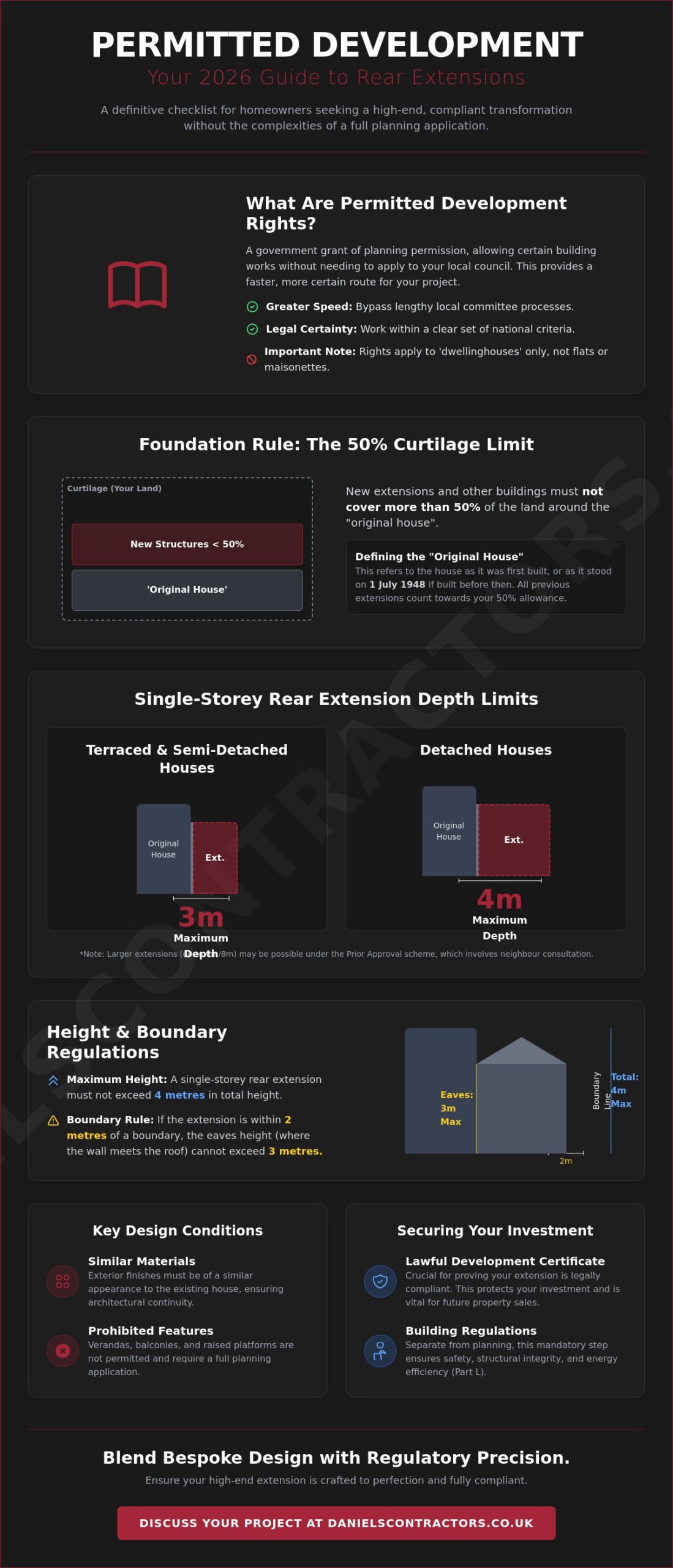
Permitted development rights represent a statutory grant of planning permission from the government, codified within the General Permitted Development Order (GPDO). By 2026, these rules have become a sophisticated framework that allows homeowners to bypass the often subjective and time-consuming local planning committee process. Instead of hoping for a favourable decision from a case officer, you’re working within a set of objective, national criteria. For those embarking on a permitted development rear extension, this provides a level of legal certainty that is invaluable when planning a significant investment in your property.
It’s vital to establish that these rights are exclusive to “dwellinghouses.” If your property is a flat, a maisonette, or a house created through a prior conversion, PD rights don’t apply. In these instances, a full planning application is mandatory. This distinction ensures that the character of multi-occupancy buildings is preserved through closer council scrutiny. By operating within the PD framework, you can focus on the craftsmanship and interior detail that truly transform a home, rather than worrying about the inconsistent whims of local politics.
The “Original House” and Curtilage Explained
To calculate what’s permissible, we must first identify the “original house.” This refers to the property’s footprint as it stood on 1 July 1948, or as it was first built if constructed after that date. Any previous extensions added by former owners count towards your total allowance. You cannot cover more than 50% of the land around the original house with new structures. This area, known as the curtilage, encompasses the land immediately surrounding and serving the house, such as gardens and driveways. Understanding Permitted Development through this lens allows us to maximise your space whilst remaining strictly within the law.
Why PD is the Preferred Choice for London Renovations
Speed is often the primary driver for choosing this route. A traditional planning application can be fraught with delays and neighbour objections that stall your timeline. PD offers a more streamlined path, which in turn provides greater certainty for fixed-price construction contracts. When you know exactly what the law allows, you can finalise designs and material costs with confidence. This efficiency is particularly beneficial for bespoke house extensions London, where the focus is on integrating high-end aesthetics with a compliant structural shell. It’s a methodical approach that replaces guesswork with precision, giving you peace of mind from the very first sketch.
The Definitive Rear Extension Checklist: Limits and Conditions
Achieving a successful permitted development rear extension requires a meticulous adherence to specific dimensional and aesthetic criteria. For a single-storey addition, the standard depth limits are set at 3 metres for terraced or semi-detached properties and 4 metres for detached homes. These measurements are taken from the rear wall of the original dwelling. Height is equally regulated; the structure must not exceed a total height of 4 metres. However, if your extension sits within 2 metres of a property boundary, the eaves height is restricted to 3 metres to prevent overshadowing neighbouring gardens.
A common pitfall in premium renovations is overlooking the “materials of similar appearance” rule. To qualify under permitted development, the exterior finishes must closely mirror those of the existing house. This isn’t merely a legal requirement but an opportunity for architectural continuity. A master craftsman understands that matching the specific bond of Victorian brickwork or the exact tone of weathered mortar is essential for a seamless finish. It’s this level of detail that ensures the new addition feels like an integral part of the home rather than an afterthought. You should also note that certain features, such as balconies, verandas, or raised platforms, are strictly excluded from PD rights. If your vision includes these luxury elements, a full planning application becomes necessary. Referencing the official government guidance can help clarify these nuanced distinctions before you finalise your design.
The Larger Home Extension Scheme: 6m and 8m Rules
If your project requires more significant floor space, the Larger Home Extension Scheme offers a pragmatic solution. Under this Prior Approval process, depth limits increase to 6 metres for terraced or semi-detached houses and 8 metres for detached properties. This route involves a 21-day neighbour consultation period where the local council assesses the impact on adjoining residents. For a comprehensive understanding of how to maximise your footprint under these rules, our guide to extended permitted development explains the full Prior Approval roadmap in detail. It’s a vital mechanism for ambitious house extension projects that need to balance significant scale with a streamlined legal path. Should an objection arise, the council will evaluate the proposal’s impact on local amenity before granting approval.
Double Storey Rear Extensions under PD
Two-storey additions are permissible under PD but carry more stringent constraints to protect neighbour privacy and local character. The depth is strictly limited to 3 metres from the original rear wall, and the extension must be situated at least 7 metres away from the rear boundary. To maintain aesthetic integrity, the roof pitch must match the existing house as closely as possible. Furthermore, any upper-floor windows on a side elevation must be obscure-glazed and non-opening unless they are more than 1.7 metres above the floor. If you’re considering a more complex multi-level transformation, it’s often wise to consult with a specialist designer to ensure every detail aligns with these technical standards.
Navigating Constraints: Conservation Areas and Designated Land
Whilst the general rules for a permitted development rear extension are clear, they shift significantly when a property sits on Article 2(3) designated land. This category includes Conservation Areas, Areas of Outstanding Natural Beauty (AONBs), and National Parks. In these locations, the standard ‘blanket’ permissions are tightened to preserve the unique character of the environment. For instance, any exterior cladding or side extensions that might be allowed elsewhere are often prohibited here. However, a single-storey rear extension can still be viable, provided it adheres to the strict volume and material constraints outlined in the Official government guidance for householders.
The strategic advantage of a rear addition in a conservation area is that it remains largely hidden from the principal elevation, also known as the front of the house. This makes it more acceptable to heritage officers who are tasked with protecting the street scene. High-end refurbishments in these areas require a sensitive touch, often involving bespoke solutions that respect the original architecture whilst providing modern functionality. If your property is Grade 2 listed, you must set aside PD rights entirely; every modification will require Listed Building Consent to ensure the historical fabric is protected from unsympathetic changes.
Article 4 Directions in London Boroughs
Some local authorities choose to go a step further by implementing Article 4 Directions. These legal tools allow councils to withdraw specific permitted development rights across certain streets or entire neighbourhoods without prior notice. This is particularly common in luxury residential pockets where the council wishes to maintain a very specific aesthetic standard. For example, the London Borough of Hammersmith & Fulham planning rules include several areas where PD rights for even minor alterations have been removed. Verifying whether your street is subject to such a direction is a critical first step before investing in architectural drawings.
Listed Buildings and Heritage Considerations
Securing Your Investment: Certificates of Lawfulness and Building Control
A permitted development rear extension represents a significant financial commitment, making legal and structural protection paramount. Whilst you may be certain your design fits within the GPDO criteria, the local council hasn’t formally verified it until you possess a Lawful Development Certificate (LDC). This document acts as a legal safety net, providing written confirmation that your project is lawful and exempt from full planning permission. Without it, you rely on your own interpretation of the law, which can lead to complications if regulations are contested during a future property sale.
Future-proofing your home’s value is a key consideration for any premium renovation. When it comes time to sell, a buyer’s solicitor will demand proof that all works were carried out legally. An LDC simplifies the conveyancing process, removing the risk of delays or the need for expensive indemnity insurance. It also serves as a shield against potential enforcement actions, giving you the peace of mind that your bespoke addition is beyond reproach. Obtaining this certificate typically requires a fee of £274, which is half the cost of a full householder planning application, making it a cost-effective insurance policy for your investment.
The Value of a Certificate of Lawfulness
Applying for an LDC involves submitting your architectural drawings and a detailed evidence of how the proposal meets the permitted development criteria. It’s a methodical process that mirrors a planning application but focuses on law rather than policy. Once granted, the certificate stays with the property indefinitely. It’s the ultimate evidence of compliance, ensuring that your high-end project is recognised as a legitimate, value-adding asset by lenders, surveyors, and future owners alike.
It’s vital to remember that planning rights and Building Regulations are separate entities. Every extension, regardless of its PD status, must comply with Building Regulations to ensure structural integrity and fire safety. For luxury projects, this often involves complex structural calculations for steel beams and foundations. You’ll also need to adhere to Part L (Conservation of Fuel and Power), which sets strict targets for insulation and glazing performance. If your property is a terraced or semi-detached London home, you’ll likely need to navigate the Party Wall etc. Act 1996, serving formal notices to neighbours before work commences. Additionally, if you’re building within 3 metres of a public sewer, a “build over” agreement from Thames Water is often required. To ensure your project meets these exacting technical standards, discuss your technical requirements with our design team today.
Executing a Bespoke Rear Extension with Daniels Contractors
Transitioning from the regulatory framework of the GPDO to the physical transformation of your home requires more than just technical knowledge. It demands a partnership with a team that respects the integrity of your property as much as you do. For a permitted development rear extension, our role at Daniels Contractors is to bridge the gap between strict legal compliance and ambitious architectural design. We bring 25 years of experience in the London market to every project, ensuring that your vision is realised with the precision of a master craftsman.
Our approach is rooted in a “gentleman builder” ethos, where clear communication and mutual respect are the foundations of every build. We take the weight of the process off your shoulders by managing the intricacies of the Prior Approval process and Lawful Development Certificate applications on your behalf. This allows you to focus on the creative potential of your new living space whilst we navigate the technical hurdles and council correspondence. We believe that a high-end extension should be a seamless experience from the first structural calculation to the final coat of paint.
From Architectural Vision to High-End Finish
Transparent Project Management for Premium Developments
Professionalism in high-end construction is defined by transparency and reliability. We operate with fixed-price contracts and provide methodical milestone reporting, so you’re always informed of your project’s progress without any hidden surprises. Our team works in close coordination with RIBA architects and structural engineers to ensure that every house extension or refurbishment meets the exacting standards of the 2026 Building Regulations. This collaborative approach ensures that the structural integrity of your home is never compromised, providing you with a finished product that is as durable as it is beautiful. If you’re ready to start your journey toward a refined home transformation, contact Daniels Contractors for your bespoke extension consultation.
Transforming Your Home with Confidence and Precision
Navigating the rules of a permitted development rear extension doesn’t have to be a source of stress. By mastering the specific depth limits for your property type and securing a Lawful Development Certificate, you create a robust legal foundation for your investment. We’ve explored how matching original materials and respecting conservation constraints can elevate a simple addition into a signature architectural feature that enhances your lifestyle.
Since 2001, we’ve delivered luxury London developments that balance complex structural refurbishments with meticulous details like sash window restoration. Our comprehensive project management ensures your peace of mind from the initial design phase through to the final handover. If you’re ready to extend your living space whilst maintaining the highest standards of craftsmanship, we’re here to guide you through every technical detail and design choice.
Discuss your bespoke rear extension with our expert team today. Your home’s next chapter is within reach, and we’re committed to making the transformation as seamless as it is beautiful.
Frequently Asked Questions
Can I build a 6-metre rear extension without planning permission in 2026?
Yes, you can build a 6-metre extension on a semi-detached or terraced house using the Larger Home Extension Scheme, provided you follow the Prior Approval process. Detached homes can extend up to 8 metres under this same scheme. This route requires notifying the local council, who then consult your immediate neighbours for a period of 21 days to ensure the structure doesn’t unfairly impact their local amenity. For a full breakdown of how to navigate these rules, our guide to extended permitted development rights for larger home extensions provides a detailed step-by-step roadmap.
Does permitted development apply to flats or maisonettes in London?
No, permitted development rights don’t apply to flats, maisonettes, or other multi-occupancy buildings. These rights are strictly reserved for “dwellinghouses” that haven’t had their rights removed by an Article 4 Direction. If you own a flat in London and wish to extend, you’ll need to submit a full planning application to your local borough council, regardless of the size of the proposal.
What is the maximum height for a rear extension under permitted development?
The maximum total height for a single-storey permitted development rear extension is 4 metres. However, if any part of the extension sits within 2 metres of your property boundary, the eaves height is restricted to a maximum of 3 metres. These limits are designed to prevent new structures from overbearing onto neighbouring gardens or blocking excessive natural light.
Do I need a Party Wall Agreement for a permitted development extension?
Yes, you’ll likely need a Party Wall Agreement if your construction involves excavating for foundations near a neighbour’s structure or working on a shared wall. Planning permission and the Party Wall etc. Act 1996 are entirely separate legal requirements. Even if your project is lawful under permitted development, you must still serve the correct statutory notices to your neighbours before work begins on site.
Can I use different materials for my extension under PD rules?
No, the standard condition for permitted development is that the materials used must be of a similar appearance to those on the existing house. This rule ensures architectural continuity within the neighbourhood. Whilst you can’t use contrasting materials like modern zinc cladding under standard PD rights, a master craftsman can source premium bricks and finishes that perfectly mirror your home’s original character.
What happens if I build a rear extension without a Lawful Development Certificate?
Building without an LDC isn’t illegal, but it leaves you without official proof that your project is compliant. This often causes significant delays when you come to sell your property, as the buyer’s solicitor will require evidence that the work didn’t need planning permission. Without this certificate, you also face the risk of local council enforcement if the rules were misinterpreted during the design phase.
Is a side-return extension covered under rear permitted development rights?
No, side-return extensions fall under a different set of criteria within the GPDO and are treated as side extensions rather than rear ones. To qualify for permitted development, a side extension must be single-storey, have a maximum height of 4 metres, and cannot exceed half the width of the original house. Combining a side and rear extension into a “wraparound” usually requires a full planning application.
How does the “50% land rule” affect my extension plans?
The 50% land rule dictates that you cannot cover more than half the area of land around the “original house” with new extensions or outbuildings. This calculation includes any sheds or previous additions built since 1948. It’s a vital regulation intended to prevent the over-development of garden spaces, ensuring that even large-scale luxury renovations maintain a balanced ratio of built structure to open green space.