
In the architectural landscape of the capital, the loft conversion cost London homeowners encounter is dictated by architectural ambition and structural integrity rather than mere square footage. You likely recognise that expanding upwards is the most sophisticated way to enhance your home’s footprint, yet the complexity of London’s planning landscape and the fear of unforeseen structural expenses can feel daunting. It’s natural to feel concerned about how a premium build might impact your daily life in a dense urban neighbourhood, particularly when navigating the specific constraints of terraced or semi-detached properties.
We understand that a luxury transformation requires more than just a builder; it demands a partner who values meticulous craftsmanship and transparent communication. This guide provides a comprehensive breakdown of the investment required for a bespoke attic transformation in 2026, ensuring you move forward with absolute clarity and peace of mind. We will explore the specific price brackets for various conversion types, navigate the latest 2026 building regulations, and outline a methodical roadmap for a seamless, high-end construction process that respects both your vision and your property’s heritage.
Key Takeaways
- Understand how the unique structural heritage of London’s Victorian and Edwardian homes, paired with 2026 building regulations, shapes your initial project scope.
- Compare the investment profiles of various build styles to understand how the total loft conversion cost london is influenced by the choice between functional dormers and prestigious mansard transformations.
- Identify the essential legal and structural variables, such as Party Wall agreements and steel requirements, that ensure your build remains compliant and secure.
- Discover how premium specifications and bespoke joinery maximise the utility of your new space whilst reflecting your personal style and increasing property value.
- Learn how a transparent, fixed-price approach provides budget predictability and peace of mind throughout the entire construction journey.
Understanding the London Loft Conversion Landscape in 2026
London’s architectural heritage is a tapestry of Victorian, Edwardian, and Georgian terraces. These properties offer magnificent structural opportunities for expansion, yet they present unique challenges that don’t exist in newer developments. The loft conversion cost london residents encounter is deeply influenced by the necessity of working within these historic footprints. Whilst a high roof pitch in a Victorian villa provides ample volume, the age of the timber and the integrity of the party walls require a level of care that goes beyond standard construction. Investing in a luxury conversion is as much about preserving the soul of the building as it is about adding modern square footage.
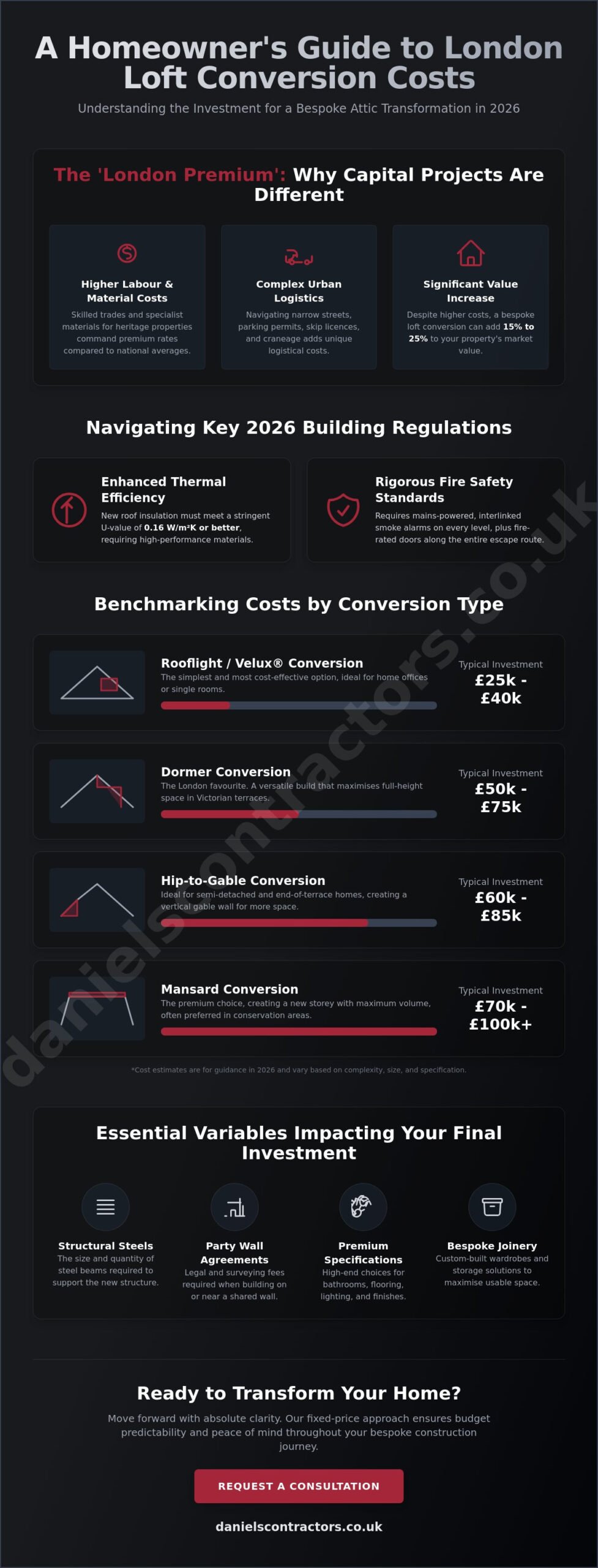
Logistics play a defining role in the capital’s construction budget. Managing a project in a dense urban environment involves more than just bricks and mortar. You must account for borough-specific parking permits, skip hire licences on narrow streets, and occasionally the use of specialist craneage to lift structural steels over heritage facades. These “invisible” costs are essential for a smooth, respectful build. Despite these complexities, the financial incentive remains strong. A bespoke attic transformation typically adds between 15% and 25% to a property’s market value, often providing a return that far outstrips the initial investment in prime London postcodes.
The “London Premium”: Why National Averages Mislead
Generic online estimators often fail because they ignore the distinct economic reality of the capital. Labour rates for skilled trades in London are consistently higher than the national average, and the requirement for specialist craftsmanship adds to this margin. For a heritage property, you can’t simply use off-the-shelf materials. Matching original London Stock brickwork or sourcing bespoke timber sashes requires a dedicated approach. In this environment, bespoke design isn’t a luxury; it’s a structural requirement to ensure the new storey integrates seamlessly with the existing terrace.
The 2026 Regulatory Environment
The regulatory landscape has shifted significantly in recent years. As of 2026, building regulations demand higher thermal efficiency, with roof insulation now required to meet a U-value of 0.16 W/m²K or better. This often necessitates thicker, high-performance insulation materials that impact the internal head height. Fire safety standards are equally rigorous for loft conversions in the United Kingdom, particularly in multi-storey London dwellings. You’ll need to account for mains-powered, interlinked smoke alarms on every level and the installation of fire-rated doors along the entire escape route to the front exit. These details ensure your home isn’t just beautiful, but fundamentally safe and energy-efficient for the future.
Benchmarking Costs by Conversion Type
Selecting the appropriate architectural style is the most significant decision impacting your total investment. In the capital, the loft conversion cost london homeowners anticipate is rarely a flat rate; it’s a reflection of how much volume you wish to create and the structural complexity required to achieve it. Whilst a simple Velux-only “rooflight” conversion serves as a refined entry point for a dedicated home office, most Londoners seek the substantial footprint increase offered by more structural transformations. These projects require a deeper level of engineering but offer a far more significant transformation of the living environment.
For semi-detached properties common on the Surrey and Essex borders, a Hip-to-Gable conversion is often the preferred choice. This involves extending the sloping side of your roof to create a vertical wall, which significantly increases the usable internal area and allows for a more natural staircase placement. However, for the majority of the city’s terrace stock, the decision usually rests between the versatility of a dormer or the prestige of a Mansard.
Dormer Conversions: The Versatile London Favourite
The dormer loft conversion price typically represents a pragmatic balance between additional floor space and construction efficiency. This style is particularly effective for Victorian terrace houses, where a rear dormer can transform a cramped attic into a full-height master suite with ease. If your property has a rear addition, an L-shaped dormer can effectively double the new floor area, though this requires a more substantial structural frame to support the extended span. You might consider discussing your specific property layout with a specialist to determine which configuration offers the best return on investment for your particular street.
Mansard Conversions: Maximising Volume and Aesthetic
The Mansard conversion remains the gold standard for luxury London homes, favoured for its ability to maximise volume whilst maintaining an elegant, integrated appearance. This style involves altering the entire slope of the roof to a 72-degree angle, creating a space that feels like a true additional storey rather than a converted attic. Because this change is so significant, you must consult official planning permission guidance, as Mansards almost always require full approval. The investment is higher due to the extensive structural roof alteration and the use of premium materials like slate or lead to match the existing character of the building. This architectural choice is often the only way to achieve a truly bespoke, high-ceilinged finish in conservation areas.
Structural and Regulatory Variables Impacting Your Investment
Whilst the aesthetic choices of a conversion are often the most exciting, the underlying structural and regulatory requirements form the backbone of your budget. A significant variable often overlooked is the “starting again” factor. We frequently encounter London properties with existing “loft rooms” or amateur conversions completed decades ago. These spaces rarely meet the 2026 Building Regulations for thermal efficiency or fire safety. Rectifying these non-compliant structures to ensure they’re legally habitable often requires a complete strip-back to the rafters. This process is essential for protecting your investment, as a conversion without the correct certification can significantly hinder a future property sale. Understanding these requirements early helps ensure the loft conversion cost london residents plan for remains accurate and transparent.
Professional fees are another essential pillar of a high-end build. A bespoke project demands a team of specialists, including architects to refine the vision and structural engineers to calculate load distributions. You’ll also need to budget for building control inspectors who provide the final certification of works. These experts ensure that every element, from the depth of the floor joists to the placement of fire-rated partitions, is executed with meticulous attention to detail. Investing in high-quality professional advice at the outset prevents costly structural corrections during the construction phase.
The Party Wall Process in Dense London Boroughs
In the tightly packed terraces of boroughs like Fulham or Hackney, your neighbours are an integral part of the project’s logistics. The Party Wall Act is a non-negotiable legal framework designed to protect both you and your adjoining owners. You’ll likely need to appoint a surveyor to manage these agreements, particularly if you’re inserting structural steels into shared walls. If neighbours dissent to the initial notice, costs can rise as additional surveyors are required. Early, polite engagement with your neighbours is the most effective way to mitigate delays and maintain a harmonious environment whilst your home is transformed.
Structural Engineering and Steelwork
The integrity of a luxury loft depends on a bespoke steel frame that supports the new floor and roof structure without stressing the original Victorian or Edwardian brickwork. The complexity of this steelwork is a primary driver of the “shell” phase costs. In 2026, steel prices remain a variable that requires careful management through fixed-price contracts. Beyond the material itself, the logistics of delivery in narrow London streets often require specialist craneage. Coordinating these lifts requires precision and experience to ensure the structural skeleton of your new storey is installed safely and efficiently without disrupting the local neighbourhood.
The Luxury Finish: How Specifications Drive the Final Quote
Once the structural shell is secure and the steelwork is in place, the focus shifts to the tactile elements that define a luxury living space. The loft conversion cost london clients eventually sign off on is heavily weighted by these internal specifications. Whilst the “shell” provides the volume, it’s the meticulous selection of materials and bespoke craftsmanship that transforms a simple attic into a high-end retreat. You might find inspiration in our curated list of luxury loft conversion ideas London, which highlights how premium materials can be integrated into the unique architectural constraints of the capital.
A sophisticated finish requires a holistic approach to design. This phase covers everything from the invisible infrastructure of smart home wiring to the visible elegance of handcrafted wardrobes. In a dense urban environment where every square centimetre is valuable, the quality of the finish isn’t just about aesthetics; it’s about intelligent functionality. Our design team works to ensure that every finish, from the choice of flooring to the specific hue of the paint, complements the architectural integrity of the building. Choosing high-specification materials ensures the longevity of your investment and provides a daily living experience that is both seamless and serene. Many of our clients who undertake a loft conversion also explore a broader high-end home refurbishment London programme to elevate the entire property in a single, cohesive project. To ensure your vision is perfectly translated into a technical reality, you can discuss your bespoke design requirements with our team.
High-End Master Suites and En-Suites
Creating a sanctuary at the top of your home often involves the installation of a premium en-suite. This requires more than just beautiful tiling and high-end sanitaryware. In many older London properties, water pressure is a significant consideration. You’ll likely need to budget for booster pumps or the installation of an unvented cylinder to ensure your rainfall shower performs as expected. Wet rooms are increasingly popular for their sleek, modern appearance, though they require specialist tanking and drainage solutions that add to the technical complexity of the build. Underfloor heating is another non-negotiable for a luxury finish, providing efficient warmth without compromising wall space for radiators. Additionally, the way you invite natural light into the space impacts the quote. Whilst standard Velux windows are efficient, bespoke floor-to-ceiling glazing or “Juliet” balconies offer a transformative sense of scale and connection to the city skyline.
Bespoke Joinery and Smart Storage
Navigating Your London Loft Project with Daniels Contractors
Selecting a partner for your attic transformation is a decision that extends beyond simple construction. At Daniels Contractors, we bring a “Gentleman Builder” approach to every project, combining the technical precision of a master developer with the personal touch of a boutique service provider. With over 25 years of experience across the luxury markets of London, Surrey, and Essex, we understand that the loft conversion cost london residents manage is often a reflection of the trust they place in their contractor. We operate with a quiet confidence that avoids aggressive tactics, opting instead for a transparent and reassuring relationship with our clients.
We organise the entire programme from inception to completion. This includes everything from the initial architectural design and structural calculations to the final decorative flourishes. By managing the project as a cohesive whole, we ensure that the high standards established in the design phase are meticulously maintained through to the build. This integrated methodology provides a sense of momentum and accountability that is often missing in fragmented construction projects. Our passion for transformation ensures your project is in the hands of professionals who value quality as much as you do.
One of the most significant pillars of our service is the use of fixed-price contracts. In the evolving landscape of 2026, budget predictability is paramount. We believe that once a design is finalised and the scope is agreed, your investment should remain stable. This commitment eliminates the fear of hidden structural costs or creeping expenses, allowing you to enjoy the transformation of your home with total financial clarity. Our approach is designed to be aspirational yet dependable, focusing on high-end results and the transparency of the process.
Transparent Project Management
London logistics require a specialist touch. We manage the complexities of parking permits, skip licences, and neighbourhood communication so you don’t have to. Our project management is methodical and steady, providing regular milestone updates that offer total peace of mind. Every structural detail is executed with a dedication to craftsmanship that ensures the longevity of your home’s new storey. This steady pace suggests a commitment to quality that never cuts corners, mirroring a well-organised project from start to finish. We take the time to explain the value of our approach, building a foundation of trust through every phase of the build.
Your Next Steps to a Bespoke Loft
A successful conversion begins with a clear understanding of your property’s unique characteristics. An initial feasibility study and professional site survey are essential first steps to identify the structural opportunities within your roof space. These assessments allow us to provide a detailed, bespoke quote tailored specifically to your architectural ambition and the requirements of your borough. If you are ready to explore the potential of your home, you can discuss your London loft conversion with our expert team to begin your journey toward a refined living space.
Realising Your Vision for a Premium Attic Transformation
A successful loft conversion is a sophisticated marriage of architectural ambition and structural integrity. By understanding the nuances of London’s heritage properties and navigating the latest 2026 building regulations, you can ensure your project adds significant value and refined living space to your home. We’ve explored how the loft conversion cost london homeowners invest is ultimately a reflection of the quality, craftsmanship, and bespoke joinery that define a luxury finish. Whether you opt for the versatile dormer or the prestigious mansard, the key to a stress-free build lies in meticulous planning and transparent communication.
At Daniels Contractors, we have been delivering luxury London renovations since 2001, bringing high-end structural expertise to every bespoke project. Our commitment to integrity includes offering fixed-price contract options, providing you with total budget transparency from the very beginning. We invite you to request a bespoke loft conversion consultation with Daniels Contractors to discuss how we can transform your space with quiet confidence and professional care. Your journey towards a beautifully crafted, high-specification home starts with a single, well-informed conversation.
Frequently Asked Questions
How much does a loft conversion add to the value of a London home in 2026?
A well-executed loft conversion typically adds between 15% and 25% to the market value of a London property. This uplift is particularly significant in prime boroughs where additional square footage is at a premium. Beyond the immediate financial return, adding a high-specification master suite or a sophisticated home office makes your property far more desirable to future buyers. It’s an investment that often pays for itself by substantially increasing your home’s total footprint.
Do I need planning permission for a loft conversion in a London conservation area?
You will almost certainly require full planning permission if your property is situated within a conservation area. Whilst many London homes benefit from permitted development rights, these are frequently restricted in heritage-protected zones to preserve the local architectural character. We always recommend obtaining a Lawful Development Certificate even for standard builds. This document provides legal certainty that your project is compliant with local authority requirements before construction begins.
How long does a high-end loft conversion typically take from start to finish?
A high-end loft conversion generally takes between 8 and 12 weeks for the physical construction phase. However, you should allow an additional three to six months for the necessary pre-construction preparations. This period includes architectural design, structural engineering calculations, and the time required for planning or Party Wall approvals. A methodical approach during this preparation stage ensures that the build proceeds smoothly without unforeseen delays or structural complications.
What is the most expensive part of a London loft conversion?
The structural skeleton and the bespoke internal finishes are the primary drivers of the loft conversion cost london homeowners encounter. Fabricating and installing the complex steel frame required to support a new storey is a significant investment. Equally, luxury specifications such as custom-built joinery and high-end en-suite installations contribute heavily to the final quote. These elements ensure the new space feels like an integrated, premium part of your home.
Can I stay in my house whilst the loft conversion is being built?
Most clients remain in their homes whilst the conversion is underway. We typically manage access via external scaffolding to minimise disruption to your daily life. The most intrusive phase occurs when the new staircase is installed, which usually takes only a few days. We pride ourselves on maintaining a clean and respectful site, ensuring that the heavy structural work remains separated from your primary living areas for as long as possible.
Do I need a Party Wall agreement for a loft conversion in a terraced house?
You must obtain a Party Wall agreement if your project involves work on a shared wall or if you’re excavating near a neighbour’s foundations. This is a legal requirement under the Party Wall Act 1996 for the majority of terraced and semi-detached properties in London. Early engagement with your neighbours is essential. Appointing a professional surveyor to serve notices ensures that the process is handled with the necessary technical precision and legal compliance.
What is the difference in cost between a Dormer and a Mansard loft conversion?
A Mansard conversion is generally 20% to 30% more expensive than a standard Dormer. This price difference reflects the extensive structural work required to alter the entire slope of the roof to a 72-degree angle. Whilst a Dormer is often built under permitted development rights, a Mansard involves significant architectural changes that nearly always require full planning permission. The result is a more integrated, aesthetic finish that maximises internal volume and head height.
How do I ensure my loft conversion meets 2026 Building Regulations?
Ensuring compliance with 2026 Building Regulations requires a focus on thermal efficiency and fire safety. Your project must meet a U-value of 0.16 W/m²K for roof insulation and include interlinked smoke alarms on every level. We work closely with building control inspectors throughout the build to verify that every structural element meets these mandatory standards. This rigorous process guarantees that your loft conversion cost london investment results in a safe, habitable, and legally certified space.