
What if the most significant barrier to your home’s transformation wasn’t the local council’s approval, but your own understanding of the rules? Many homeowners feel a sense of paralysis when considering a bespoke renovation, fearing that a lengthy planning process will end in rejection or costly delays. It’s a common frustration to receive conflicting advice whilst trying to interpret complex legislation. However, mastering permitted development rights provides a sophisticated alternative, allowing you to bypass the traditional planning route for many high-end extensions and loft conversions.
You likely feel that the planning system is designed to be restrictive, yet these rights offer a powerful tool for those who value precision and efficiency. We promise to demystify the current GPDO regulations, showing you exactly how to extend your living space without the uncertainty of a full application. This guide examines the 2026 size limits for detached and terraced homes, explains why the rules remain stable despite recent consultations, and details how to secure your investment with a Lawful Development Certificate.
Key Takeaways
- Grasp the role of the General Permitted Development Order as a national framework designed to streamline and simplify your home’s transformation.
- Master the specific volume and height parameters for extensions and loft conversions that allow for significant spatial growth within legal boundaries.
- Navigate the complexities of Article 4 directions and conservation areas that often override standard permissions in prime London postcodes.
- Secure your investment by understanding the critical role of Lawful Development Certificates in providing long-term legal certainty.
- Learn how to integrate permitted development rights into a bespoke design strategy that prioritises high-end craftsmanship and seamless architectural execution.
What are Permitted Development Rights in 2026?
Permitted development rights represent a sophisticated legal shortcut for the discerning homeowner. Rather than submitting a full planning application and awaiting the subjective verdict of a local committee, these rights act as a national grant of planning permission. This framework allows specific types of work to proceed without the traditional, often arduous, application process. It’s a system designed to provide certainty. If your project adheres to the strict criteria set out by the government, the law deems the permission already granted.
The legal foundation for these rights is the General Permitted Development Order (GPDO). This statutory instrument outlines various “classes” of development, from modest rear extensions to complex loft conversions. The primary purpose of the GPDO is to streamline home improvements and reduce the administrative backlog within local councils. By removing smaller, predictable projects from the planning queue, authorities can focus their resources on larger, more contentious developments. It’s a pragmatic approach that benefits both the homeowner and the state.
However, it’s vital to distinguish “permitted” work from “unregulated” construction. Whilst you may not need a full planning application, you’re still bound by rigid technical constraints regarding height, volume, and materials. Failure to respect these boundaries can result in enforcement action, making the project a liability rather than an asset. Professional oversight ensures that your bespoke renovation remains within the law, protecting both your peace of mind and your property’s future market value.
The Evolution of the GPDO
The landscape of permitted development rights has shifted significantly over the last decade. Legislation has gradually expanded to allow for larger extensions and even the addition of entire storeys. As we move through 2026, the rules remain remarkably stable. Whilst a government consultation on expanding these rights closed in April 2024, no new legislation has been enacted as of early 2026. This stability is a favourite amongst London homeowners. It allows for confident, long-term investment in high-value refurbishments without the fear of shifting legal goalposts mid-project.
Who Holds These Rights?
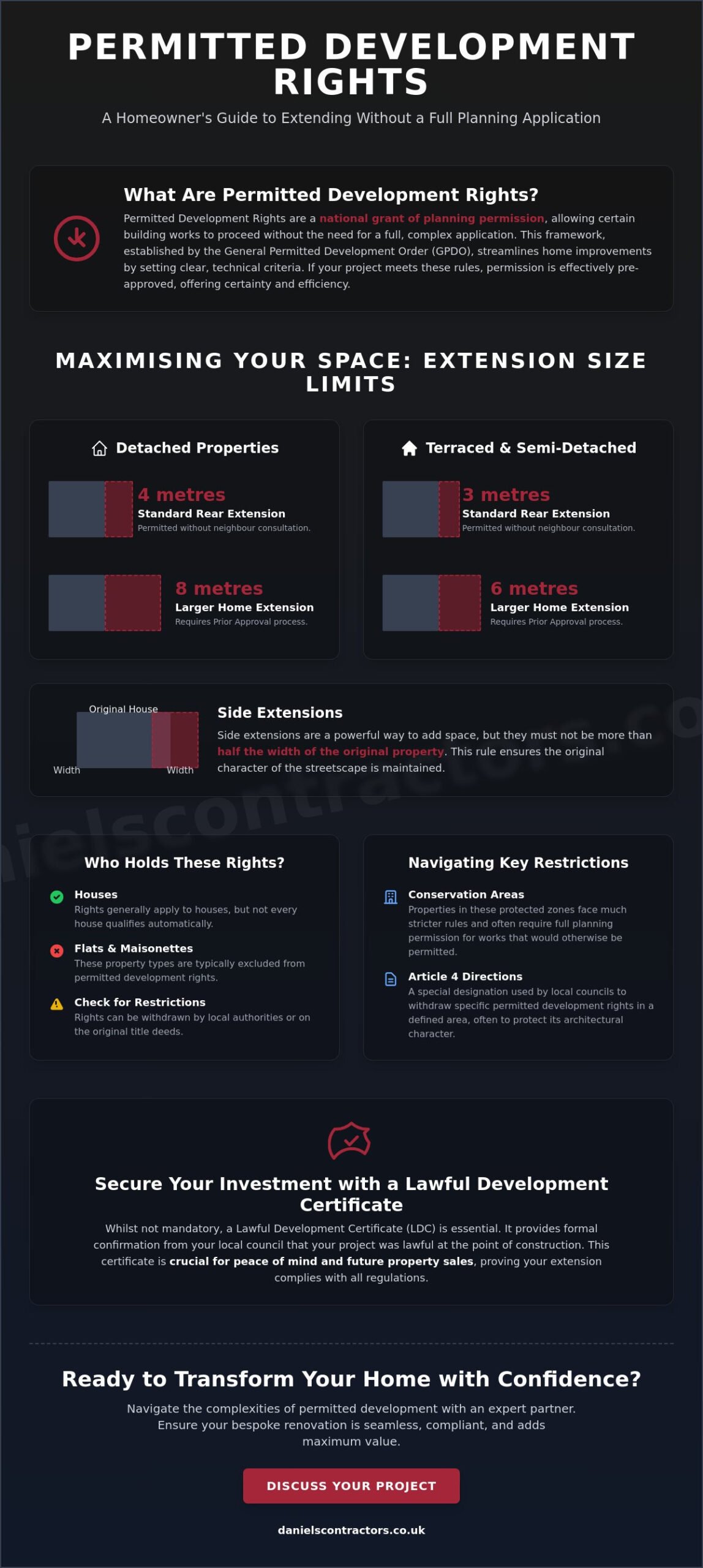
Not every property owner enjoys the same level of freedom. This distinction is particularly crucial for London residents. Generally, permitted development rights apply to houses, but they don’t extend to flats or maisonettes. If you live in a converted property or a dwelling created through “prior approval” routes, your rights might be restricted or entirely absent. It’s also essential to check your original title deeds. In some cases, developers or local authorities have “withdrawn” these rights through specific clauses or Article 4 directions. A thorough initial assessment is the only way to ensure your vision is legally viable.
Maximising Space: Common Projects Under Permitted Development
Achieving an expansive, light-filled home whilst adhering to national legislation requires a meticulous approach to architectural design. For many homeowners, permitted development rights serve as the ultimate design envelope. They provide a clear set of parameters that, when handled with precision, allow for significant spatial growth. The challenge lies in balancing your aesthetic ambition with strict technical compliance. In high-end construction, every millimetre of height and every cubic metre of volume is a strategic asset. By understanding these boundaries, we can create bespoke house extensions London residents value for their seamless integration and increased property worth.
Rear and Side Extensions
The most frequent use of these rights involves extending the ground-floor footprint. For a single-storey rear addition, the rules are specific. Detached houses can extend up to 4 metres, whilst semi-detached or terraced properties are limited to 3 metres. However, the Prior Approval process allows for extended permitted development of up to 8 metres for detached homes and 6 metres for others, provided neighbours are consulted. Side extensions are equally transformative but must not exceed half the width of the original house. Following a permitted development rear extension checklist ensures that your project avoids the common pitfalls of boundary proximity and height restrictions.
Luxury Loft Conversions
A loft conversion is often the most efficient way to add a master suite or a sophisticated home office. Under current rules, you’re permitted an additional roof volume of 40 cubic metres for terraced houses and 50 cubic metres for detached or semi-detached homes. The ultimate boundary is the original ridge line; your new structure must not exceed the highest part of the existing roof. To maintain the character of the property, materials must be of a similar appearance to the existing exterior. This requirement for visual harmony is where craftsmanship truly shines, ensuring the new addition feels like a natural evolution of the home rather than an afterthought.
Outbuildings and Bespoke Garden Rooms
The trend for “improve, not move” has popularised the luxury garden studio. You can utilise up to 50% of the land around the original house for outbuildings, provided they are single-storey. If the building is within 2 metres of a boundary, the eaves height is restricted to 2.5 metres. These spaces must remain “incidental” to the main dwelling, serving as gyms, studios, or guest spaces rather than independent residences. Many clients choose to consult our design team to ensure these structures provide a high-end finish that complements the main house. Before breaking ground, obtaining Lawful Development Certificates is a prudent step to confirm your project meets all criteria for “incidental” use.
Navigating Restrictions: Conservation Areas and Article 4 Directions
In many prime London boroughs, the term “permitted” is often a misnomer. Whilst national legislation provides a generous framework, local councils possess the legal authority to override these rules to protect the architectural integrity of a street or neighbourhood. For the homeowner, this means that permitted development rights are not always an automatic entitlement. In high-value areas, the tension between modern spatial requirements and heritage preservation is constant. Navigating this requires more than just a cursory glance at the official government guidance on permitted development; it demands a strategic understanding of local policy.
Understanding Article 4 Directions
Councils use Article 4 directions as a surgical tool to withdraw specific rights in a defined area. This is usually done to prevent the slow erosion of a characterful street’s appearance. If your property is subject to an active direction, works that would normally be exempt, such as replacing sash windows, adding a front porch, or even changing exterior paint colours, suddenly require full planning permission. You won’t always find this information on a property’s title deeds. The most reliable way to verify your status is by checking the local authority’s interactive planning maps or consulting with a professional who understands the specific constraints of your postcode.
Building in Conservation Areas
Properties located on “Article 2(3) Land”, the technical term for conservation areas, face additional hurdles. In these zones, the allowance for side extensions is typically removed entirely. Loft conversions are also more complex. Whilst a dormer might be permitted elsewhere, councils in conservation areas often insist on more discreet rooflight solutions or require a full planning application to ensure the proposal respects the historic roofline. The goal isn’t to prevent development, but to ensure that any addition is a sympathetic, high-quality evolution of the original structure. We often find that a bespoke design, rooted in traditional craftsmanship, is the key to unlocking potential in these sensitive settings.
The nuances of local policy are best illustrated through a specific London Borough of Hammersmith & Fulham planning case study, where conservation rules are applied with particular rigour. It’s also vital to remember that Grade II listed status effectively negates almost all permitted development rights. For listed buildings, any alteration, internal or external, requires Listed Building Consent. This ensures that the unique historical fabric of the home is protected for future generations. Understanding these layers of restriction early in the process prevents costly delays and ensures your investment remains legally sound. For those undertaking a Victorian house refurbishment London projects often demand, navigating these conservation constraints is an essential part of achieving a result that honours the property’s heritage whilst meeting modern standards.
The Certification Process: Lawful Development Certificates
Whilst not a mandatory requirement, a Lawful Development Certificate (LDC) is widely regarded as the gold standard for any high-end renovation. It provides a formal, legal confirmation from your local authority that your project falls squarely within your permitted development rights. In the sophisticated London property market, where investments often reach significant sums, this document is your primary shield against future legal complications. It transforms a technical assumption into a binding legal fact.
There is a crucial distinction between a “Proposed” and an “Existing” certificate. A Certificate of Lawfulness of Proposed Use or Development (CLPUD) is secured before construction begins, providing the absolute certainty needed to break ground with confidence. Conversely, a Certificate of Lawfulness of Existing Use or Development (CLEUD) is sought after the works are complete, often to rectify missing paperwork or prove that a structure has been in place long enough to be immune from enforcement. For projects in 2026, the fee for a householder proposed LDC is £274, which is exactly half the cost of a full planning application fee of £548.
Securing Your LDC: Step-by-Step
The process begins with the preparation of meticulous evidence. This includes high-fidelity architectural drawings, precise site location maps, and technical specifications that prove adherence to volume and height limits. Once submitted, your local planning office typically takes eight weeks to issue a decision. It’s also vital to distinguish this from the Prior Approval process. For larger home extensions using extended permitted development rights or additional storeys, a separate application is required, carrying a fee of £249 as of April 2026. This process allows the council to assess the impact on neighbouring properties whilst still operating under the PD framework.
The Consequences of Non-Compliance
Proceeding without formal certification carries substantial risks. Local authorities possess the power to issue enforcement notices, which can lead to the mandatory and costly removal of the new structure. Beyond the threat of remedial work, the absence of an LDC can jeopardise high-end home insurance policies and complex mortgage arrangements. Most luxury buyers and their solicitors will demand proof of lawfulness before a sale can proceed. Without it, your property’s value and marketability are significantly compromised. At Daniels Contractors, we manage the entire certification process on your behalf, ensuring every detail of your bespoke refurbishment is legally protected from the outset.
Designing for Luxury: Implementing PD Rights with Daniels Contractors
A truly bespoke home is born from the harmonious marriage of architectural vision and legal precision. At Daniels Contractors, we don’t view the technical constraints of permitted development rights as a limitation on creativity. Instead, we treat these parameters as a framework for innovation. Our design-build approach ensures that technical compliance is integrated into the aesthetic DNA of your project from the very first sketch. This synergy prevents the common friction between architects who dream big and builders who must navigate the practicalities of the GPDO. By aligning design and construction under one roof, we ensure that every millimetre of your extension is both lawful and luxurious.
Bespoke Refurbishment and Extension
When undertaking a high-end home refurbishment London residents expect a finish that is both contemporary and timeless. A significant challenge in PD projects is the legal requirement for materials to be of a “similar appearance” to the existing dwelling. We turn this potential hurdle into a bespoke feature. For a recent Victorian house refurbishment London project, we sourced reclaimed London Stock bricks and matched the mortar texture perfectly, whilst introducing expansive, slim-frame glazing that transformed the internal light levels. This meticulous attention to detail ensures that your extension feels like an organic part of the original architecture rather than a disjointed addition. Our commitment to transparent project management means you’re kept informed as we navigate these fine margins of craftsmanship and law.
Start Your Transformation Journey
The most successful luxury projects begin with a comprehensive feasibility study. This initial phase is where our 25 years of experience across London, Surrey, and Essex becomes your greatest asset. We identify the specific potential of your site, accounting for the nuances of local council behaviour and the specific classes of development available to you. By resolving technical questions early, we eliminate the risk of legal hurdles during the construction phase. This proactive stance provides the peace of mind that your investment is protected and your vision is achievable. Precision in the early stages is the only way to avoid the enforcement notices discussed earlier in this guide.
If you’re ready to explore how permitted development rights can unlock the hidden potential of your property, we invite you to contact us. We’ll provide a professional consultation to assess your project’s viability and discuss how our master craftsmen can bring your bespoke renovation to life with the precision and care it deserves. Whether you’re planning a sophisticated loft conversion or an expansive rear extension, we’re here to ensure the process is as seamless as the final result.
Securing Your Home’s Future Transformation
Mastering the technicalities of permitted development rights is the first step toward a successful high-end renovation. You’ve seen how these rules provide a clear path for extensions and loft conversions, provided you respect the strict volume and height boundaries. Whilst local restrictions in conservation areas add a layer of complexity, they don’t have to be a barrier to your ambition. Securing a Lawful Development Certificate remains the ultimate way to protect your investment and ensure a seamless sale in the future.
Transformation requires a partner who understands both the craft and the code. Since 2001, we’ve delivered bespoke luxury across London’s most challenging planning landscapes. We offer fixed-price contracts for total peace of mind, ensuring your project stays on track from the first drawing to the final finish. Discuss your bespoke project with London’s luxury building experts. Your home has incredible potential; it’s simply a matter of unlocking it with precision and care.
Frequently Asked Questions
Do I need a Lawful Development Certificate if I have permitted development rights?
No, a Lawful Development Certificate is not a legal requirement, but it is highly recommended for any high-end project. This document provides formal proof that your development was lawful at the time of construction, which is vital when selling your property. It prevents the common delays caused by solicitors requesting evidence of planning compliance during the conveyancing process.
Can I build a double-storey extension under permitted development in 2026?
Yes, you can build a two-storey rear extension provided it does not exceed a depth of 3 metres from the original wall. The new structure must be at least 7 metres away from the rear boundary, and the roof pitch should match the existing house to maintain architectural consistency. This allows for a sophisticated expansion of both living and sleeping quarters without a full application.
How much can I extend my house by without planning permission?
Single-storey rear extensions can project up to 4 metres for detached houses and 3 metres for semi-detached or terraced properties. Using permitted development rights through the Prior Approval scheme, these limits can be increased to 8 metres and 6 metres respectively. These parameters offer a reliable way to increase your ground-floor footprint whilst avoiding the uncertainty of a full planning committee review.
Does permitted development apply to flats or maisonettes in London?
No, these rights do not apply to flats, maisonettes, or other subdivided buildings within the UK planning system. Owners of such properties must always submit a full planning application for any external alterations, including window replacements or extensions. This is a crucial distinction for London residents in converted period homes who are planning a bespoke refurbishment or spatial reconfiguration.
What happens if I build something that doesn’t meet permitted development rules?
Building outside the strict technical criteria risks an enforcement notice from your local planning authority. This legal order can compel you to alter the work or demolish the structure entirely at your own expense. Beyond the physical cost, non-compliance can invalidate your home insurance and make it impossible for future buyers to secure a mortgage on the property.
Can I use permitted development rights for a loft conversion in a conservation area?
You generally cannot use these rights for external roof extensions, such as dormers, if your property is situated within a conservation area. Whilst internal loft refurbishments may be possible, any change to the shape or elevation of the roof usually requires full planning permission. This ensures that the unique heritage and rooflines of protected neighbourhoods are preserved with the utmost care.
Do I still need building regulations approval for a PD project?
Yes, building regulations approval is a mandatory requirement that is entirely separate from planning permission. Whilst permitted development concerns the right to build, building regulations ensure the structure itself is safe, energy-efficient, and structurally sound. You must secure this approval to ensure your project meets the high standards required for modern, high-quality construction and legal certification.
How do Article 4 directions affect my permitted development rights?
An Article 4 direction effectively cancels specific permitted development rights for a particular property or geographic area. If your home is subject to such a direction, you will need to apply for planning permission for works that would otherwise be exempt. Local councils implement these directions to prevent unsympathetic changes and maintain the character of prestigious or historically significant streets.