
A successful Victorian refurbishment is not a simple renovation; it’s a sophisticated dialogue between heritage restoration and structural innovation. You’ve likely spent hours admiring the intricate plasterwork and high ceilings of your property, yet the practicalities of damp, outdated layouts, and strict conservation area rules can quickly dampen that initial excitement. It’s a delicate balance to strike, especially when you’re seeking a victorian house refurbishment london that demands both historical integrity and high-end modern finishes.
We understand that your goal is a home that feels timeless yet functions perfectly for a contemporary lifestyle. This definitive 2026 guide offers the expert guidance you need to modernise your property whilst honouring its original character. We’ll walk you through navigating London’s planning complexities, addressing structural decay with precision, and selecting bespoke finishes that increase your property’s value. From opening up dark rooms to integrating seamless extensions, you’ll discover how to manage a stress-free project that results in a sanctuary of period charm and modern luxury.
Key Takeaways
- Discover how to harmonise original architectural features with contemporary luxury to create a high-end investment property that retains its historic soul.
- Learn to identify and address critical structural challenges, such as London clay movement and damp, to ensure your home’s long-term integrity.
- Master the planning process for a victorian house refurbishment london by navigating the nuances of Permitted Development and essential Party Wall Act requirements.
- Explore bespoke side-return extensions and structural glass solutions that invite natural light into traditionally narrow Victorian layouts.
- Gain insights into professional project management that delivers a transparent, stress-free transformation from the initial design through to the final handcrafted finish.
The Victorian Terrace in 2026: Balancing Heritage with Modern Capability
A victorian house refurbishment london is far more than a fresh coat of paint or a new kitchen. It represents a deep commitment to the building’s legacy. In 2026, high-end homeowners view these terraces as the gold standard for luxury investment because they offer a character that new builds simply cannot replicate. The “bones” of these houses are robust, providing a sturdy foundation for ambitious transformations that increase both aesthetic and financial value. This process is about honouring the past whilst ensuring the property meets the rigorous demands of modern life.
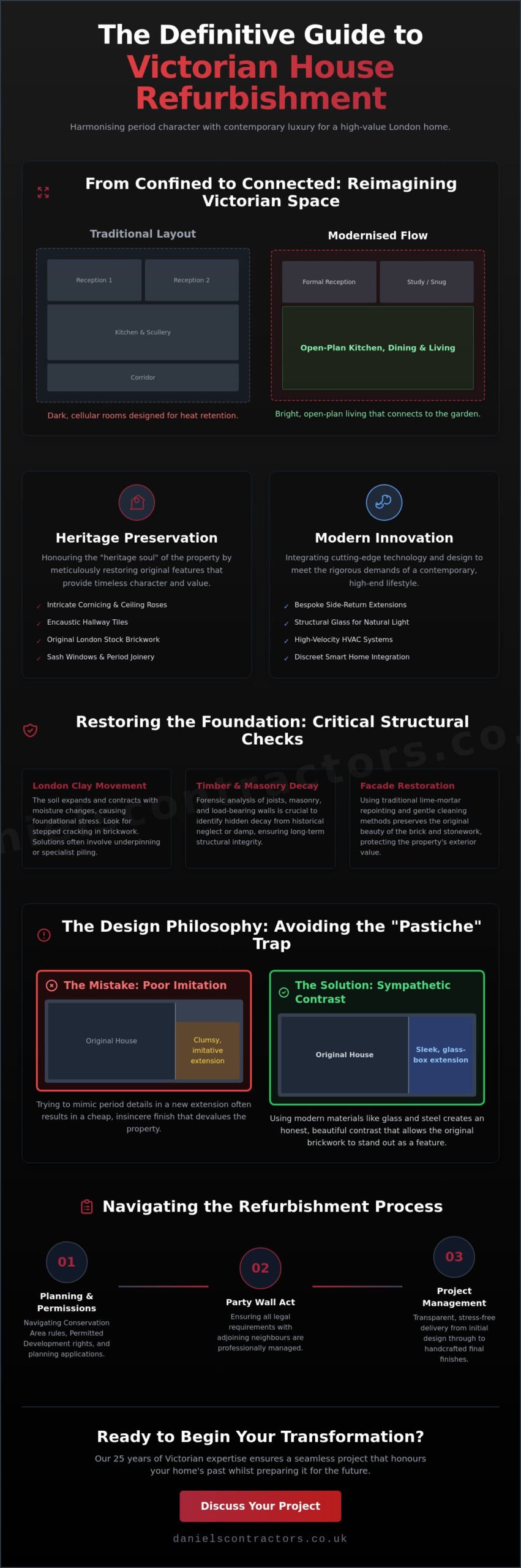
The primary hurdle for most owners is the traditional floor plan. Victorian homes were built for a different age, often featuring a series of small, dark rooms designed for privacy and heat retention. Today’s desire for open-plan living and natural light, especially when planning a victorian house refurbishment london, requires a clever architectural approach. We don’t just tear down walls; we preserve the “spatial journey” of the home. This means keeping the grand entrance and formal reception rooms whilst opening up the rear to create a dynamic flow into the garden. It’s about creating a home that feels both grand and liveable.
The Evolution of Victorian Architecture in London
London’s landscape is defined by various Victorian architectural styles, ranging from the restrained elegance of the early 1840s to the ornate, brick-heavy designs of the late 19th century. Identifying original features like intricate cornicing, ceiling roses, and encaustic hallway tiles is the first step in any high-end project. These elements provide the “heritage soul” that anchors the property. Late Victorian styles often feature more elaborate stonework and larger windows, which we can utilise to enhance the sense of space during a restoration.
The “Pastiche” Trap: Why Design Symmetry Matters
Many renovators fall into the trap of poor imitation. Trying to mimic period details in a modern extension often results in a “pastiche” that feels cheap and insincere. We prefer a design language that uses contrast to highlight beauty. For instance, a sleek, glass-box extension allows the original London stock brickwork to stand out as a piece of history. The success of a victorian house refurbishment london depends on this sympathetic design language. It’s particularly important in conservation areas, where planners value designs that respect the past without pretending to be part of it. True luxury lies in the honest meeting of two different eras.
Restoring the Foundation: Structural Integrity and Heritage Preservation
Beneath the ornate plasterwork of a London terrace lies a century-old structure that requires meticulous care. Before we consider the aesthetic finishes of a victorian house refurbishment london, we must ensure the building’s core is sound. Many properties suffer from historical neglect or poorly executed past renovations. Our approach involves a forensic analysis of the timber joists, masonry, and load-bearing walls to identify hidden decay before it compromises the project’s longevity. It’s about providing you with total peace of mind that your investment is built on a stable, secure foundation.
A unique challenge for London homeowners is the heavy clay soil common across the capital. This material is highly susceptible to volume changes, expanding in wet winters and shrinking during dry summers. This movement often leads to stepped cracking in the brickwork or sticking doors, signals that the foundations are under stress. Stabilising these structures often requires underpinning or specialist piling, particularly when we are planning a heavy rear extension or a basement conversion. It’s a technical undertaking that demands precision to protect the integrity of the original terrace whilst preparing it for another century of life.
Restoring the facade is equally vital for preserving the property’s value. We use traditional lime-mortar repointing and gentle stone cleaning to reveal the original beauty of the London stock brick and decorative masonry. Simultaneously, we discreetly integrate modern infrastructure. This includes high-velocity HVAC systems and smart home wiring tucked behind cornices, ensuring your home functions with 21st-century intelligence without sacrificing its period charm. If you are concerned about the hidden condition of your property, we recommend a professional refurbishment assessment to establish a solid baseline for your project.
Sash Window Restoration and Thermal Performance
Traditional sash windows are the eyes of a Victorian home. Whilst Grade II listed status often mandates repair over replacement, we can often integrate slim-profile double glazing into original frames. This significantly improves thermal performance and acoustic insulation from London street noise without losing the delicate glazing bar profiles that define the era. It’s a bespoke solution that marries classic aesthetics with modern comfort.
Damp Proofing and Breathability in Period Buildings
Modern cement-based tanking is often the enemy of Victorian masonry. These buildings were designed to breathe. Using non-breathable materials traps moisture within the walls, leading to “blown” plaster and timber rot. We advocate for traditional lime plasters and mineral-based paints. These materials allow moisture to evaporate naturally, preserving the health of the brickwork and creating a far healthier internal climate for your family.
Bespoke Extensions: Blending Contemporary Luxury with Period Architecture
Side Return and Wraparound Extensions
When exploring Bespoke House Extensions in London, the priority is often to reclaim the “unused” side alley common in L-shaped layouts. A side return extension broadens the kitchen area, allowing for a generous island and a more inclusive cooking experience. For those seeking maximum impact, a full wraparound extension creates a vast, open-plan living zone. We use bespoke skylights and “fifth wall” design features, such as exposed timber beams or wallpapered ceilings, to ensure these wide spaces feel warm and architecturally significant.
Double-Height and Vaulted Spaces
Navigating the Refurbishment Process: Planning, Costs, and Management
Managing the financial investment of a luxury restoration requires a level of transparency that goes beyond a simple estimate. High-end finishes, from reclaimed parquet flooring to bespoke stonework, require precise quoting to avoid the “budget creep” often associated with older buildings. Because Victorian properties frequently hide unforeseen issues behind their plasterwork, we advocate for a detailed cost breakdown that accounts for every specialist trade. To understand the current market rates for these high-specification projects, you can review our detailed breakdown of House Extension Cost London.
If you’re ready to move from the planning phase to active development, we invite you to contact our project management team for a professional consultation on your property’s potential.
The Planning Hurdles of Conservation Areas
Working within prestigious boroughs like Hammersmith, Fulham, and Kensington often means adhering to strict conservation area guidelines. These rules generally focus on maintaining the “front aspect” of the street, meaning your restoration must respect the original facade whilst allowing for a total interior transformation. Navigating these constraints requires a nuanced understanding of what is possible. For many projects, we can utilise specific allowances to extend your living space without a full application. You can explore these options in our guide to Understanding Permitted Development Rights.
Project Management and the RIBA Plan of Work
A structured approach is the only way to ensure a stress-free experience. We follow a methodical programme that aligns with professional standards, moving from initial concept through to technical design and final handover. This ensures that every specialist artisan, from heritage joiners to smart-home integrators, is perfectly synchronised. A main contractor acts as your single point of accountability, protecting the quality of the craft at every stage. For a deeper look at how we structure these phases, see The RIBA Plan of Work Guide.
The Daniels Contractors Approach: 25 Years of Victorian Expertise
At Daniels Contractors, we believe that a victorian house refurbishment london is a responsibility as much as it is a project. For 25 years, we’ve dedicated ourselves to the meticulous restoration of the capital’s period homes, honing a process that balances technical excellence with a boutique service. Our philosophy is rooted in the precision of the master craftsman and the reliability of a partner who understands that your home is your most significant investment. We don’t just build. We transform spaces with a quiet confidence that ensures every heritage detail is preserved whilst modern comforts are seamlessly integrated.
Why a Bespoke Builder Outperforms General Contractors
Our heritage as bespoke builders means we possess a deep understanding of London’s specific architectural fabric. We know how these buildings behave over time and how to solve the complex problems they often present. Our team embodies the “Gentleman Builder” persona. We are professional, polite, and thorough in every interaction. We value clear communication and mutual respect, ensuring your journey is as smooth as the final finish. You can learn more about our regional expertise in our guide to Bespoke Builders in Surrey & London.
Our Commitment to Quality and Transparency
Trust is built on transparency. We provide fixed-price contracts and milestone-based schedules to give you total peace of mind throughout the build. Our experts work alongside your architect from the earliest stages. This collaboration ensures that every design choice is structurally feasible and beautifully executed. From the initial consultation to the final handover, we remain committed to the integrity of the work and the transparency of the process. If you are ready to begin your journey, you can book a consultation for your Victorian house refurbishment today.
Transforming Your Period Property for the Next Century
Reimagining a Victorian home requires a delicate touch and a visionary approach. You now understand that a successful project hinges on more than just aesthetics; it’s about the invisible work of stabilising foundations on London clay and the strategic use of structural glass to invite light into narrow floorplans. By prioritising heritage preservation alongside modern engineering, you create a residence that is both a sanctuary and a sound investment.
Embarking on a victorian house refurbishment london is a significant journey that rewards meticulous planning and craftsmanship. Since 2001, we’ve specialised in high-end heritage restorations, delivering luxury London developments with a commitment to quality and integrity. Our approach offers the peace of mind that comes from transparent project management and fixed-price contracts. Some clients also find it valuable to explore how luxury new build contractors London specialists approach bespoke residential construction, particularly when weighing the merits of a full rebuild against a comprehensive restoration. We invite you to discuss your bespoke Victorian refurbishment with our experts today. Your property has stood for over a hundred years; let’s ensure its next chapter is its most magnificent yet.
Frequently Asked Questions
Do I need planning permission for a Victorian house refurbishment in London?
Internal victorian house refurbishment london often falls under Permitted Development, but extensions or exterior alterations usually require a formal application. In London, approximately 60% of properties face restrictions due to conservation areas or Article 4 directions. You should always verify your property’s status with the local council, as householder application fees in England are £528 as of April 2026. Expert guidance ensures your project remains compliant whilst achieving your design goals.
How much does a high-end Victorian house refurbishment cost in 2026?
High-end and heritage renovations in London typically range from £2,500 to £3,500 per square metre in 2026. For a standard three-bedroom Victorian terrace of 110 square metres, a realistic budget sits between £132,000 and £198,000 for a mid-to-high specification. These figures exclude professional fees for architects and structural engineers. We always recommend a 10% to 15% contingency budget to cover the unforeseen structural challenges common in century-old buildings.
Can I modernise a Grade II listed Victorian property?
You can certainly modernise a Grade II listed home, though you must obtain Listed Building Consent for any alterations that affect its character. The secret is a sympathetic dialogue between old and new. This involves using traditional materials like lime plaster alongside discreetly integrated smart home technology. Our approach focuses on preserving the heritage soul whilst installing high-performance services that meet the comfort expectations of a luxury 2026 lifestyle.
How long does a full Victorian terrace refurbishment typically take?
A full victorian house refurbishment london typically takes between six and twelve months to complete. The exact timeline depends on the complexity of structural repairs and whether you are adding a basement or loft conversion. A well-organised project follows a methodical programme to prevent delays. We manage every phase with precision, from the initial dirty work of foundation stabilisation to the final bespoke joinery installation and handcrafted finishes.
What are the most common structural issues found in Victorian houses?
The most frequent structural issues include subsidence caused by London clay, rising damp, and timber decay in suspended floors. London properties are particularly prone to foundation movement as the clay soil expands and contracts with the seasons. Additionally, many older homes have suffered from non-breathable modern repairs that trap moisture. Identifying these hidden defects early is essential for a stress-free project and ensures the building’s long-term integrity and value.
Is it better to repair or replace original Victorian sash windows?
We always advocate for repairing original sash windows whenever possible to maintain the property’s historical value and aesthetic symmetry. Modern techniques allow us to draught-proof original frames and even integrate slim-profile double glazing without altering the window’s slender profile. If the timber is beyond salvage, we provide bespoke replacements that match the original joinery exactly. This ensures your home remains thermally efficient whilst honouring its Victorian architectural roots.
How can I make my Victorian home more energy-efficient?
Improving energy efficiency in a Victorian home requires a balance between insulation and breathability. You can achieve significant gains by draught-proofing windows, insulating lofts with natural fibres, and installing high-efficiency HVAC systems. It’s vital to avoid non-breathable synthetic foams that can cause dampness in solid brick walls. Using lime-based plasters and mineral paints allows the structure to regulate moisture naturally, creating a warm, healthy, and sustainable living environment for your family.
What is a side return extension and is it right for my property?
A side return extension infills the narrow alleyway at the rear of a Victorian L-shaped layout to create a wider, open-plan kitchen. This is the classic London solution for narrow plots, as it transforms a dark, underutilised space into the social heart of the home. By using structural glass or skylights, you can flood the centre of the house with natural light, creating a seamless transition between the heritage front rooms and a modern rear.