
High-end building in London is a rigorous discipline of risk management, not just an aesthetic pursuit of luxury finishes. You likely recognise that a premium renovation requires more than a substantial budget; it demands a partner who respects the delicate heritage of a listed terrace and the specific challenges of the capital’s clay soil. The anxiety surrounding cost overruns or structural risks can easily overshadow the excitement of a transformation. Understanding how to choose a high-end builder in London is the most vital step in securing your investment and your peace of mind.
We believe that your project deserves a seamless journey from the first sketch to the final bespoke detail. This guide provides the framework to master the art of vetting premium contractors, ensuring your home is delivered with precision, transparency, and master craftsmanship. We will examine the essential criteria for 2026, including how to navigate the latest Building Safety Regulator standards and the technical complexities of basement excavations, so you can move forward with absolute confidence in the structural integrity of your build.
Key Takeaways
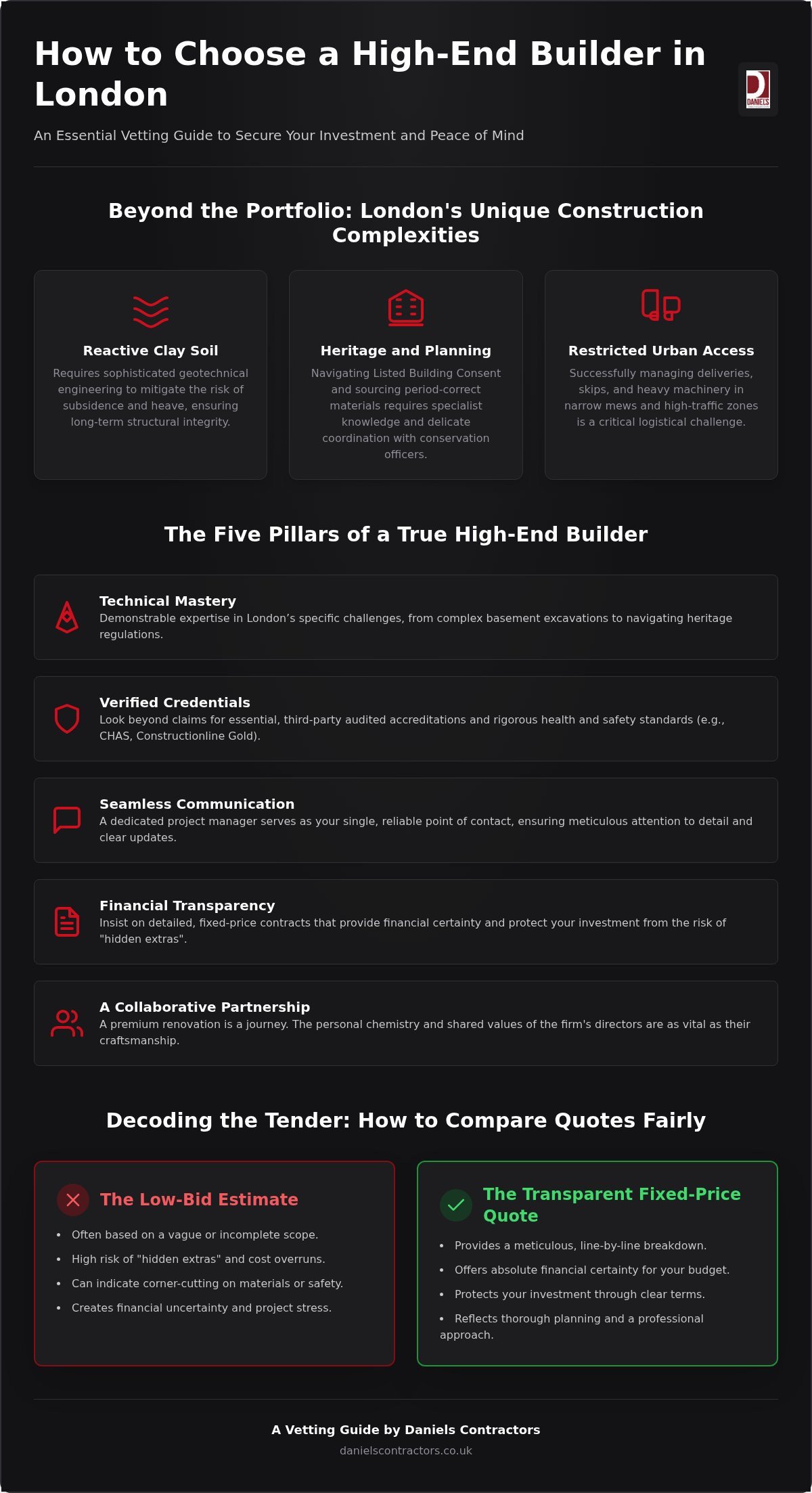
- Technical mastery over London’s specific geographical challenges, such as clay soil and restricted access, is what truly separates a high-end builder from a standard contractor.
- Master the art of how to choose a high-end builder in London by looking beyond the portfolio to verify essential technical accreditations and rigorous health and safety standards.
- Prioritise firms that provide a dedicated project manager to serve as your single point of contact, ensuring seamless communication and meticulous attention to detail throughout the build.
- Protect your investment by opting for transparent, fixed-price contracts that offer financial certainty whilst avoiding the “hidden extras” often found in low-bid estimates.
- Recognise that a premium renovation is a collaborative journey, making the personal chemistry and shared values of the firm’s directors as vital as their craftsmanship.
Beyond the Portfolio: Understanding the Complexity of London Construction
“High-end” is a term often misapplied in the construction industry. For a discerning homeowner, it represents a precise intersection of technical mastery, rigorous project management, and bespoke finishing. When researching how to choose a high-end builder in London, you must look beneath the surface of a glossy portfolio. A truly premium contractor understands that a project’s success depends on managing the invisible complexities of the capital’s unique landscape, from the logistical constraints of narrow mews access to the structural sensitivities of Victorian foundations.
London presents a dense urban environment where every millimetre counts. Navigating the Party Wall Act and securing Listed Building Consent are not mere administrative hurdles; they are critical phases that require a builder who speaks the language of surveyors and planning officers. A standard contractor might excel at a suburban extension, but they often lack the specialised infrastructure to manage the structural demands of a luxury basement conversion in London, where the risks to neighbouring properties are substantial. With the Building Safety Regulator now operating as a standalone body in 2026, the technical vetting of your builder has become a non-negotiable step in protecting your investment.
Structural Integrity in London’s Clay Soil
Excavating beneath or extending a London property requires a deep understanding of the city’s heavy clay soil. This material is notoriously reactive, expanding and contracting based on moisture levels, which necessitates sophisticated engineering and complex temporary works to support the existing structure. Premium builders employ geotechnical specialists to mitigate the risk of subsidence, ensuring the build remains stable for decades. Heave is the upward movement of the ground following the removal of weight or the increase of moisture in the soil, which can cause significant damage to foundations if not correctly managed during the design phase.
Navigating Heritage and Planning Constraints
Working on Grade II listed properties in areas like Kensington or Marylebone requires a delicate touch. High-end builders coordinate closely with conservation officers and members of the Royal Institute of British Architects to ensure that modern luxury doesn’t compromise historical integrity. This involves:
- Sourcing period-correct materials that satisfy strict planning conditions.
- Implementing discrete modern services, such as underfloor heating or air cooling, within traditional architectural frameworks.
- Managing the logistical constraints of skips and deliveries in high-traffic, narrow-access zones.
Choosing a partner who prioritises these technical nuances ensures your renovation is a seamless blend of heritage charm and contemporary performance. It’s about finding a builder who views these constraints as a framework for excellence rather than an obstacle to progress.
Essential Benchmarks: Technical Vetting and Accreditations
Accreditations in the luxury construction sector aren’t merely badges for a letterhead; they’re evidence of a firm’s internal systems and commitment to safety. Whilst many contractors claim to deliver quality, a rigorous vetting process is the only way to verify these claims. When considering how to choose a high-end builder in London, you should treat industry memberships as the baseline rather than the finish line. In 2026, with the Building Safety Regulator now operating as a standalone body, the technical competence of your builder is a matter of legal compliance as much as it is of craftsmanship.
High-end projects demand a level of health and safety rigour that standard residential work rarely touches. Look for builders with CHAS or Constructionline Gold status. These certifications prove the firm has undergone intensive third-party audits of their safety protocols and financial stability. Similarly, a professional build should follow the RIBA Plan of Work. This framework organises the project into distinct stages, from strategic definition to handover, ensuring that nothing is missed during the transition from design to delivery. It provides a shared language between you, your architect, and your contractor.
Insurance is another critical differentiator. Standard public liability insurance is often insufficient for high-value refurbishments. A premium builder will carry substantial cover, typically £10 million or more, alongside specific Contract Works insurance. This protects the existing structure of your home during complex works, such as a basement excavation or a significant structural extension, providing a level of financial security that a smaller firm simply cannot offer.
If you’re looking for peace of mind, partnering with a bespoke construction specialist who understands these technical nuances is essential.
Recognised Industry Standards
The Value of Local Experience in Surrey and Essex
The requirements for a project can shift significantly as you move from the dense urban centre of London to the Home Counties. Whilst Central London projects often hinge on heritage constraints, builds in Surrey or Essex may focus more on the UK government’s technical guidance regarding permitted development and green belt restrictions. A builder with local knowledge of specific council planning departments can anticipate potential delays before they occur. Vetting a builder’s recent projects in your neighbourhood allows you to speak with previous clients about how the firm managed local logistics and site conduct.
Assessing Professionalism: Communication and Project Management
Professionalism in the luxury construction sector is often as visible as the craftsmanship itself. It manifests in the way a site is organised, the clarity of the reporting, and the respect shown to your property. Whilst technical accreditations provide the baseline, the day-to-day management of the build determines your peace of mind. If you want to find a vetted Master Builder, you must look for a firm that prioritises communication as much as they do structural engineering. Understanding how to choose a high-end builder in London requires evaluating their project management infrastructure alongside their portfolio.
A dedicated project manager serves as your single point of contact, bridging the gap between your vision and the technical team. They provide transparency through weekly progress updates that contain detailed logs of work completed, upcoming milestones, and any adjustments to the timeline. This methodical rhythm ensures there are no surprises. It reflects a “Gentleman Builder” philosophy where respect for your home and your neighbours is paramount. High-end building in a dense city means managing noise, dust, and logistics with a level of politeness that preserves your relationships with the local community and protects your reputation in the neighbourhood.
The Role of the Site Manager
A permanent on-site presence is non-negotiable for a high-end home refurbishment in London. Unlike high-volume contractors who might visit a site once or twice a week, a dedicated site manager oversees every trade in real-time. They manage health and safety protocols and material logistics in the notoriously tight spaces of the capital. Site cleanliness is a direct indicator of the quality of the final finish; a tidy, well-organised site prevents damage to bespoke materials and fosters a culture of precision amongst the craftsmen. This constant supervision ensures that the highest standards are maintained from the structural core to the decorative surface.
Integrated Design and Technical Coordination
Premium builders act as the technical glue between various disciplines. They work seamlessly amongst architects, interior designers, and structural engineers to ensure that the vision is achievable. A builder who can accurately interpret complex technical drawings can identify potential friction points before the first brick is laid. This proactive problem-solving reduces delays and ensures that bespoke elements, such as integrated lighting or hidden HVAC systems, are installed with the necessary structural support. This level of coordination transforms a complex construction project into a steady, reassuring process that delivers on its promise of master craftsmanship.
The Tender Process: How to Compare High-End Quotes Fairly
In the London luxury market, the lowest bid is rarely the most economical choice. When you are researching how to choose a high-end builder in London, you’ll quickly find that a significantly lower tender usually indicates a lack of understanding regarding project complexity or a strategy built on future “extras”. A truly professional contractor provides a detailed Bill of Quantities, ensuring that every element of the scope is transparent and accounted for from the outset. This level of granularity is what separates a vague estimate from a robust, fixed-price contract that offers genuine financial certainty.
Comparing tenders requires a methodical approach that looks beyond the bottom-line figure. You must ensure that each builder is quoting for the same quality of materials and the same level of technical supervision. A high-end project involves sophisticated structural work and bespoke finishes that cannot be accurately priced through guesswork. If you value financial transparency and master craftsmanship, you can contact our team at Daniels Contractors to discuss your project requirements.
Vetting the Breakdown of Costs
A comprehensive quote should leave no room for ambiguity. It must include specific provisions for structural work, waterproofing systems, and high-specification finishes. Be wary of tenders that lean heavily on “provisional sums” or “PC Sums” (Prime Cost Sums) for essential items. Whilst these are necessary for items not yet selected, such as specific light fittings or stone slabs, using them for core structural elements suggests the builder hasn’t fully interrogated the architectural plans. Transparent pricing is the foundation of trust, ensuring that both parties share a clear understanding of the project’s financial landscape.
The Importance of Milestone Payments
Professional builders structure their payment schedules against verified progress rather than arbitrary dates. This protects your capital and ensures that the flow of funds mirrors the physical work completed on-site. You should avoid contractors who demand large upfront deposits; a reasonable commitment is typically limited to what is required to secure initial materials and mobilise the team. A standard high-end contract also includes a “retention” clause, where a small percentage of each payment is held back until the final snagging is completed and the defects liability period has ended. This mechanism ensures that the builder remains fully committed to the project until the very last detail is perfected.
Establishing a Partnership: Why a Bespoke Approach Matters
Selecting a contractor for a premium project is fundamentally about finding a long-term partner for your property. A high-end renovation or new build in the capital often spans many months, requiring a relationship built on mutual respect and shared values. Whilst technical skills are the prerequisite, the personal chemistry between you and the firm’s directors often dictates the daily atmosphere and eventual success of the build. Understanding how to choose a high-end builder in London involves looking for a partner who treats your vision with the same level of care and dedication as you do.
A boutique firm like Daniels Contractors, which has operated in the capital since 2001, provides a level of tailored attention that high-volume companies often struggle to replicate. This focused approach ensures that bespoke house extensions in London reflect the owner’s personality whilst meeting the most rigorous structural standards. When the directors are personally invested in the outcome, the project benefits from a “Master Craftsman” mentality that prioritises quality over speed.
Post-Completion Support and Guarantees
The mark of a truly high-end builder is their presence after the keys are handed over. A professional partnership doesn’t end at the final snagging list. You should expect a comprehensive handover pack that includes all structural warranties and insurance-backed guarantees, providing security for your investment. Premium builders often maintain a relationship with their clients for years, offering advice and support as the building settles. This commitment to longevity is a hallmark of integrity, ensuring that the bespoke finish remains as flawless in five years as it is on the day of completion.
Next Steps: Vetting Your Shortlist
Once you have narrowed down your options, a site visit to a current project is essential. This allows you to observe the “gentleman builder” persona in action. Pay close attention to how the team interacts and the cleanliness of the workspace. When speaking to previous clients, ask specific questions about how the builder managed technical challenges or communicated during the more complex phases of the build. An honest appraisal from a peer is the most valuable tool in your vetting process. If you are ready to begin your journey, you can speak to the experts at Daniels Contractors about your vision today. We are here to handle the technical complexity whilst you focus on the potential of your space.
Securing the Future of Your London Home
Building at the highest level is a technical discipline that requires a partner intimately familiar with the capital’s unique structural and heritage landscape. Success hinges on rigorous vetting, transparent fixed-price contracting, and a project management structure that prioritises clear communication over guesswork. Mastering how to choose a high-end builder in London is ultimately about finding a team that values integrity and precision as much as you do.
With over 25 years of experience in the capital, Daniels Contractors specialises in complex structural and heritage projects delivered through a reliable, fixed-price model. We handle the technical complexity and regulatory navigation, allowing you to focus on the creative potential of your space. We invite you to book a professional consultation for your London project to discuss your vision with our team of master craftsmen.
Your home is your most significant investment. Choosing the right partner ensures it’s transformed with the care, transparency, and master craftsmanship it deserves. We look forward to helping you bring your vision to life.
Frequently Asked Questions
What is the difference between a general builder and a high-end contractor?
A high-end contractor is distinguished by their ability to manage technical risk and deliver bespoke finishes through a dedicated project management structure. Whilst a general builder may handle standard extensions, they often lack the specialised infrastructure required for the capital’s complex heritage and structural demands. Understanding how to choose a high-end builder in London means looking for a firm that prioritises meticulous site organisation and transparent reporting over high-volume project turnover.
How much should a detailed tender for a London refurbishment cost?
Preparing a detailed tender for a luxury project is a rigorous process that involves a comprehensive Bill of Quantities and subcontractor vetting. Most premium firms view this as a professional service that ensures budget accuracy and prevents future cost overruns. Whilst fees for tender preparation vary depending on the project’s scale and engineering requirements, this investment provides the financial clarity and structural certainty needed for a successful high-end renovation.
What accreditations should I look for in a luxury London builder?
You should look for builders who hold CHAS Gold or Constructionline accreditation, as these prove a commitment to health and safety and financial stability. Membership in the Federation of Master Builders (FMB) is also a vital benchmark for quality. These certifications ensure the firm has undergone independent audits, providing you with peace of mind that your project is in the hands of a verified professional who adheres to the highest industry standards.
Can a builder help with the planning permission process in London?
Many high-end builders offer integrated design services or work closely with architects to navigate the complexities of London’s planning departments. They provide technical insights that ensure your vision is both achievable and compliant with local regulations, including those for Grade II listed properties. This proactive coordination reduces friction with conservation officers and helps to streamline the approval process for extensions, loft conversions, or structural refurbishments.
How do I know if a builder is experienced in basement excavations?
Verify their experience by requesting a portfolio of completed subterranean projects and asking about their approach to waterproofing and temporary works. A specialist will be comfortable discussing the nuances of London’s clay soil and the specific engineering required for safe excavation. It’s also wise to speak with past clients whose basements were completed several years ago to ensure the structural integrity and waterproofing systems have stood the test of time.
What are the red flags to watch out for during the initial consultation?
Red flags include a lack of specific insurance documentation, a reluctance to provide a fixed-price contract, and the absence of a dedicated project manager. If a builder provides a vague quote without a Bill of Quantities or suggests starting work before structural drawings are finalised, it indicates a lack of professional rigour. A premium contractor will always prioritise transparency and technical preparation over a rushed start date.
Is a fixed-price contract better for a large-scale renovation?
A fixed-price contract is generally superior for large-scale renovations as it offers the most financial protection and certainty. It requires a detailed and finalised scope of work before the project begins, which prevents the “hidden extras” that often plague estimate-based builds. This model aligns the interests of both parties, ensuring the builder is committed to efficiency whilst the client enjoys peace of mind regarding the final investment.
How do high-end builders manage noise and disruption for neighbours?
High-end builders manage disruption through a “gentleman builder” approach that includes acoustic shielding and strict adherence to local council working hours. They maintain proactive communication with neighbours, providing them with a direct point of contact for any concerns. By keeping the site clean and managing logistics with precision, a professional team ensures that your project proceeds smoothly without damaging local relationships or your reputation in the neighbourhood.