
True luxury is a structural discipline rather than a mere aesthetic layer; the most devastating high-end renovation mistakes London has to offer often occur long before the first marble slab is laid. You likely understand that transforming a period property in Mayfair or a townhouse in Kensington requires more than just a vision for beautiful interiors. It demands a meticulous respect for the building’s history and a firm grasp of the capital’s unique architectural challenges. It’s natural to feel a sense of trepidation regarding the complexities of London clay soil or the strict requirements of conservation area planning.
We’ve seen how easily a project can falter when structural integrity is overlooked or when planning applications aren’t handled with the necessary precision. In 2026, the stakes for luxury refurbishments are higher than ever, yet this guide will show you how to navigate these complexities whilst protecting your investment and ensuring your home’s architectural soul remains intact. We’ll explore the critical steps to achieving a bespoke, high-quality finish that increases your property’s value. You’ll learn how to manage your project with confidence, from securing planning permission in sensitive zones to choosing partners who value craftsmanship as much as you do.
Key Takeaways
- Understand the critical importance of professional soil analysis and Party Wall agreements to prevent structural failures in London’s challenging clay conditions.
- Learn how to avoid high-end renovation mistakes London projects often face by balancing bespoke aesthetic finishes with robust, high-quality core infrastructure.
- Discover how to account for specific London logistical challenges, such as parking and delivery restrictions, to maintain a realistic and transparent budget.
- Identify why the “lowest bid” strategy often compromises architectural integrity and how a fixed-price contract offers genuine financial security.
- Gain insights into why early-stage planning of electrical and plumbing layouts is essential for the seamless integration of bespoke joinery and luxury finishes.
The Landscape of High-End Renovation Mistakes in London
A high-end renovation in the capital is far more than a simple aesthetic upgrade; it is a sophisticated fusion of architectural integrity and bespoke modernisation. In a city where historic charm meets cutting-edge design, the standard for due diligence is exceptionally high. Many high-end renovation mistakes london homeowners make stem from treating a luxury project as a purely cosmetic exercise. Whilst a fresh palette and new flooring can transform a room, a true high-end refurbishment often involves significant structural alterations that require a deep understanding of the building’s original skeleton.
As we move through 2026, the defining trend in the London market is the seamless integration of smart home technology without compromising period features. Achieving this balance is a delicate task. It requires hiding complex wiring and hardware behind ornate cornicing or beneath original floorboards, a process that demands meticulous planning. Failing to integrate these systems early in the design phase can lead to intrusive retrofitting, which inevitably damages the very character you are trying to preserve.
Why the ‘London Premium’ Requires Expert Oversight
The density of London’s residential streets, particularly in areas like Kensington or Marylebone, creates a unique set of logistical hurdles. Managing a project amongst tightly packed terraces requires a sophisticated approach to site organisation and waste removal. Without expert oversight, these logistical pressures can quickly spiral into costly delays. Equally, working within conservation areas means navigating strict borough guidelines that dictate everything from window materials to roof profiles. There is also a significant risk of devaluing a property by choosing “cheap” luxury finishes that don’t align with the building’s heritage; true value is created through authenticity and craftsmanship, not just a high price tag.
The Cost of Cutting Corners on Professional Fees
Attempting to save on professional fees is a common false economy that frequently leads to the most expensive high-end renovation mistakes london projects face. Skipping the appointment of a dedicated structural engineer or a party wall surveyor can result in catastrophic delays or legal disputes with neighbours. Adhering to UK building regulations is a non-negotiable aspect of any refurbishment, and professional consultants ensure your project meets these standards without compromising the design vision. A main contractor acts as the vital link, coordinating specialised trades to ensure that bespoke elements are executed with precision. A bespoke refurbishment is a tailored solution for unique London floorplans, ensuring that modern functionality is woven into the existing fabric of the home with absolute care.
Structural and Regulatory Pitfalls in Prime London Postcodes
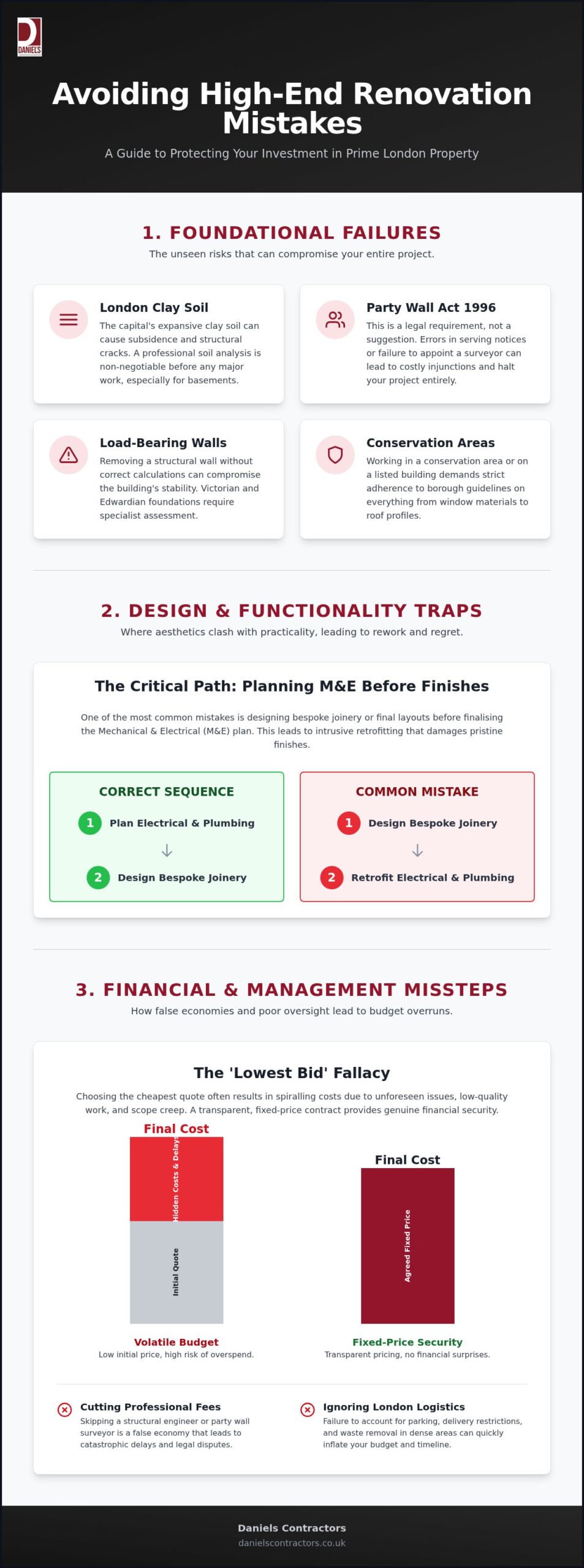
London’s geology is a silent partner in every project. The heavy clay soil characteristic of the capital expands and contracts with the seasons, which is a critical consideration during a luxury basement conversion London homeowners often overlook. Failing to conduct a thorough soil analysis or ignoring the specific drainage needs of clay is one of the most frequent high-end renovation mistakes london developers encounter. Precision is paramount here. Without it, you risk subsidence and cracked masonry that can take years to rectify, potentially devaluing your investment before the project even concludes.
Navigating the Party Wall Act 1996 is another area where projects often stumble. It isn’t just a legal formality; it’s a framework for protecting your property and your neighbours’ rights. Errors in serving notices or failing to appoint a qualified surveyor can lead to costly injunctions that halt work entirely. Similarly, don’t ignore official government guidance regarding internal load-bearing walls. Removing a wall without the correct structural calculations can compromise the building’s stability. Victorian and Edwardian foundations were not designed for modern subterranean loads or open-plan layouts, so damp-proofing must be addressed with specialist knowledge to prevent moisture from rising into your newly finished spaces.
Listed Buildings and Conservation Area Constraints
Grade II listings require a gentle, expert touch. Unauthorised changes to these properties can lead to criminal prosecution, making it vital to work within the specific consents granted by the local council. You should always prioritise authentic heritage materials, such as lime mortar and reclaimed brick, to maintain the building’s historical narrative. This commitment to integrity is essential for sash windows repair, where you must balance modern thermal requirements with the preservation of the original timber profiles. If you’re unsure about the status of your property, consulting a professional London contractor early can help clarify the necessary permissions.
Basement Excavation: A High-Risk, High-Reward Zone
Subterranean works offer incredible potential for space, but they are high-risk zones. “Cowboy” excavation techniques often result in structural failure for both your home and adjacent properties. Clay is unforgiving. A comprehensive ‘Method of Works’ is non-negotiable, detailing exactly how the structure will be supported at every stage. To ensure a dry, habitable environment, you must implement a multi-layered waterproofing strategy. This involves combining Type A barrier protection, Type B integral protection, and Type C drained cavity systems. Cutting corners on these systems is a mistake that leads to catastrophic flooding later.
Design vs. Functionality: The Aesthetic Trap
It’s easy to get swept away by the allure of a Pinterest board or a glossy magazine spread, but many high-end renovation mistakes london homeowners fall into involve choosing “Instagram-ready” finishes at the expense of core infrastructure. A beautiful room loses its charm quickly if it’s drafty, poorly lit, or acoustically hollow. True luxury is felt as much as it’s seen. This means investing in “invisible luxury” such as advanced HVAC systems, high-performance acoustic insulation, and efficient underfloor heating before selecting your marble or silk wallpapers. These elements form the backbone of a comfortable home, yet they’re often the first to be sacrificed when budgets tighten.
The Importance of a Cohesive Design Language
A common pitfall is the “mismatch” error, where a modern extension feels like a jarring addition rather than a natural evolution of the property. When planning bespoke house extensions London residents often find that the most successful projects are those that enhance natural light and flow through the entire floorplan. Using materials that age gracefully, such as natural stone and solid hardwoods, ensures that the new and old sections of the house eventually speak the same language. This approach creates a sense of permanence and quality that “fast-fashion” interiors simply cannot replicate.
Lighting and Electrical: The Afterthought Error
Architectural lighting design shouldn’t be a final flourish; it must be finalised before the first-fix electrics begin. High-end kitchen refurbishments often suffer from inadequate socket placement or poorly positioned task lighting, which can’t be easily fixed once the splashbacks are in place. If you’re integrating smart home hubs like Lutron or Control4, these systems need to be woven into the structural fabric of the building from the start. This ensures that the technology remains discreet and functional, providing effortless control over your environment without cluttered panels or visible wiring.
Financial and Project Management Missteps
Budgeting for a capital project requires a granular understanding of the “London Premium” that extends far beyond bricks and mortar. One of the most overlooked high-end renovation mistakes london homeowners make is failing to account for the sheer logistical friction of the city. Parking permits for trade vehicles, skip licences, and the strict delivery windows imposed by many boroughs can add significant sums to a project’s bottom line. If these aren’t factored into the initial feasibility study, they become “invisible” costs that erode your contingency before the first wall is even stripped.
The “Lowest Bid” trap is another frequent pitfall. In a competitive market, it’s tempting to opt for the most aggressive quote. However, an artificially low price often masks a lack of detail in the scope of works, leading to a cascade of expensive variations once the build is underway. True value lies in transparency. A comprehensive, realistic quote might look more daunting at first, but it protects you from the stress of constant “add-ons.” Similarly, procurement timing is vital. If you’ve specified book-matched Italian marble or precision-engineered German glazing, these long-lead items must be ordered months in advance. A delay in procurement ripples through the entire schedule, leaving trades idle whilst you wait for materials to clear customs.
For London refurbishments, a contingency fund of 15-20% is the gold standard. This isn’t a sign of poor planning; it’s a realistic buffer for the hidden complexities of period properties. From outdated wiring to structural surprises in Victorian foundations, having a robust financial cushion ensures the quality of the finish isn’t compromised when the unexpected occurs. To ensure your project remains on track and within budget, it’s vital to partner with an experienced London contractor who understands these local nuances.
The RIBA Plan of Work: A Framework for Success
Managing a luxury build without a structured framework is a recipe for chaos. We follow a methodical approach that mirrors the RIBA Plan of Work, which is the definitive benchmark for managing luxury construction projects. This journey moves through clearly defined stages from “Concept” to “Handover,” ensuring every detail is captured before construction begins. In a volatile material market, fixed-price contracts offer essential peace of mind. They lock in costs and protect your investment, allowing you to enjoy the transformation of your home without the anxiety of fluctuating prices.
Communication Failures and the ‘Absent Architect’ Syndrome
The success of a bespoke refurbishment hinges on the quality of communication between the client, the architect, and the contractor. Regular site meetings and transparent reporting are non-negotiable. Without them, you risk the “Chinese Whispers” effect, where design intent is lost in translation between different trades. A dedicated project manager acts as your single point of contact, ensuring that the master vision is executed with absolute precision. We utilise digital tools for real-time budget and timeline tracking, providing you with a clear, honest view of your project’s progress at every stage.
The Daniels Contractors Approach: Precision and Partnership
With a legacy spanning 25 years, Daniels Contractors has established itself as a Master Craftsman within the capital’s most exclusive postcodes. Since our founding in 2001, we’ve remained dedicated to a philosophy of quiet confidence and technical excellence. We understand that avoiding high-end renovation mistakes london homeowners frequently face requires more than just a skilled workforce; it demands a partner who treats your investment with the same care as their own. Our experience allows us to foresee the structural and logistical hurdles discussed in previous sections, ensuring they’re mitigated before a single brick is moved.
Our commitment to your peace of mind is reflected in our “Zero Compromise” policy. We never cut corners on structural safety or material quality, as we know that the integrity of a luxury home is found in the details that aren’t always visible. By specialising in high-end home refurbishment London projects, we provide transparent, fixed-price quotes that eliminate the “lowest bid” trap. This approach ensures that your vision is delivered without the stress of unexpected financial variations or compromised craftsmanship. We work in close collaboration with architects, interior designers, and surveyors to ensure every bespoke element is perfectly integrated into the build.
A Portfolio of Excellence Across London and Surrey
Our expertise extends across the most prestigious areas of London, Surrey, and Essex. We’ve developed a deep understanding of heritage properties, from Victorian terraces to expansive country estates, allowing us to navigate the complexities of conservation area regulations with ease. Whether you’re inquiring about loft conversion cost London for a bespoke attic transformation or planning a complex subterranean build, our local knowledge is an invaluable asset. We invite you to view our gallery of luxury developments and bespoke extensions to see how we blend period charm with contemporary functionality.
Your Next Steps: Securing a Professional Consultation
Preparing for a high-end renovation is a significant undertaking, and we’re here to guide you through every stage. By identifying and addressing high-end renovation mistakes london projects often encounter early on, we ensure a seamless transition from concept to completion. Our pre-construction services and feasibility studies provide the clarity needed to protect your investment from the start. During an initial site visit with our senior team, we’ll discuss your aspirations and the practicalities of your unique floorplan. It’s an opportunity to experience our “gentleman builder” approach firsthand and see how we can transform your space with precision. Contact Daniels Contractors to discuss your high-end London renovation today.
Securing Your Property’s Future with Professional Precision
Transforming a prime London residence is an exercise in balancing heritage with modern performance. You’ve seen how the most common high-end renovation mistakes london homeowners face often stem from a lack of structural foresight or a misunderstanding of the capital’s unique regulatory environment. By prioritising core infrastructure and navigating the complexities of the Party Wall Act with expert guidance, you protect both your investment and the architectural soul of your home. A successful project isn’t just about the final reveal; it’s about the transparency of the process and the integrity of the build beneath the surface.
With 25 years of London expertise, Daniels Contractors provides the steady hand required for such ambitious transformations. We specialise in listed and period properties, ensuring that every modernisation respects the building’s history whilst delivering contemporary luxury. Our fixed-price contracts offer the financial certainty you need in a fluctuating market, allowing you to focus on the creative journey rather than budgetary surprises. It’s time to turn your vision into a lasting reality with a partner you can trust. Book a Professional Consultation for Your London Renovation and take the first step towards a bespoke, stress-free home transformation.
Frequently Asked Questions
What is the most expensive mistake in a London high-end renovation?
Neglecting structural due diligence is often the most costly error. Many high-end renovation mistakes london homeowners encounter involve rushing into aesthetics before securing the building’s core. If you skip a detailed soil analysis or structural survey, you risk remedial works that can cost significantly more later. It’s far more efficient to invest in a robust structural design phase than to fix subsidence or cracked masonry once the luxury finishes are already in place.
How do I ensure my basement conversion doesn’t damage my neighbour’s property?
You ensure safety by appointing an experienced structural engineer and adhering strictly to the Party Wall Act 1996. A comprehensive “Method of Works” must be shared with neighbours to detail how the excavation will be supported. This transparency builds trust and prevents legal injunctions. Specialist monitoring equipment should also be used to detect any minute movements in the neighbouring foundations during the subterranean phase, allowing for immediate adjustments if required.
Can I carry out a high-end refurbishment under Permitted Development rights?
Whilst Permitted Development (PD) rights allow for some extensions and loft conversions, they’re often restricted in London’s many conservation areas. If your property is Grade II listed, PD rights don’t apply at all, and you’ll require Listed Building Consent for almost any change. It’s essential to obtain a Lawful Development Certificate even for PD works to provide legal certainty for future sales and ensure your project complies with local constraints.
Why do London renovations often go over budget?
Budgets often expand due to “London Logistics” and the hidden complexities of period architecture. Parking permits, skip licences, and restricted delivery hours in boroughs like Westminster add significant overheads. Additionally, opening up Victorian or Georgian walls frequently reveals outdated wiring or structural decay that wasn’t visible during the initial survey. We recommend a 15-20% contingency fund to manage these high-end renovation mistakes london projects often face without compromising on quality.
How do I choose the right contractor for a listed building in London?
Prioritise contractors with a proven 20-year plus legacy in heritage restoration and listed building works. You should ask for case studies involving Grade II properties where they’ve successfully integrated modern services whilst preserving original features like lath and plaster or ornate cornicing. A “gentleman builder” approach is vital here; you need a partner who values clear communication and respects the delicate fabric of a historic London home.
What are the current lead times for luxury materials in 2026?
In 2026, lead times for high-end materials remain extended, with bespoke German glazing and Italian stone often requiring 16 to 24 weeks from order to delivery. Precision-engineered smart home components can also face delays. To avoid project stagnation, these items must be procured during the early design stages. Your contractor should manage this timeline meticulously to ensure that long-lead materials arrive exactly when the site is ready for installation.
Is a fixed-price contract better for a luxury home renovation?
A fixed-price contract is highly beneficial for luxury refurbishments as it provides essential financial security in a volatile market. It locks in the construction costs based on a detailed scope of works, protecting you from price hikes in raw materials like timber or steel. This arrangement demands thorough pre-construction planning, but it ultimately results in a more transparent relationship between the client and the contractor, ensuring no hidden surprises during the build.
What structural risks should I look for in a Victorian terrace refurbishment?
Victorian terraces are particularly susceptible to settlement issues caused by London’s expansive clay soil. You should also check for “rising damp” and timber decay in floor joists, which are common in properties over a century old. If internal walls have been removed in the past without proper steel supports, the building may have structural instabilities. A thorough survey by a specialist familiar with London’s historic housing stock is non-negotiable before starting works.