
Most London homeowners believe a detailed architectural estimate is a reliable financial roadmap; in reality, it’s often just a starting point that ignores the granular complexities of a live site. Successfully controlling house extension budget london requirements in 2026 demands more than just a spreadsheet. It requires a deep understanding of structural variables and statutory costs that a simple drawing cannot capture. You’ve likely felt the anxiety of watching material prices fluctuate or feared the hidden extras that often surface once the first brick is laid.
It’s a common frustration to see a project’s vision compromised by unpredictable cost increases during the build phase. This guide provides the clarity you need, offering a professional framework for financial precision through the use of fixed-price contracts and milestone-based transparency. We’ll examine the 2026 statutory landscape, from the latest planning application fees to current VAT regulations, ensuring you can select a contractor with absolute confidence. By bridging the gap between architectural estimates and real-world construction quotes, you can achieve a luxury home addition delivered with complete peace of mind.
Key Takeaways
- Understand how the 2026 London market impacts logistics and site constraints to establish a realistic baseline for your luxury project.
- Distinguish between critical structural investments and visible aesthetic finishes to ensure your budget is allocated with maximum impact.
- Discover why a fixed-price contract is the ultimate mechanism for controlling house extension budget london expectations and eliminating mid-project financial stress.
- Learn how involving a contractor during the design phase identifies structural complexities before they escalate into costly site delays.
- Recognise the long-term value of bespoke craftsmanship, where precision in the initial build reduces the lifetime maintenance costs of your home.
The Financial Landscape of London House Extensions in 2026
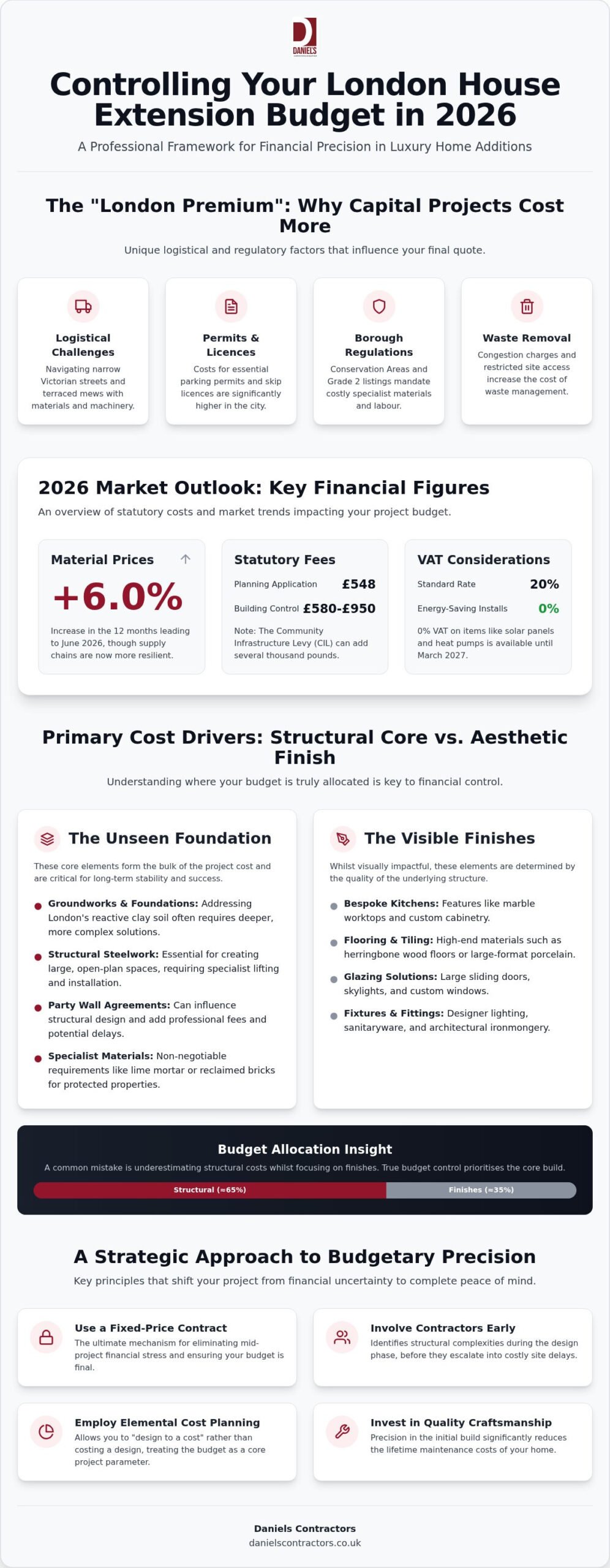
As of August 2026, the construction market has moved away from the extreme volatility of previous years. Data from the Department for Business and Trade indicates that whilst material prices rose by 6.0% in the 12 months leading to June 2026, supply chains have become more resilient. This stability allows for more precise financial forecasting. By utilising the principles of Elemental Cost Planning, homeowners can now design to a specific cost rather than hoping the design fits the budget later. This approach treats your project as a bespoke investment, where the choice between a “shell only” build and a “turnkey luxury finish” is a strategic decision rather than a surprise.
Why London Boroughs Require a Tailored Budget
The borough you live in dictates more than just your council tax. If your property is within a Conservation Area or holds a Grade 2 listing, your budget must accommodate specialist materials like lime mortar or reclaimed London stock bricks. These requirements are non-negotiable and often come with higher price tags for both materials and the specialist labour needed to install them. Logistical costs also vary; waste removal in central London is significantly more expensive than in the suburbs due to congestion charges and restricted site access. Understanding your permitted development rights early can help you avoid the £548 statutory fee for a full planning application, offering a small but helpful efficiency in the early stages of your build.
The Role of VAT and Statutory Fees
VAT is a major factor in any financial plan, usually adding a standard 20% to your construction costs. However, there are nuances to consider. For instance, certain energy-saving installations like solar panels or heat pumps currently qualify for 0% VAT until March 2027, which can offset some of the premium costs of high-end finishes. Beyond taxes, you must budget for statutory fees. A householder planning application in England currently costs £548, whilst building control fees for a single-storey extension typically range from £580 to £950. The Community Infrastructure Levy (CIL) is a non-negotiable charge imposed by London boroughs on new floor space to fund local infrastructure, often adding several thousand pounds to a project’s bottom line depending on the scale of your extension.
Identifying the Primary Cost Drivers for Bespoke Extensions
Structural Complexity: Below Ground and Behind Walls
The ground beneath your feet dictates the first major expense of any extension. London clay soil is notoriously reactive, often necessitating deeper foundations or specialised underpinning to ensure long-term stability. For those envisioning the expansive, open-plan layouts typical of bespoke house extensions London, structural steelwork becomes a significant cost centre. A single recessed beam designed to create a seamless ceiling can require complex lifting equipment, particularly in terraced properties with restricted rear access. Furthermore, Party Wall Agreements can influence structural design; if a neighbour’s foundation depth is shallow, your own structural plans may require adjustment to mitigate risk, adding both professional fees and construction costs to the bottom line.
High-End Finishes and Material Curation
Once the shell is secure, the focus shifts to the elements you touch and see. Glazing is perhaps the most variable cost driver in modern extensions. High-performance, slimline aluminium frames offer a sophisticated aesthetic but require a larger initial outlay than standard uPVC or timber alternatives. This is a strategic choice; according to a House of Commons Library briefing on housing standards, the UK continues to prioritise energy efficiency, making high-spec thermal glazing a sensible long-term investment. Similarly, bespoke joinery allows for a level of precision and space optimisation that off-the-shelf solutions cannot match. Integrating smart home technology and advanced HVAC systems at this stage is also critical. Retrofitting these systems later is invariably more expensive, so including them in the initial material curation prevents mid-project budget inflation.
Professional site management acts as the glue that holds these disparate elements together. Without a dedicated lead to coordinate deliveries and specialist trades, a two-week delay in glazing can stall the entire interior fit-out, leading to mounting labour costs. For those seeking a seamless transition from vision to reality, engaging with bespoke construction expertise ensures that every cost driver is identified and managed with professional rigour.
Estimates vs. Fixed-Price Contracts: Mitigating Financial Risk
An architectural estimate is a valuable vision, but it isn’t a financial guarantee. Whilst an architect provides a high-level benchmark based on square-metre rates, a contractor’s quote is a commitment based on real-world labour and material costs. True precision in controlling house extension budget london requirements only arrives when that vision is translated into a detailed, commitment-backed quote. This distinction is the difference between a project that feels like a gamble and one that proceeds with methodical certainty.
The most effective tool for homeowner peace of mind is the fixed-price contract. Unlike an estimate, which can drift as the build progresses, a fixed-price agreement locks in the cost for a specific scope of works. This structure shifts the risk of material price fluctuations or logistical delays away from the homeowner. To ensure accountability, these contracts should be paired with milestone-based payments. By linking financial outlays to tangible progress on-site, such as the completion of foundations or the building reaching a watertight stage, you maintain a steady project momentum and ensure your capital is always backed by physical results.
Homeowners often ask if the price will change once work begins. In a professional partnership, the answer should be “only if you choose to change the plan.” A fixed price remains fixed for the agreed design. If unforeseen structural issues arise, a transparent contractor will present these immediately, but the majority of price movements usually stem from late-stage design changes or “provisional sums” that weren’t finalised during the tender stage.
The Security of a Fixed-Price Agreement
A comprehensive fixed-price contract should leave nothing to chance. It must include detailed specifications for everything from structural steel to the final coat of paint. By finalising these choices early, you eliminate the “provisional sums” that often act as placeholders for undecided items. A clear Scope of Works document is essential here; it acts as the definitive record of what is included, preventing disputes and ensuring both parties share the same expectations for the quality of the finish.
Managing Variations and Contingency Funds
Even with the most meticulous planning, a 10-15% contingency fund remains essential. This isn’t a sign of poor budgeting; it’s a pragmatic safeguard against the unique structural surprises London’s older housing stock can hide behind its walls. Client-led variations, such as upgrading a kitchen specification mid-build, are the most common reason for budget expansion. A “gentleman builder” approach prioritises transparent variation reporting, ensuring every adjustment is documented and agreed before the work proceeds. This methodical way of working keeps you in total control of the final balance, even when your vision evolves during the construction process.
Strategic Budget Management: From Planning to Practical Completion
Strategic budget management is a proactive discipline that begins long before the first spade hits the ground. It’s a common misconception that cost control is something that happens during the build; in reality, the most significant financial decisions are made during the pre-construction phase. Controlling house extension budget london projects effectively involves a chronological roadmap that moves from high-level vision to granular procurement. This methodical progression ensures that your capital is allocated to areas that provide the greatest return on investment, both in terms of property value and daily enjoyment.
Early contractor involvement (ECI) is perhaps the most undervalued tool in a homeowner’s arsenal. By bringing a builder’s perspective into the design phase, you can identify structural complexities that an architect might overlook. This collaboration allows for the procurement of long-lead items, such as bespoke glazing or specialist timber, well in advance. Securing these materials early protects your budget from inflationary price hikes and ensures that site progress isn’t stalled by supply chain delays. When you balance “must-haves” like structural integrity with “nice-to-haves” like premium ironmongery at the design stage, you create a project that is both aspirational and financially grounded.
The Pre-Construction Phase: Locking in Value
Precision starts with data. Conducting thorough site surveys, including drainage and soil analysis, identifies structural risks before they become expensive mid-build surprises. This level of detail is equally important for adjacent projects; for instance, refining your loft conversion cost london early by deciding between a mansard or dormer style ensures the structural load is accounted for in the extension’s foundations. Finalising internal layouts at this stage is also critical. Deciding the exact position of kitchen islands or bathroom suites prevents late-stage plumbing or electrical changes, which are notoriously costly once the walls are closed. These early decisions lock in value and provide a clear mandate for the construction team.
On-Site Efficiency and Professional Conduct
Once construction begins, the focus shifts to operational discipline. A tidy, well-organised site is more than just a matter of professional pride; it’s a direct reflection of a well-managed budget. When materials are stored correctly and waste is removed systematically, labour waste is minimised. The Project Manager plays a pivotal role here, synchronising trades so that electricians aren’t tripping over tilers. Regular financial reporting keeps the narrative transparent, ensuring you’re informed of every pound spent against the agreed milestones. This steady flow of information builds trust and ensures the project remains on its intended financial path. For a partner who prioritises this level of detail, contact our specialist team to discuss your project’s feasibility.
The Daniels Contractors Approach to Budgetary Precision
Establishing a legacy of excellence since 2001, Daniels Contractors has redefined the standard for high-end home refurbishment London. We believe that true luxury is found in the integrity of the work, where every structural detail is executed with meticulous care. For our clients, controlling house extension budget london requirements isn’t just about the initial quote; it’s about investing in a build that stands the test of time without requiring corrective maintenance. Our “Master Craftsman” approach ensures that quality is woven into every phase of the project, from the first structural beam to the final bespoke finish.
Our commitment to polite professionalism and transparent project management sets us apart in a crowded market. We understand that a home extension is a deeply personal journey, so we prioritise clear, respectful communication throughout. This “gentleman builder” ethos ensures that you’re never left in the dark regarding site progress or financial milestones. We invite you to view our portfolio of luxury developments across the capital, which showcases our ability to deliver complex projects with quiet confidence and unwavering precision.
Bespoke Solutions for Discerning Homeowners
Every London borough presents its own structural narrative. We tailor our construction methods to address specific local challenges, such as the reactive nature of London clay or the complexities of building adjacent to Grade 2 listed structures. Our collaborative approach involves working closely with architects and surveyors to ensure technical excellence at every turn. The “Daniels Guarantee” is our promise of precision and integrity, ensuring a seamless execution that respects both your vision and your financial boundaries.
Starting Your Journey with Confidence
Engaging with us for a comprehensive project quote is the first step towards a stress-free transformation. Our clients value the peace of mind that our fixed-price contracts provide, as this is the most reliable method for controlling house extension budget london expectations. We take the time to understand the nuances of your project, providing a quote that is as detailed as it is dependable. If you are ready to master the complexities of your next build, Enquire about your bespoke London extension today and experience construction delivered with professional rigour.
Achieving Architectural Excellence with Financial Precision
Mastering your home transformation requires a shift from passive estimation to active financial management. By prioritising fixed-price contracts and addressing the capital’s unique subterranean challenges early in the design phase, you ensure that your capital is invested in quality rather than consumed by unforeseen delays. Successfully controlling house extension budget london expectations is entirely possible when you pair a clear vision with a methodical construction partner who values transparency as much as craftsmanship.
At Daniels Contractors, we’ve been delivering luxury London renovations since 2001. As specialists in bespoke, fixed-price contracts, we provide the grounded reliability needed to navigate complex structural works and the reactive nature of London clay. Our approach combines technical expertise with a commitment to polite professionalism, ensuring your project is a seamless experience from planning to practical completion. We take pride in our ability to solve structural puzzles whilst maintaining the highest standards of finish.
Your home deserves a legacy of quality that lasts for generations. Discuss your high-end London extension with our master builders today and take the first step toward a beautifully executed, stress-free addition. We look forward to helping you realise the full potential of your space with absolute financial confidence.
Frequently Asked Questions
How much does a house extension cost per square metre in London in 2026?
High-end London extensions in 2026 typically range from £3,000 to £5,000 per square metre for architect-designed projects. Premium builds in central boroughs can exceed £6,000 per square metre due to complex site constraints. These figures reflect the “London Premium,” including higher labour rates and specialist logistics. When controlling house extension budget london requirements, remember these rates usually exclude the 20% VAT and professional fees for structural engineers.
Can I avoid a full planning application for my London extension?
You can often avoid a full planning application by utilising Permitted Development rights, provided your extension meets specific size and height criteria. For instance, single-storey rear extensions are generally limited to 3 metres for terraced houses and 4 metres for detached homes. Applying for a Lawful Development Certificate, which costs £264, is a recommended way to confirm your project is legal without the £548 full planning fee.
What is a fixed-price construction contract and why is it beneficial?
A fixed-price contract is a legally binding agreement where the contractor commits to completing a specific scope of works for a set sum. It’s beneficial because it transfers the risk of material price fluctuations and labour delays to the builder. This provides homeowners with total financial certainty, ensuring the final bill aligns with the initial quote, provided the design and material specifications remain unchanged throughout the build.
How long does a typical house extension take to build in London?
A standard single-storey extension in London typically takes between 12 and 20 weeks to complete on-site. Larger, more complex projects involving basement work or multiple storeys can extend to 6 months or more. This timeline accounts for structural work, reaching a watertight stage, and the final internal fit-out. Professional project management is essential to synchronise trades and prevent the delays that often lead to budget overruns.
What are the hidden costs of extending a Victorian terrace house?
Is it cheaper to extend a house or move to a larger property in London?
Extending is often more cost-effective than moving in London once you factor in Stamp Duty, estate agent fees, and legal costs. A high-end extension not only adds immediate living space but also increases the long-term capital value of your home. By staying and renovating, you avoid the significant transaction costs of the London market and can tailor the space to your exact bespoke requirements.
How do I manage Party Wall Agreements without blowing my budget?
You can manage Party Wall costs by serving notice to your neighbours as early as possible to seek their consent. If they agree to a shared “Agreed Surveyor” rather than appointing their own, you can significantly reduce professional fees. A detailed “Schedule of Condition” taken before work starts protects you from unfounded damage claims, keeping your legal and structural budget on track during the construction phase.
What contingency fund should I set aside for a luxury renovation?
For a luxury renovation, you should set aside a contingency fund of 10% to 15% of the total construction cost. Whilst a fixed-price contract provides security, this reserve covers client-led design changes or genuine structural surprises often found in older properties. Having this buffer in place ensures that you can complete the project to a high-end standard without the stress of mid-build financial pressure or compromised finishes.