
Owning a piece of London’s architectural history is a rare privilege, yet the financial reality of maintaining that legacy often feels like a moving target. Understanding the listed building refurbishment cost London homeowners face in 2026 requires looking beyond simple square footage to the meticulous craftsmanship required for Grade II preservation. You likely recognise that heritage projects come with a unique set of pressures, from the significant cost premiums over standard renovations to the constant fear of legal complications for unapproved works.
We believe that restoring a historic home should be a journey of passion, not a series of expensive surprises. This guide provides the transparent breakdown you need to plan your investment with absolute precision. We’ll examine the latest 2026 benchmarks for specialist labour and materials, whilst detailing the legal framework and professional fees essential for a compliant, high-spec restoration. By the end, you’ll have a clear roadmap to achieving a beautifully restored residence that honours its past whilst securing its future value.
Key Takeaways
- Understand the 2026 financial benchmarks and why the listed building refurbishment cost London homeowners face includes a significant heritage premium of up to 40%.
- Navigate the complexities of the planning process with a clear 5-stage roadmap for securing essential Listed Building Consent in London’s conservation areas.
- Discover the value of specialist craftsmanship and “like-for-like” materials in preserving the structural integrity and historical aesthetic of period facades.
- Learn how transparent project management eliminates the risk of hidden costs and ensures your restoration stays on schedule and within budget.
Understanding the Scope of Listed Building Refurbishment in London
Owning a heritage property in the capital is a mark of distinction. It connects you to London’s rich architectural narrative, yet this privilege comes with significant responsibility. Before you can accurately project the listed building refurbishment cost London projects require, you have to grasp the legal and structural boundaries set by Historic England and your local council. Understanding What is a listed building? is the first step in ensuring your investment is both protected and compliant.
Grade I vs Grade II: What it Means for Your Project
Buildings are categorised based on their historic or architectural significance. These grades dictate the level of scrutiny your refurbishment will face from planning authorities. Whilst the listed building refurbishment cost London owners face is often higher than standard builds, the result is a home of enduring value.
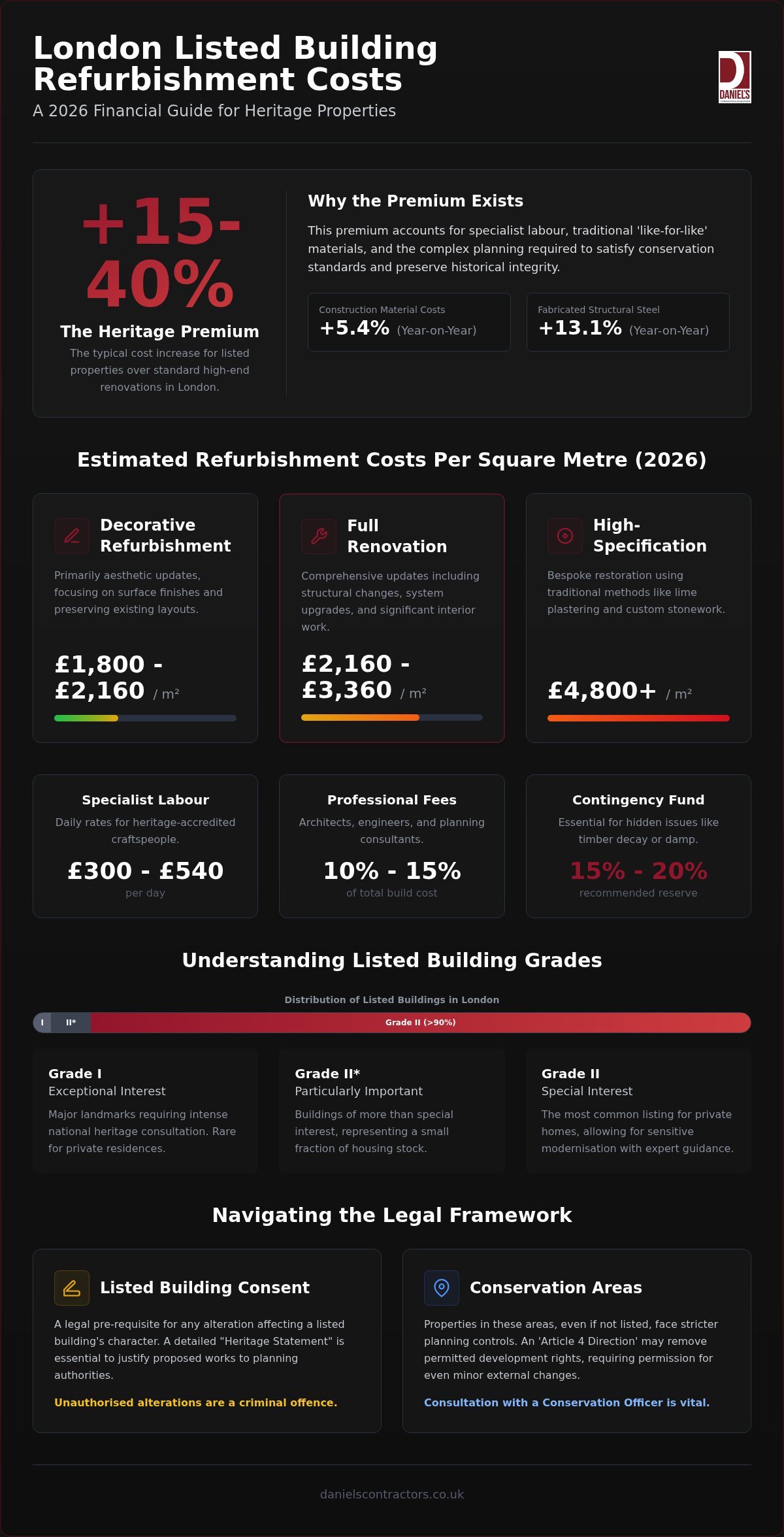
- Grade I: These are buildings of exceptional interest, such as major landmarks. Refurbishing these requires intense consultation with national heritage bodies and is rare for private residential projects.
- Grade II*: This category applies to particularly important buildings of more than special interest, representing only a small fraction of the capital’s housing stock.
- Grade II: This is the most frequent listing for private London residences, accounting for over 90% of all listed buildings. It allows for the most flexibility, provided the modernisation is handled with expert sensitivity.
Unauthorised alterations to a listed asset are more than a planning breach; they’re a criminal offence. This reality makes the “Heritage Statement” a cornerstone of your project. This document defines the historical significance of your home and justifies your refurbishment plans to the authorities. It acts as the blueprint for your scope, ensuring every bespoke detail respects the property’s past.
London Conservation Areas and Article 4 Directions
Boroughs like Westminster and the Royal Borough of Kensington & Chelsea have some of the strictest conservation rules in the UK. Even if your building isn’t individually listed, being within a conservation area adds a layer of complexity to your refurbishment. The role of the London Conservation Officer is to ensure that any changes, from sash window repairs to extensions, don’t diminish the character of the neighbourhood.
An Article 4 Direction is a legal tool used by local authorities to remove specific permitted development rights, meaning you’ll need planning permission for even minor external changes like replacing windows or painting masonry. Working closely with specialists who understand these local nuances is the only way to avoid the fear of prosecution and ensure your project moves forward with peace of mind.
Calculating the Listed Building Refurbishment Cost in London (2026)
Investing in a heritage property requires a transparent understanding of the “Heritage Premium.” In London, you should expect to pay between 15% and 40% more for works on a listed building compared to a standard high-end renovation. This uplift reflects the necessity for specialist labour and the use of traditional materials that satisfy conservation requirements. By May 2026, the overall price index for construction materials rose by 5.4% compared to the previous year, with fabricated structural steel seeing a sharp 13.1% increase. These market shifts make it vital to secure a precise, professionally managed budget from the outset.
Estimated Costs Per Square Metre for London Listed Properties
The scale of your ambition directly dictates the investment level. For a decorative refurbishment focused on aesthetic updates, costs generally range from £1,800 to £2,160 per m². A more comprehensive, full renovation of a listed property typically sits between £2,160 and £3,360 per m². However, for a high-spec restoration involving bespoke stone work and traditional lime plastering, costs often exceed £4,800 per m². Specialist tradespeople in London, such as heritage-accredited stonemasons or sash window specialists, currently charge between £300 and £540 per day.
Integrating modern living spaces into a historic frame requires exceptional care. If you’re considering a luxury basement conversion within a listed structure, the complexities of underpinning in London clay and reinforcing the existing heritage fabric will significantly influence the budget. These works demand a methodical approach to preserve the structural integrity of the period architecture whilst creating seamless, contemporary subterranean spaces.
Taxation also plays a role in your financial planning. Whilst the standard 20% VAT applies to most refurbishments, a reduced rate of 5% may be applicable if the property has been empty for two or more years. While private funding is the norm for luxury residences, understanding the criteria for heritage building grants can provide useful context for the standards expected by conservation bodies. For a detailed breakdown of how these costs apply to your specific London postcode, we invite you to discuss your vision with our specialist team at Daniels Contractors.
Navigating Listed Building Consent and the Planning Process
Securing Listed Building Consent is a meticulous exercise in diplomacy and detail. It is a negotiation with history. Whilst many view the planning phase as a bureaucratic hurdle, we see it as the foundation of a successful restoration. In London, where conservation officers are particularly vigilant, a well-prepared application is your strongest asset against delays and rising costs. A flawed submission can stall a project for months, whereas a transparent, expertly drafted proposal builds the trust necessary to move forward.
The process typically follows a structured five-stage path that begins long before the first brick is touched. Following the initial significance survey, we strongly advocate for the pre-application advice service. Although this involves an additional fee from the local borough, it provides a direct line of communication with the conservation officer. This early engagement allows us to refine the design before the formal clock starts ticking. It significantly reduces the likelihood of a costly refusal. Historic England often enters the conversation for Grade I or II* properties, or for substantial changes to Grade II buildings. Their involvement adds a layer of national expertise, ensuring that any modernisation respects the building’s place in the UK’s heritage.
Step-by-Step Guide to Securing Consent
A methodical approach ensures nothing is left to chance during the 8-to-12 week determination period. Every stage must be handled with precision to protect the project timeline.
- Stage 1: Detailed survey and heritage significance assessment to identify and protect original features.
- Stage 2: Pre-application consultation with the local London borough to gauge officer sentiment and address concerns early.
- Stage 3: Submission of the formal application alongside a robust Heritage Statement and technical drawings.
- Stage 4: The statutory determination period, which usually involves site visits from the planning officer to inspect proposed work areas.
Crafting a Successful Heritage Statement
The Heritage Statement is the most critical document in your application. It must move beyond a simple description of works to provide a clear justification for every change. Whether you’re proposing a bespoke extension or sensitive internal modernisation, you must demonstrate how the special architectural interest of the property remains intact. At Daniels Contractors, we collaborate with seasoned heritage specialists to ensure every proposal is backed by historical evidence and architectural integrity. This proactive stance helps manage the overall listed building refurbishment cost London projects incur by avoiding the need for expensive redesigns or legal challenges later in the programme.
Specialist Materials and Craftsmanship: The Cost of Quality
For a heritage project in the capital, “off-the-shelf” solutions simply don’t exist. The core of any successful restoration lies in the “like-for-like” principle, a mandatory requirement where new materials must match the original fabric in composition, texture, and appearance. This strict adherence to authenticity is a primary driver of the listed building refurbishment cost London owners must navigate. Whether it’s sourcing reclaimed London stock bricks that have weathered a century or finding the exact quarry for Portland stone, the logistics of procurement require a specialist touch.
Authenticity isn’t just about aesthetics; it’s about structural health. Using modern, non-breathable materials on a historic frame can trap moisture and cause irreversible damage to the masonry. This is why we prioritise traditional sourcing and artisan techniques. Reclaiming materials often involves a 20% to 30% premium over modern equivalents, but it’s the only way to ensure the refurbishment respects the building’s narrative and meets the stringent standards of London’s conservation officers.
Restoring Traditional Sash Windows
The windows are the “eyes” of a heritage facade, and their preservation is often a non-negotiable condition of consent. Whilst full replacement is sometimes necessary, a high-quality sash windows repair is often the preferred route for Grade II properties. We focus on integrating modern comforts like draught-proofing and slimline double glazing, which offers thermal efficiency without compromising the delicate profile of the glazing bars. Traditional frames require a meticulous process of hand-painting and puttying to replicate the original finish whilst ensuring long-term durability.
Ornate Plasterwork and Lime Rendering
Inside the home, the restoration of Victorian or Georgian details requires a master’s hand. Breathable lime mortar is non-negotiable for historic London properties to prevent damp issues that modern gypsum plaster can exacerbate. Replicating ornate ceiling roses or intricate cornicing often involves taking moulds from surviving fragments to create bespoke casts. Finding the few remaining master craftsmen capable of traditional pargeting or lime rendering is a challenge, yet it’s these finishes that define the luxury and integrity of the project.
Every detail, from the mix of the mortar to the grain of the bespoke joinery, contributes to a home that feels both timeless and impeccably modernised. If you’re ready to begin your restoration journey with a team that values precision as much as you do, contact us to discuss your bespoke refurbishment project.
The Daniels Approach: Managing Your Listed Refurbishment
Refurbishing a heritage asset requires more than technical skill; it demands a partnership built on mutual respect and a shared vision for the property’s potential. At Daniels Contractors, we’ve refined our process since 2001 to address the specific anxieties of the London luxury market. We understand that the listed building refurbishment cost London homeowners commit to represents a significant investment in the city’s architectural fabric. Our role is to act as both the master craftsman and the reliable partner, ensuring that every bespoke detail is executed with quiet confidence and absolute transparency.
Our “Gentleman Builder” philosophy is the cornerstone of our service. This approach prioritises clear communication and integrity, ensuring you’re never left in the dark about the progress of your home. We’ve spent over two decades cultivating a network of London’s finest heritage specialists, from lime plasterers to conservation architects. This collective expertise allows us to solve the complex structural problems inherent in historic buildings whilst maintaining a steady, methodical pace that never compromises on quality.
Fixed-Price Contracts and Milestone Payments
The unpredictability of hidden structural issues is often the greatest fear for those embarking on a heritage project. We eliminate this anxiety through rigorous financial transparency and detailed planning. Before the first brick is moved, we produce a comprehensive Schedule of Works that accounts for every specialist material and artisan hour required. This document forms the basis of our fixed-price contracts, providing you with budget certainty from the outset.
By linking payments to clearly defined project milestones, we ensure that your investment is always matched by tangible progress. This methodical rhythm builds trust and allows for a seamless transition between the different phases of the build. It’s our way of managing the listed building refurbishment cost London projects demand without the “hidden cost” surprises that often plague less experienced contractors. You receive regular, professional updates that focus on the practicalities of the construction whilst respecting the high-end results you expect.
A Portfolio of London Excellence
Our commitment to precision has seen us transform some of the most prestigious addresses in London, Surrey, and Essex. Whether we’re restoring delicate period features or integrating modern technology into a historic frame, our focus remains on the preservation of architectural history. Our extensive experience in high-end home refurbishment London projects ensures that your property is in the hands of someone who values its legacy as much as you do.
We invite you to experience a refurbishment journey that is as refined as the finished home itself. Our team is ready to provide the technical expertise and personal touch your project deserves. Enquire about your listed building project with Daniels Contractors today.
Securing Your Heritage Legacy in 2026
Restoring a historic London home is a meticulous act of stewardship that requires a delicate balance of preservation and modernisation. Success in this field hinges on early planning, from the creation of a robust Heritage Statement to the sourcing of authentic, like-for-like materials that respect the property’s structural integrity. Understanding the nuances of the listed building refurbishment cost London homeowners face is the first step in ensuring your investment remains both legally compliant and architecturally significant.
With 25 years of luxury construction expertise, Daniels Contractors specialises in navigating the complexities of the capital’s heritage market. We provide peace of mind through transparent, fixed-price project management, ensuring your vision is delivered without the anxiety of hidden structural surprises. Our network of master craftsmen is dedicated to maintaining the highest standards of precision, turning complex regulatory hurdles into a seamless journey toward a beautifully restored residence.
Your property is a unique piece of history. We’re here to help you protect its value and enhance its future with integrity and care. Discuss your bespoke listed refurbishment with our expert team today to begin your transformation with confidence.
Frequently Asked Questions
How much does listed building consent cost in London?
There is no application fee for listed building consent in England. However, you must budget for the professional documentation required to support your submission. A heritage statement typically costs between £1,500 and £4,000, and professional fees for architects and consultants generally add 10% to 15% to your total budget. These costs are essential for justifying your plans and securing approval from the local conservation officer.
Can I modernise the interior of a Grade II listed building?
You can modernise the interior, provided the works respect the property’s historical character. Unlike non-listed properties, even internal changes like removing walls, installing new kitchens, or replacing floorboards usually require listed building consent. The goal is sensitive modernisation that preserves original features like cornices or fireplaces. We focus on bespoke solutions that integrate contemporary luxury whilst maintaining the building’s special architectural interest and historical value.
Is VAT payable on listed building refurbishments in 2026?
The standard VAT rate of 20% applies to most refurbishment work on listed buildings in 2026. There isn’t a special reduced rate specifically for heritage properties. However, you might qualify for a reduced rate of 5% if the building has been empty for two or more years. Navigating these tax nuances is a key part of managing the listed building refurbishment cost London homeowners must factor into their financial planning.
How long does a full listed building refurbishment typically take?
A full restoration typically takes between 9 and 18 months to complete. This timeline includes the 8 to 12 week determination period for securing listed building consent and the meticulous craftsmanship required for heritage finishes. Because we don’t cut corners, the steady pace ensures every detail, from lime rendering to sash window repair, meets our high standards. Complex projects involving extensions or structural reinforcement often take longer.
Do I need a specialist architect for a listed building renovation?
Engaging a conservation architect is highly recommended for any listed project. They possess the technical expertise to design alterations that planning officers are likely to approve. A specialist architect understands how to balance modern requirements with heritage protection, reducing the risk of a costly refusal. Their involvement is a vital component of the listed building refurbishment cost London projects incur, as it ensures the long-term integrity of your home.
What happens if I refurbish a listed building without consent?
Performing unauthorised work on a listed building is a criminal offence in the UK. Local authorities have the power to issue enforcement notices requiring you to reverse the changes at your own expense. You could also face unlimited fines or prosecution. Beyond the legal risks, unapproved alterations can make the property difficult to sell, as future buyers will require proof that all necessary consents were obtained before work began.
Can I add an extension to a listed building in London?
You can add an extension, but it must be subservient to the original structure and designed with exceptional sensitivity. Most London boroughs require both planning permission and listed building consent for such works. As of April 2026, the householder planning application fee is £548. Success depends on demonstrating that the new addition doesn’t diminish the heritage asset’s significance, often favouring high-quality contemporary designs or traditional bespoke additions.
Are there grants available for listed building repairs in 2026?
Grants for private residential listed buildings are extremely rare in 2026. Most funding from bodies like Historic England is reserved for heritage assets on the “At Risk” register or buildings with significant public access. Homeowners should generally expect to fund their refurbishments privately. While some local authorities offer small grants for specific conservation works, these are competitive and usually focused on external repairs that benefit the wider community character.