
What if the best renovation plan isn’t the biggest one, but the one that fits your home and the way you live? Choosing home renovation services Chigwell homeowners can rely on starts with understanding the property, its condition and the changes that would make daily life work better.
It’s natural to be unsure which rooms to renovate together, whether structural requirements or permissions could affect the scope, and how construction may disrupt your household. A considered plan brings these decisions into focus before work begins. This article explains how to shape a renovation around your priorities, assess the home and understand the design, planning and construction stages.
Clear communication, a defined scope and a proposed timeline help set expectations, while building control coordination supports work that follows UK building regulations. From agreeing the brief to discussing changes and completing the handover, each stage should be handled with care, precision and attention to detail. The aim is a transformation that respects your property and supports the way you want to live in it.
Key Takeaways
- Start by identifying what your home needs and how you want each space to support your household.
- See how design choices, structural requirements and permissions shape a practical renovation plan.
- Learn when targeted improvements may suit your goals and when connected work is better planned together.
- Understand the stages from initial brief and assessment through construction coordination, finishing and handover.
- Explore how home renovation services Chigwell can be managed through clear communication, a defined scope and proposed timelines.
Home renovation services in Chigwell: start with your property and priorities
Every Chigwell home has its own character, condition and possibilities, and every household has different priorities. One family may need a more practical kitchen and dining area; another may want to refresh tired finishes or address parts of the property that no longer work as they should. Home renovation is planned work that improves a property’s condition, layout or finish. A renovation is the process of improving broken, damaged, or outdated structures, but your brief can also focus on making sound rooms more useful or better suited to everyday life.
Build the scope around three things: how you intend to use the home, what its existing condition allows, and the result you have in mind. Your priorities might include making shared spaces work better, updating a bathroom, improving the finish in several rooms or rethinking how the layout serves the household. Describe the outcome you want first, rather than assuming a particular type of building work is needed.
A focused room update and a complete property refurbishment have different levels of reach. The first concentrates on a defined space and selected improvements; the second considers multiple areas as part of a wider transformation. Neither approach is automatically better. The key question is whether the proposed work addresses the real need and accounts for how the home functions as a whole.
Which renovation scope suits your Chigwell home?
Start by identifying whether your main concern is layout, condition, finish or a combination of connected needs. A room may need decorating to bring its appearance up to date, while another project may involve refurbishment to renew surfaces and fittings. Structural changes could be considered where the existing arrangement limits how you use a space, but they aren’t necessary for every renovation.
A site assessment connects these ideas to the property itself. It helps the project team understand the existing spaces and consider how the requested work fits together. For example, note which rooms you use most, where circulation feels awkward and whether planned changes affect adjoining areas. This creates a practical basis for shaping the scope, instead of treating a wish list as a construction plan before the home has been assessed.
How should you define the result you want?
Describe how you want each space to function after the work. Think about who uses it, what currently feels restrictive and what would make everyday routines easier. Then separate essential work from preferred design details. Essentials might relate to a room’s use or condition; preferences might include particular finishes, colours or fittings. This distinction gives the brief useful structure while leaving room for design decisions to develop.
A well-defined brief gives everyone a clearer basis for design choices, scope decisions and the details that follow. With home renovation services Chigwell homeowners can shape around their property and lifestyle, the first step is a shared understanding of what matters most. That clarity keeps the proposed work connected to your vision while allowing the property’s condition to inform practical decisions.
Planning a Chigwell renovation: design, structure and permissions
A well-considered renovation plan brings the design, the property’s physical condition and the intended finish into alignment. Choices about room layout, materials and details affect how the work is carried out, while structural requirements may shape what is practical. Considering these elements together turns your brief into a coordinated proposal, rather than a collection of decisions made in isolation.
For home renovation services Chigwell homeowners can plan with greater confidence, the starting point is a careful assessment of the building and proposed changes. Existing condition, structural considerations and connections between rooms can all influence the design and sequence of work. If construction reveals a condition that differed from what was visible during the initial assessment, clear communication helps you understand its implications before decisions are made about how to proceed.
What should a property assessment establish?
Before the scope and construction approach are finalised, an assessment should consider the property as it stands and how proposed changes relate to one another. For example, a layout change may affect adjoining spaces, so reviewing each area in context can inform both the design and the order in which work is planned. Findings on site provide a practical basis for discussing how the intended finish can be achieved.
Design choices should also respond to the home’s character. In a period or heritage property, existing features and materials may guide decisions about finishes and alterations. Where a building is listed or sits within a conservation area, specific constraints may apply. Identifying these considerations early helps the project team develop a suitable approach before construction details are settled.
How do permissions and compliance fit into the plan?
Planning permission and building regulations address different aspects of a project. Whether planning permission is required depends on the proposed work and the property, so don’t assume a particular alteration is automatically permitted. Identify any restrictions associated with listed status or a conservation area as part of the early planning discussion. The guide to permitted development rights explains one route that may be relevant to some projects.
Separately, work must follow UK building regulations, the standards governing matters such as safety and construction performance. The project plan should include building control coordination, so the relevant compliance process is considered alongside design and construction. Requirements depend on the scope and circumstances of the work. Planning permission does not replace building regulations compliance, and the two should not be treated as interchangeable.
Bringing these strands together early makes decisions clearer: establish what the property needs, develop a design that responds to its condition, then account for permissions and compliance before work proceeds. Daniels Contractors’ renovation planning approach provides a starting point for discussing design, coordination and the requirements of your home.
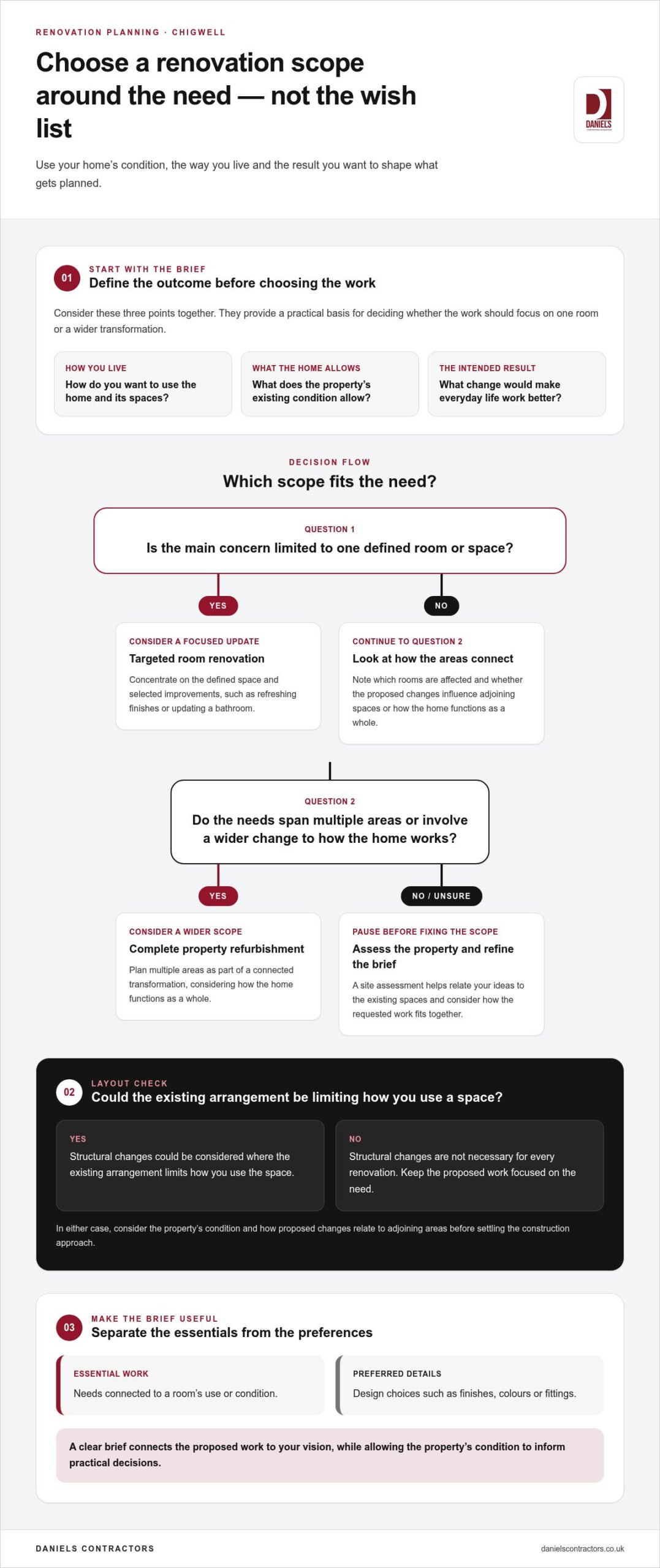
Choosing between targeted work and complete home refurbishment in Chigwell
Once you understand what the property needs, the next decision is how much of the home to include. A focused renovation can address a clearly defined issue, while complete refurbishment considers several rooms or the property as a whole. The right choice depends on how the work relates to the home’s condition and your plans for using it, not simply on how many changes you can list.
Scope affects coordination. Work in one area may be relatively contained, whereas projects spanning several rooms require design decisions and construction activities to be considered across those spaces. Wider work can also affect more of the household’s routine. Neither approach guarantees less disruption: the practical impact depends on the work involved, the property and how the project is organised.
When might targeted renovation work be the right fit?
A targeted brief still benefits from design and construction planning. If work touches adjoining areas, the finish and sequence may need to be coordinated so the result feels considered. Even limited work can involve practical disruption. A site assessment and a clearly defined scope help establish what the proposed improvements involve, rather than assuming a smaller project will be straightforward in every home.
Extensions, loft conversions and basement conversions each introduce their own design and construction considerations, so they’re best explored through guidance focused on those project types. The key is to assess how any proposed change relates to the rest of the property before deciding whether it belongs in a targeted brief or a wider plan.
When should a wider refurbishment be considered?
A complete refurbishment may be worth considering when several needs overlap, such as updating finishes across multiple rooms while rethinking how those spaces work together. Planning connected work as one project can help align design decisions, construction coordination and finishes. It also gives the team a chance to consider how work in one area affects the next, rather than leaving related choices until construction is under way.
Targeted renovation addresses a defined part of the home; complete refurbishment plans improvements across a broader share of the property. This distinction is about scope, not an assumption that one option is inherently better. A wider project may involve more coordination and affect more areas of daily life, so the proposed sequence and communication plan matter. Discussing these factors early helps you understand the practical implications before work proceeds.
For a closer look at how a broader project can be shaped, the high-end home refurbishment guide explores the considerations involved. With home renovation services Chigwell homeowners can tailor to their property, a considered scope keeps each element connected to the intended result, whether the brief is focused or whole-home.
Chigwell Renovation: From Assessment to Handover
A well-managed renovation follows a clear sequence, with decisions made before they become site changes wherever possible. You and the project team establish the brief, assess the property, develop the design and plan, coordinate construction, complete the finishes and review the work at handover. Each stage gives you a point to discuss priorities and understand what comes next.
Before work proceeds, the team sets out the agreed scope and proposed timeline. These give you a clear basis for understanding what is planned and how the stages are expected to fit together. Timelines vary with the scale and complexity of the work, so the proposed programme should reflect the actual project rather than a general promise.
How are work, communication and changes managed?
Renovation is a collaboration. Your input guides the design and finish, while the project team coordinates construction and communicates progress. If site findings differ from what was anticipated, or an unexpected issue affects the plan, the team informs you, explains what has been identified and discusses the available options and their implications before adapting the work.
That conversation matters. It helps you understand how a proposed change relates to the agreed brief and construction sequence. Designers and structural specialists can be coordinated as the project requires. Clear communication keeps decisions connected, rather than leaving you to interpret a site issue without context.
What should homeowners know about disruption and timing?
The effect on daily life depends on the areas being worked on, the order of construction and the safety requirements on site. You may be able to use parts of the home during some projects, but that can’t be assumed in advance. Major structural work may require temporary relocation; occupancy decisions should reflect the project’s scale and safe working conditions.
Timing also depends on the scope. A typical home extension may take 10 to 16 weeks, though timelines vary. That range applies to a typical extension, not renovations in general. The proposed programme for your project should account for its particular work and complexity, with changes discussed if site conditions affect the planned sequence.
As finishing progresses, attention turns to the details that bring the design together. Incorporating bespoke window treatments from specialists like The Window Valet can help enhance light control, privacy and the final interior aesthetic. At handover, review the completed work with the team, discuss any outstanding agreed items and make sure you understand the status of the project. This final conversation closes the loop between the original brief and the finished spaces.
For home renovation services Chigwell homeowners can approach through a defined, collaborative process, Daniels Contractors coordinates design and construction with clear communication at each stage. Discuss your Chigwell renovation project and begin shaping its assessment, sequence and handover around your home.
Plan your Chigwell home renovation with Daniels Contractors
Daniels Contractors & Development Ltd. is a London-based construction firm delivering residential projects across London, Surrey and surrounding counties, including Essex. Chigwell homeowners can plan a renovation around more than the finished look: the scope should suit the property, design and construction should be carefully coordinated, and communication should help you understand decisions as the project develops.
What does Daniels Contractors bring to a renovation project?
Operating in London since 2001, the company brings over two decades of experience to renovation and refurbishment work. Its qualified and certified team is fully insured, with a focus on considered workmanship and attention to detail. The aim is to carry the agreed design through construction with care, keeping the project connected to your priorities and the practical needs of the home.
Clear expectations are part of the process. Before work proceeds, the team sets out the proposed scope and timeline so you can understand the planned work and sequence. Communication continues as work progresses, allowing questions and site findings to be discussed in context. Where applicable, NHBC-related credentials and warranty arrangements are relevant to the project.
Material choices contribute to the quality and performance of the finished work. The team uses high-quality, UK-compliant materials sourced from trusted local suppliers and coordinates with building control as part of work that follows UK building regulations. This brings practical requirements into the project alongside design and finish, rather than treating them as separate considerations.
How can you take the first step?
Begin by sharing what you know about the property, the areas you’d like to change and how you want the home to work for you. You don’t need every design decision settled. An initial discussion can help clarify the brief and consider how the proposed scope, design, planning requirements and construction coordination fit together.
Use that conversation to explain what matters most to your household, whether you’re considering a focused update or a wider refurbishment. The team can use those priorities to guide the next steps, including assessment of the property and preparation of a project proposal. A measured, collaborative start keeps decisions grounded in both your vision and the home’s condition.
If you’re considering home renovation services Chigwell residents can shape around their property and lifestyle, share your brief with Daniels Contractors. The team can discuss the work clearly, without pressure to settle every detail at the outset. Discuss your renovation project and take the first step towards a carefully planned transformation.
Take the next step towards a home shaped around you
A renovation can be a chance to make your home work more naturally for the life you want to lead. The most useful next step is to talk through what matters most, which parts of the property need attention and how the finished spaces should feel and function. You don’t need every detail resolved before you begin. A clear sense of your priorities is a sound place to start.
With home renovation services Chigwell homeowners can tailor to their property, the process should feel considered from the first discussion, with decisions guided by your brief and the home itself. That gives you room to explore possibilities while keeping practical requirements in view.
If you’re ready to explore what your home could become, take the next step with Daniels Contractors. A thoughtful first conversation can help turn your ideas into a well-shaped project and bring you closer to a home that feels right for the years ahead.
Frequently Asked Questions
Do I need planning permission for a home renovation in Chigwell?
It depends on the proposed work and the property. To make an early planning discussion more useful, prepare a concise description of the changes and identify which parts of the home they affect. Drawings or photographs can help show the intended extent of the work. Daniels Contractors can guide the planning process and coordinate relevant requirements as the project develops.
Can I stay in my home during a renovation?
Whether you can remain at home depends on the work and safety arrangements. As you plan, consider practical needs such as access to essential rooms, secure storage for belongings and how household routines may be affected. Discuss these details alongside the work sequence, so arrangements can be considered before construction begins rather than handled at short notice.
How long does a home renovation take in Chigwell?
There isn’t one duration that applies to every home renovation. The time needed depends on the work included and how its different stages fit together. For a useful schedule, distinguish preparation and design from construction on site, then consider dependencies between tasks, such as finishing one area before work can proceed in another. The proposed programme should reflect the project brief.
What happens if unexpected issues arise during a renovation?
If an unexpected issue affects the work, the team informs you, explains the options and discusses how the issue could affect the project before adapting the plan. Keep a clear record of what was identified, which decision was made and any change to the agreed scope. This gives you and the project team a shared reference as the renovation continues.
Do renovation projects need building control?
Building control coordination is included where relevant, and the project plan should identify the applicable coordination points for the work. This helps clarify which stages need attention as construction progresses, rather than leaving those details until finishing. Daniels Contractors coordinates building control as required, with compliance considered in relation to the specific work being carried out.
Does Daniels Contractors serve homeowners in Chigwell?
Yes, Daniels Contractors undertakes projects in Chigwell as part of its work across London, Surrey and surrounding counties, including Essex. To start a useful conversation, share the type of property, the areas you’re considering changing and the result you hope to achieve. This gives the team context for discussing the brief and practical questions that may shape the scope.