
What if the true hallmark of a luxury apartment refurbishment in London isn’t the book-matched marble or the designer lighting, but the structural integrity hidden behind the plaster? It’s a question many homeowners overlook until a “pretty” interior begins to show its age or fails to meet the rigorous demands of a Grade 2 listing. You likely understand that in a city as historic and regulated as ours, a high-end finish is only as valuable as the craftsmanship supporting it.
We agree that the process of transforming a central London residence should be as seamless as the final result, yet the reality of navigating conservation area rules and complex logistics often feels anything but. This guide promises to help you master the art of the 2026 “quiet luxury” aesthetic whilst ensuring your investment is built on a foundation of technical excellence. You’ll discover how to blend heritage preservation with modern structural standards to create a bespoke sanctuary that commands both respect and significant market value.
Key Takeaways
- Learn why 2026 design is moving away from overt displays of wealth toward “Quiet Luxury,” prioritising tactile materials and personal narrative over flashiness.
- Understand why a successful luxury apartment refurbishment London begins with the structural “envelope” to ensure long-term integrity and aesthetic perfection.
- Explore innovative design benchmarks, including biophilic living walls and the “Jewel Box” concept for creating intimate, intensely decorated hosting spaces.
- Discover how to sensitively modernise Grade 2 listed period apartments by creating a sophisticated dialogue between original heritage features and contemporary design.
- See how engaging a design-led main contractor provides a more cohesive, transparent, and stress-free project management experience than using fragmented teams.
The 2026 Aesthetic: Defining Luxury Apartment Refurbishment in London
The Rise of Bespoke Materiality
Artisan craftsmanship is the cornerstone of the modern London interior. We’re seeing a decisive move away from “catalogue luxury,” where apartments are filled with identical, high-priced furniture sets. Instead, the focus has shifted toward curated, custom-built environments. This involves the use of rare, honed stones, hand-applied lime plasters, and hardwoods sourced from sustainable British estates. The profession of interior design has adapted to this demand by collaborating directly with master stonemasons and joiners. These craftsmen create one-of-a-kind elements, from integrated stone sinks to floor-to-ceiling library walls, that ensure no two refurbishments are ever the same.
Sustainability as a High-End Standard
Sustainability has transitioned from a niche concern to a primary status symbol in high-end renovations. For the sophisticated homeowner, energy efficiency is now as desirable as a prime postcode. 2026’s standard for a luxury apartment refurbishment London involves integrating carbon-neutral materials without sacrificing an ounce of aesthetic quality. This often manifests as a sophisticated dialogue between the old and the new. We frequently pair reclaimed heritage materials, such as centuries-old oak joists or antique chimney pieces, with ultra-modern, high-performance glazing and low-carbon heating systems. This approach doesn’t just lower the building’s footprint; it adds a layer of historical depth and integrity that new materials simply cannot replicate.
Structural Luxury: The Foundation of a High-End Refurbishment
The success of any luxury apartment refurbishment London project depends entirely on the “envelope” of the property. Whilst it’s tempting to focus on the final finishes, the structural integrity of the building dictates the limits of your interior design. A truly high-end residence is defined by what remains invisible to the casual observer. This includes the seamless integration of advanced climate control and acoustic insulation that ensures a peaceful sanctuary amidst the city’s movement. By prioritising the bones of the building, a high-end home refurbishment London secures long-term property integrity and avoids the common pitfall of “pretty” designs masking structural failures.
In 2026, the standard for luxury has shifted toward “Invisible Luxury.” This involves a methodical approach to engineering, where acoustic performance and thermal efficiency are built into the fabric of the apartment. New regulations, such as the Future Homes and Buildings Standards, now mandate higher energy efficiency and low-carbon heating technologies like heat pumps. Professional project management must also account for significant hidden costs, which often range from £15,000 to £45,000 for items such as party wall fees and unforeseen structural repairs. Addressing these practicalities early ensures the refurbishment programme remains steady and transparent.
Maximising Space in Period Footprints
London’s historic apartments often suffer from compartmentalised layouts that restrict natural light. Strategic wall removals can transform these traditional footprints into open-plan environments that feel significantly more expansive. We often find that the principles used in bespoke house extensions London can be adapted to apartment living. For instance, the use of structural glass partitions or internal light wells can brighten dark Victorian corridors without compromising the building’s heritage. This creates a fluid spatial flow that reflects a modern, sophisticated lifestyle.
Subterranean and Multi-Level Potential
For ground-floor residences, the potential for expansion is often found beneath the floorboards. Integrating luxury basement conversion London techniques allows for the creation of wellness zones or media rooms that add substantial value. When introducing multi-level elements, such as sculptural staircases or mezzanines, the structural load must be meticulously managed. This is particularly vital when using heavy luxury materials like book-matched marble flooring, which requires a reinforced subfloor to prevent deflection. If you’re considering a complex structural change, our team can help you organise a professional site assessment to determine the best path forward.
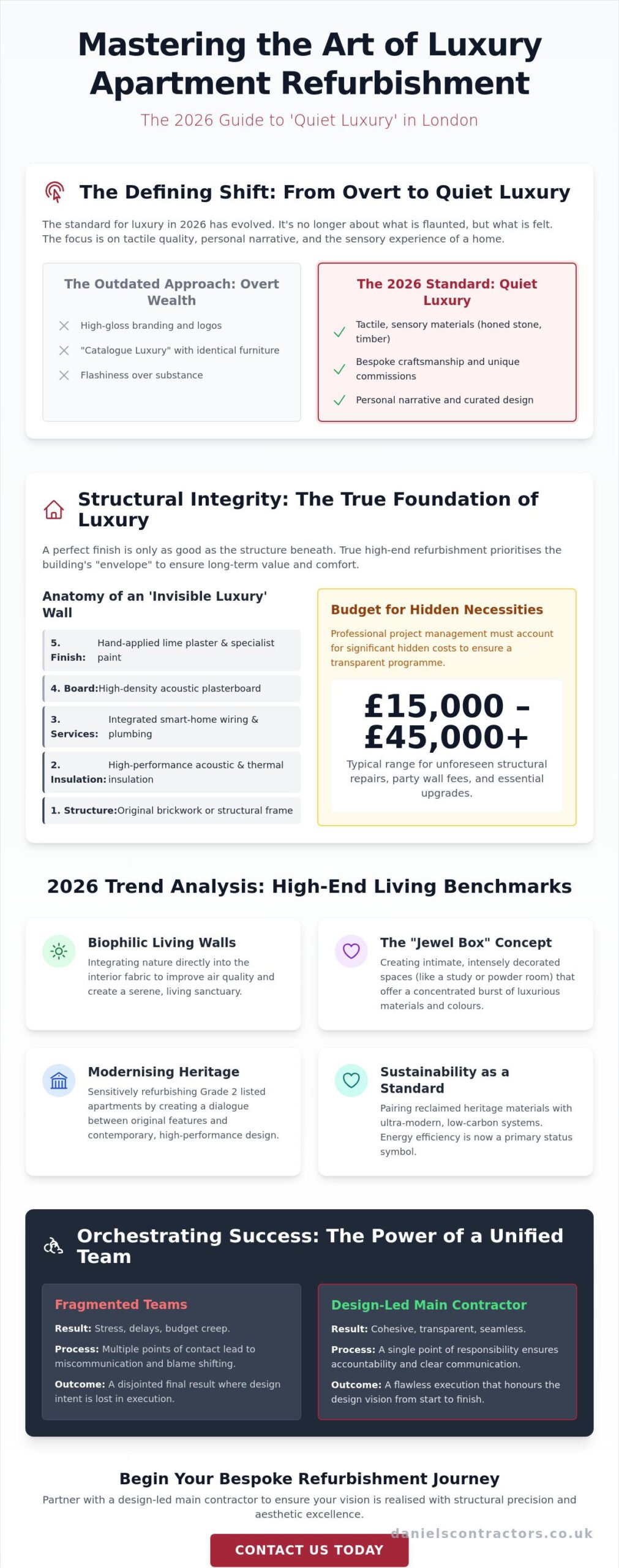
2026 Trend Analysis: High-End Living Benchmarks
The Wellness Suite: The Private Spa Trend
The master bathroom has evolved into a fully equipped wellness suite. High-end refurbishments now frequently include steam rooms, sensory showers with bespoke lighting sequences, and deep soaking tubs carved from single blocks of stone. We prioritise the use of non-toxic, VOC-free materials to ensure the “healthy home” environment is as pure as it is beautiful. This focus on physical and mental well-being is a core reason why a comprehensive house renovation london prioritises the bedroom and bathroom as sanctuaries for rest. It’s about creating a space that doesn’t just look like a spa but functions with the same restorative precision.
Seamless Smart Technology
Heritage and Modernity: Refurbishing London’s Period Apartments
London’s historic fabric is a defining characteristic of its global appeal, yet it presents a unique set of challenges for the modern homeowner. When you embark on a luxury apartment refurbishment London within a grade 2 listed building, the objective is to honour the past whilst providing the comforts of the future. This requires a sophisticated dialogue between contemporary design and original features. We don’t believe in stripping away character; instead, we use sleek, modern interventions to highlight the intricate beauty of Victorian cornicing and Georgian plasterwork. In boroughs like the Royal Borough of Kensington & Chelsea, success depends on a contractor’s ability to navigate these heritage strictures with technical precision and diplomatic planning.
A primary concern in period refurbishments is thermal performance. High-end living is impossible if the environment is draughty or thermally inefficient. This is why professional sash window repair london is a non-negotiable step in our process. By restoring original frames and introducing discreet, slimline double glazing or advanced draught-proofing, we ensure your apartment meets 2026 energy standards without altering its historic silhouette. This technical restoration provides the foundation for what we call “thermal luxury,” where the internal climate remains perfectly controlled regardless of the external weather.
Restoring Heritage with Modern Precision
True craftsmanship lies in the details that most people take for granted. Replicating original Victorian details requires specialist artisans who understand traditional techniques. We often integrate modern comforts, such as underfloor heating, beneath original parquet or reclaimed stone floors, a process that demands meticulous care to avoid damaging the historic material. To complete the aesthetic, we match historic colour palettes using high-performance, eco-friendly paints. These modern formulations provide a depth of colour that honours the era whilst offering the durability and health benefits expected in a premium 2026 residence.
Navigating Conservation Area Constraints
Securing planning permission for internal updates in a conservation area is a complex task. Approximately 60% of London properties are subject to restrictions that remove standard permitted development rights. A contractor who understands the specific nuances of local London borough planning committees is an invaluable asset. Beyond the paperwork, managing a building site in prime central London requires logistical expertise. We handle the strict restrictions on delivery times, skip placements, and noise levels that are standard in prestigious residential blocks. If you’re ready to restore your period home to its former glory, discuss your heritage project with our specialist team today.
Orchestrating the Refurbishment: The Main Contractor’s Role
From Concept to Final Handover
We follow the RIBA Plan of Work to manage risk and ensure every milestone is met with exacting precision. This methodical framework allows us to oversee everything from the initial feasibility studies to the final handover of a turnkey residence. Quality control protocols are embedded at every stage, from the hidden acoustic layers to the final hand-applied finishes. Navigating the unique logistical challenges of central London, such as restricted delivery windows and stringent noise regulations, is a core part of our expertise. We handle the complexities of skip permits and parking suspensions so the process remains seamless for you.
The Daniels Contractors Difference
With a 25-year legacy of delivering bespoke luxury across London, Surrey, and Essex, we understand that high-end renovation is an art form. Our reputation is built on a foundation of integrity and a relentless focus on precision. This dedication makes us the preferred partner for complex projects, including the sensitive victorian house refurbishment london residents entrust to us. We don’t just build spaces; we curate environments that reflect your status and personal narrative through master craftsmanship.
Begin your luxury apartment refurbishment with Daniels Contractors and experience a process defined by transparency, expertise, and care.
Securing the Future of Your London Residence
A successful luxury apartment refurbishment London depends on the invisible excellence of its structure as much as the visible beauty of its finishes. You’ve seen how 2026 design prioritises atmospheric depth and technical integrity over temporary trends. Balancing modern standards with the strict requirements of heritage buildings is a delicate task, yet it’s the only way to ensure your property remains a lasting legacy. Every decision, from acoustic insulation to bespoke materiality, contributes to a home that functions as a true sanctuary.
Daniels Contractors brings 25 years of bespoke craftsmanship to every project, specialising in the nuances of Grade 2 listed and conservation area refurbishments. Our transparent, fixed-price project management removes the uncertainty from the build process, allowing you to focus on the creative transformation of your space. We invite you to transform your London residence with Daniels Contractors and create a home that balances historic character with contemporary performance. Your vision for a sophisticated, high-performance residence is well within reach with a dedicated partner by your side.
Frequently Asked Questions
What are the key luxury apartment refurbishment trends in London for 2026?
The primary trends for 2026 involve a shift toward “Quiet Luxury,” which prioritises tactile materials and sensory depth over visual excess. We’re seeing a move toward warmer, earthier palettes such as moss green, burgundy, and warm stone, alongside the integration of biophilic elements like internal living walls. The focus has moved away from “catalogue luxury” toward entirely bespoke, artisan-crafted environments that reflect a personal narrative.
Do I need planning permission for a luxury apartment refurbishment in London?
You will likely need planning permission if your property is amongst the 60% of London homes located in a Conservation Area or if it carries a Grade 2 listing. Whilst internal cosmetic changes often don’t require consent, any structural alterations, changes to floor plans, or heritage repairs usually necessitate formal approval from the local borough. Navigating these rules requires a contractor with specific experience in central London planning nuances.
How long does a high-end apartment renovation typically take in central London?
A high-end renovation in central London typically takes between six and twelve months. This duration depends on the structural complexity and the level of bespoke joinery required for the finish. Managing site logistics in prestigious blocks often adds time due to restricted delivery windows and strict noise regulations that limit active working hours. We provide a detailed programme at the start to ensure milestones are met with precision.
Can I install smart home technology in a Grade 2 listed apartment?
You can certainly install smart home technology in a Grade 2 listed apartment, provided the installation is non-intrusive and respects the historic fabric. We recommend using “invisible” plastered-in speakers and wireless control systems that avoid the need for chasing cables into original plasterwork or cornicing. This approach ensures you enjoy modern convenience whilst remaining fully compliant with heritage preservation rules and protecting the building’s integrity.
How much does a luxury apartment refurbishment cost per square metre in 2026?
For a premium luxury apartment refurbishment London, budget estimates for 2026 range from £3,000 to £4,500 per square metre in areas like Kensington, Chelsea, and Mayfair. This investment accounts for high-performance materials, artisan craftsmanship, and the complex engineering required to meet modern luxury standards. It’s a significant commitment that reflects the value of structural integrity and bespoke finishes in the capital’s most prestigious residential postcodes.
What is ‘Quiet Luxury’ in the context of London interior design?
Quiet Luxury is a design philosophy that favours restraint, atmosphere, and material integrity over overt displays of wealth. It focuses on the quality of natural light, the texture of hand-applied finishes, and a sense of calm that makes a residence feel like a personal sanctuary. In 2026, this manifests as “Stealth Wealth,” where the value of the refurbishment is found in the craftsmanship and the quiet performance of the home.
How do I manage noise and disruption during an apartment refurb in a shared block?
We manage disruption through meticulous site conduct and proactive communication with your neighbours and the building management team. Our “Gentleman Builder” approach ensures that noise is strictly restricted to approved borough hours and that communal areas are kept immaculate throughout the project. By maintaining a professional and respectful presence, we protect your reputation within the block and ensure the process remains as stress-free as possible.
Why should I choose a design-and-build contractor over an architect?
Choosing a design-led contractor provides a single point of accountability and a more cohesive workflow than hiring separate silos. This model leads to more accurate costings and a seamless delivery, as the team responsible for the build is involved in the technical design from the very beginning. It eliminates the friction often found between designers and builders, ensuring that your vision is executed with both aesthetic and structural precision.