
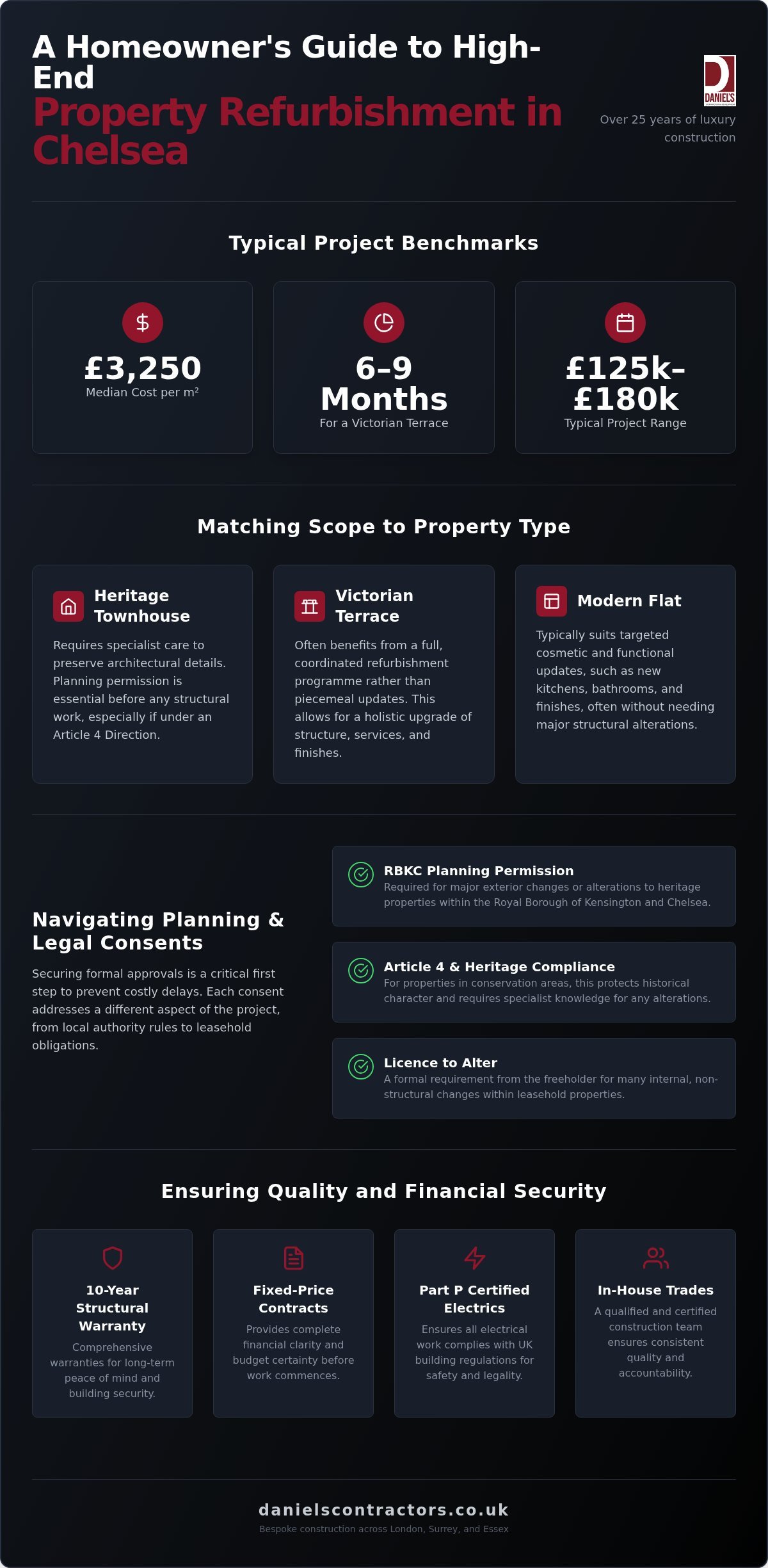
Choosing refurbishment contractors in Chelsea means weighing scope, planning risk and finish quality before any wall comes down. Property refurbishments in London typically range from £125,000 to £180,000 depending on scope, with a market median around £3,250 per square metre according to market research of 30 listings. Daniels Contractors brings over 25 years of specialist experience in high-end house refurbishment (retrofit-first policy) to guide your project through local planning constraints. Contact our team to receive a tailored project estimate that aligns with your specific home alterations.
Key Takeaways: Refurbishment contractors in Chelsea typically charge a median of £3,250 per square metre, with standard Victorian terrace projects requiring 6 to 9 months for completion.
- High-end refurbishments in London generally range between £125,000 and £180,000 based on market research.
- Mandatory legal consents include RBKC planning permission, Article 4 heritage compliance, and leasehold Licences to Alter.
- Except when only minor repairs are needed, full structural overhauls suit neglected listed estates.
- Secure a fixed-price contract and 10-year structural warranty to ensure long-term financial and building security.
Match your Chelsea property to the right refurbishment path
Your property style determines whether your project needs minor interior updates or structural alterations. Three situations come up often: a heritage townhouse under an Article 4 Direction needs planning secured before any structural opening; a tired Victorian terrace ready for a full house refurbishment benefits from one coordinated programme rather than piecemeal rooms; a modern flat usually suits targeted updates to kitchens, bathrooms and finishes without touching the structure.
Ignoring local conservation rules leads to costly delays. Select a scope that matches your vision. A fixed-price contract offers budget clarity, though large-scale refurbishments need transparent project management so common construction pitfalls do not erode the programme. High-end finishes take time to specify and install. Tailoring the structural strategy balances period charm with modern performance. Explore our comprehensive Property Refurbishment, Daniels Contractors & Development options to choose the right management approach. You get tailored solutions that protect your investment and improve daily comfort.
Fixed-price clarity on what your house refurb will cost
Planning a high-end house refurbishment requires complete financial clarity before building work begins. Costs depend entirely on your scope of work and structural ambitions. Figures vary widely with size, structure and specification, and market listings point to a median around £3,250 per square metre.
| Scope of Work | Focus Area | Cost Drivers |
|---|---|---|
| Structural Alterations | Layout changes | Steelwork and load-bearing |
| High-End Finishes | Interiors and joinery | Material quality and detail |
| Conservation Work | Heritage properties | Planning constraints |
Unexpected structural repairs such as hidden plumbing faults often sit out of sight until opening up, so their true scale only appears once work is under way. You can secure a fixed-price contract to set budgets early. Transparent project management during major refurbishments helps prevent typical construction issues, and fixed pricing depends heavily on thorough initial surveys.
We recommend securing a fully itemised schedule of work before starting. For heritage properties (Article 4 Direction), specialised planning adjustments increase investment scales.
Learn more via Home Page, Daniels Contractors & Development Ltd.. Clear costs bring peace of mind. Homeowners benefit from hearing how previous clients experienced transparent financial management firsthand.
Among Google reviews, Alan (5★) wrote:
„Daniels did an absolutely terrific job on our rear extension, we couldn’t be happier! They were professional and responsive, and kept us in the loop at every stage. Excellent communication and results, we are thrilled with the completed product!”
This feedback shows how clear project updates remove financial uncertainty during structural additions.
Clear local planning and legal consents without costly delays
You must secure formal approval from local planning authorities and your freeholder before knocking down structural walls or altering historic elevations. Navigating local constraints rewards careful sequencing: one unapproved move can freeze the programme. RBKC guidance lets you check if you need permission for major exterior changes or alterations to heritage properties. Locking budgets with a fixed-price contract helps, though large-scale refurbishments still need transparent project management.
Leasehold agreements often require a formal Licence to Alter for internal non-structural changes that standard planning rules ignore.
As your main contractor, we manage the entire RIBA Plan of Work. We coordinate with building control to deliver Part P-certified electrical circuits as part of our managed construction process. Full compliance protects property values. Review our commercial refurbishment guidance for site planning advice.
Tip: Confirm whether your electrical circuits require Part P certification before starting building work so sign-off stays on track.
Specialist craftsmanship protects period and listed homes
Period properties demand specialist historic knowledge and surgical precision to preserve original architectural details during upgrades. In our workshop we examine how delicate centuries-old masonry reacts to modern structural alterations. Failing to account for traditional lime mortars often causes long-term damp issues behind new wall linings.
Protecting heritage properties requires a carefully managed retrofit-first policy (house refurbishment) that respects strict planning constraints. Working on protected buildings rewards a light, informed hand: a heavy intervention risks permanent damage to irreplaceable historic fabric.
Proper preservation needs specialised experience. With 25 years of specialist experience in high-end residential refurbishments, Daniels Contractors provides the transparency and craftsmanship your home deserves. Choosing an inexperienced team is a costly mistake for historic structures. Read more on managing complex high-end projects in our bespoke workspace guide.
When a full house refurbishment is the wrong choice
Targeted repairs make sense when structural layout changes are unnecessary. You stand in a grand hallway, staring at a single peeling ceiling, and the question is whether to strip every room to bare brick. A complete programme at full market scale is a costly overreach for simple repairs.
On site visits we see that localised damp issues often push owners toward stripping whole structures. Addressing targeted damp-proofing saves months of disruption compared with full works.
Whole transformations suit buyers tackling neglected, listed estates that need structural overhauls. Minor room updates suit settled families who want minimal fuss.
A house refurbishment disrupts daily living heavily. Demolition creates dust. A fixed-price contract gives a rapid estimate, but large-scale work still needs transparent project management. Protect your period home’s original features by choosing precise interventions over unnecessary full-scale demolition.
Realistic project timelines you can plan around
A clear schedule removes uncertainty from your house refurbishment.
Sending architectural files early prevents structural delays. Follow these steps:
- Architectural file transfer: Share your initial drawings via secure digital formats to begin planning.
- Concept assessment: Contractors review structural feasibility alongside any heritage properties constraints.
- Formal agreement: A fixed-price contract sets scope, though large projects need active management to stay on track.
- Site execution: A standard internal refurbishment of a Victorian terrace often spans 6 to 9 months, whilst projects involving basement conversions or significant extensions usually require 12 to 18 months.
- Handover: The team inspects finishes to ensure precision.
A fixed outline keeps your vision secure. Daniels Contractors delivers continuous communication across every stage. Request a fixed-price contract when you are ready to firm up dates.
Structural warranties and completed work you can verify
You protect your investment by choosing a builder who offers verified structural warranties and a clear record of completed projects.
From client work we see that securing formal protection avoids severe post-completion stress. A dedicated building control sign-off guarantees compliance with current standard regulations.
At Hainault Road, IG7 5DL, the brief was to expand living areas on a constrained plot without losing the look of the existing house. Daniels Contractors built two rear extensions and a garage, matched external finishes with new roof tiles, render, timber decoration and windows, and completed internal plumbing, electrics, flooring, painting, decorating and kitchen fitting. The outcome added 120 square metres, created a tastefully integrated patio and delivered a stylish, naturally lit kitchen and dining area. Matching new external components with the visual appeal of existing structures is a stern test of craftsmanship.
The company states that its construction process includes comprehensive 10-year structural warranties. For peace of mind, request a fixed-price contract, noting that large-scale house refurbishment still needs transparent project management.
Tip: Verify that your contractor provides a 10-year structural warranty alongside building control sign-offs before making your final payment.
Transparent updates keep you in control of progress
You can follow each stage of your house refurbishment through scheduled updates, site photos and direct contact with your project manager. That rhythm gives you a clear view of progress without standing on site each day.
You receive continuous site logs and messages from your dedicated manager so decisions land while the trade is still on the job. Scope adjustments still need formal approval on large-scale refurbishments, which is where transparent project management earns its keep.
Documents, drawings and variations stay organised in one place so you remain informed without stress. Ask our team how reporting will run on your programme when you request a fixed-price contract.
Details and enquiries: Daniels Contractors.
Frequently asked questions
What will your house refurb cost?
Your house refurbishment (professional equivalent: retrofit-first policy) costs depend entirely on scope, finishes and structural changes, so direct quotes are essential. As a general baseline according to market listings, local projects typically range between £125,000–£180,000 (market median £3,250). Beyond size, cost shifts when high-end joinery or basement alterations enter the project. We advise requesting a personalised quote to capture exact project specifications.
Do you handle heritage properties?
Yes, we handle heritage properties (professional equivalent: Article 4 Direction) by balancing original period details with reliable modern engineering. Our team brings 25 years of London building expertise to every project, with a particular speciality in period property restorations. We protect historical elements while modernising internal systems carefully.
What services does the contractor offer?
Our team provides comprehensive construction management, structural alterations and period restorations backed by long-term building guarantees. We coordinate building control and deliver Part P-certified electrical circuits as part of our managed construction process. The construction process includes comprehensive 10-year structural warranties for your complete peace of mind. We also manage complex layouts, such as the two-storey rear extension on Hainault Road (IG7 5DL) that added 120 square metres to the ground floor space, created a tastefully integrated patio, included a new garage and delivered a stylish, naturally lit kitchen and dining area. A standard internal refurbishment of a Victorian terrace often spans 6 to 9 months. Projects involving basements take longer.
How long does a Chelsea house refurbishment usually take?
A standard internal refurbishment of a Victorian terrace often spans 6 to 9 months. Programmes that add basement conversions or significant extensions usually need 12 to 18 months. Early transfer of architectural files, a clear fixed-price contract and active management of heritage constraints keep those windows realistic.
How do I send project files?
You can send your architectural plans, structural drawings and scope documents directly through our secure online contact routes. Digital files allow our estimating team to review your layout and schedule an initial site consultation efficiently. We assess your structural drawings swiftly to provide clear feedback. Clear initial files support accurate cost estimates.
Working with Refurbishment Contractors in Chelsea
Planning a house refurbishment in Chelsea means balancing strict planning rules with high-quality workmanship and meticulous attention to detail. The same decisions you face at the outset (scope versus disruption, consent risk versus programme, fixed price versus open-ended variation) are the ones our full project management and comprehensive 10-year structural warranties are built to settle with peace of mind.
Managing Director Tetiana Doronina brings strategic growth, luxury branding and a refined design vision to every structural transformation. CEO and Founder Ruslan Barabash applies over 20 years’ experience to guide complex residential builds across London, Surrey and Essex. Every project includes Part P-certified electrical circuits to ensure safety and compliance.
Ready to start your project? Contact the Daniels Contractors team for a personalised fixed-price contract on your property and take the next step with clear figures in hand.