
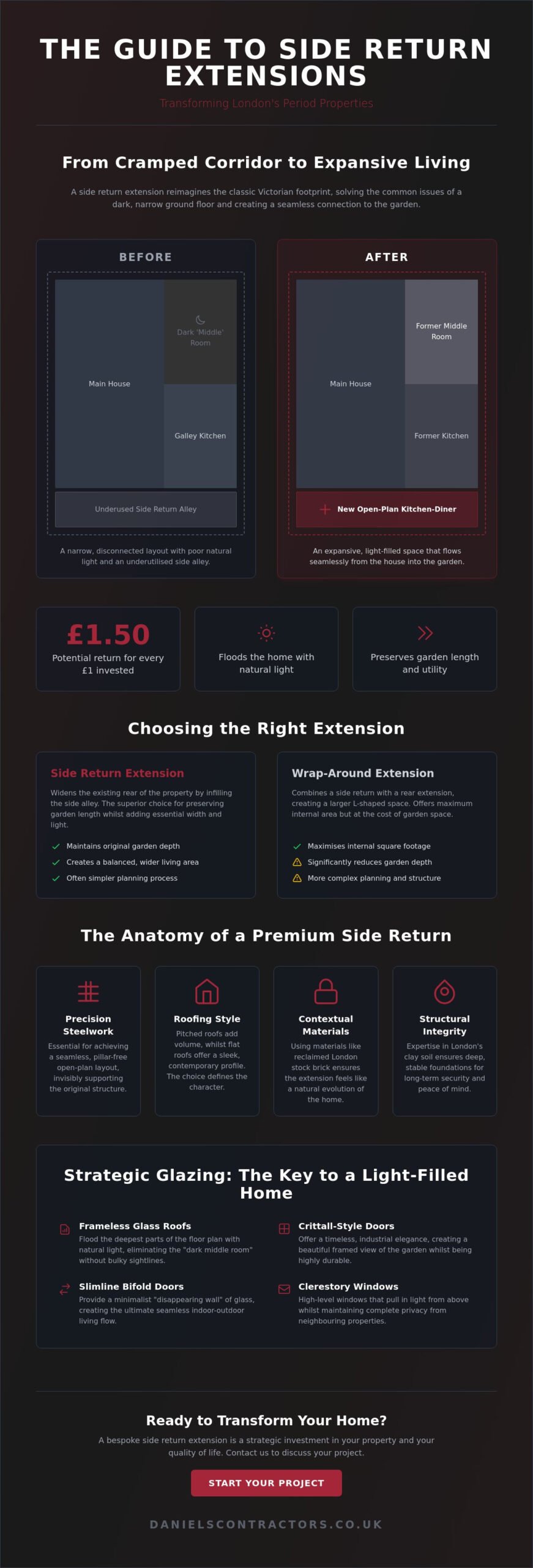
In the competitive London property market, a side return extension is far more than a simple infill; it’s a strategic architectural reimagining that can return as much as £1.50 for every £1 invested. You likely feel the daily frustration of a cramped, dark galley kitchen and that windowless middle room that serves little purpose. It’s a common struggle for owners of Victorian and Edwardian terraces who want to host friends but find themselves trapped in narrow corridors whilst the garden remains an underused afterthought.
Discover how a bespoke side return extension can transform your narrow period property into a spacious, light-filled luxury home that prioritises both craftsmanship and function. We will guide you through the 2026 landscape of property value increases and ROI, providing clarity on the complexities of London planning and party wall agreements. From choosing high-specification glazing to achieving a seamless indoor-outdoor living flow, this article provides the roadmap for a kitchen-diner that feels architecturally significant and adds substantial value to your home.
Key Takeaways
- Learn how a bespoke side return extension transforms narrow Victorian footprints into expansive, light-filled spaces whilst preserving your garden’s utility.
- Understand the structural role of precision steelwork in achieving a seamless, pillar-free layout that connects your interior living space to the outdoors.
- Discover the specific criteria for Permitted Development to navigate London’s complex planning landscape and streamline your home’s transformation.
- Master strategic glazing and roof light placement to eliminate dark “middle rooms” and flood your ground floor with natural light.
- Identify the essential differences between a standard “infill” build and a bespoke architectural project that prioritises structural integrity and high-end finishes.
Understanding the Side Return Extension: A Solution for Period Properties
A side return extension involves infilling the narrow strip of land that runs alongside the rear projection of a house. For many owners of terraced houses in the United Kingdom, this underutilised space is the key to unlocking a property’s true potential. Unlike a full rear extension, this modification focuses on widening the existing footprint to create a more balanced internal volume. It’s a precise structural intervention that preserves the precious length of your garden whilst fundamentally changing how you experience the ground floor.
When planning this type of project, you’re addressing the primary frustration of London living: the galley kitchen bottleneck. Most period terraces feature a narrow, isolated kitchen that makes social cooking or family gatherings nearly impossible. By incorporating the side alley, you create a generous, open-plan kitchen-diner. This shift doesn’t just add square metres; it resolves the awkward flow of period layouts by connecting the front of the house to the garden in a single, cohesive movement. It’s about creating a home that breathes.
The Anatomy of the London “Outrigger”
The original L-shaped footprint of 19th-century homes was designed for utility rather than comfort. The “outrigger” typically housed the scullery and coal store, leaving the side return as an outdoor passage for light and drainage access. Today, this space often becomes a neglected corridor for bins or bicycles. Transforming this dumping ground into a premium living area requires a deep understanding of the original masonry and load-bearing points, honouring the home’s history whilst modernising its function.
Side Return vs. Wrap-Around Extensions
Choosing between a side return and a wrap-around extension depends on your plot width and lifestyle requirements. A wrap-around combines the side infill with a rear extension to create a larger L-shaped space. Whilst it offers maximum square footage, it significantly reduces garden depth and often requires more complex planning permissions. For many homeowners, the side return extension is the superior choice because it provides essential architectural breathing room without overwhelming the outdoor sanctuary or sacrificing the garden’s length.
The Architectural Anatomy of a Premium Side Return
A premium side return extension relies on hidden engineering to achieve its most striking effects. The most successful projects utilise a sophisticated structural steel frame to create a pillar-free environment, allowing the original house and the new addition to merge into one expansive room. Without these hidden supports, you’re often left with awkward nibs or columns that disrupt the visual flow. When you align the floor levels perfectly between the old and new sections, the transition becomes invisible, reinforcing the sense of architectural integrity. If you’re planning a bespoke house extension, these structural nuances define the final quality of the living space.
Roofing choice is equally vital for the internal atmosphere. A pitched roof can offer a sense of traditional volume, whilst a flat roof provides a contemporary, sleek profile that often simplifies the interface with the original building. Regardless of the style, the material finish should respect the local context. Using reclaimed London stock brick ensures the new masonry feels like a natural evolution of the property rather than a jarring addition.
Glazing and Natural Light Solutions
To solve the “dark middle room” problem, we often specify frameless glass roofs. These flood the deep interior with light without the bulky sightlines of standard skylights. For the garden threshold, bespoke Crittall-style doors offer a timeless, industrial elegance, whilst slimline aluminium bifolds provide a more minimalist, “disappearing” wall of glass. Clerestory windows are another excellent tool; they pull in light from above whilst maintaining total privacy from neighbours.
Structural Integrity and Foundations
London’s notorious clay soil requires a steady hand and technical expertise. Depending on the proximity of trees or the depth of existing footings, deep foundations or piling may be necessary to ensure long-term stability. This technical rigour extends to the “knocking through” process, where precision is paramount to protect the original load-bearing walls. Whilst we focus on aesthetics, we never overlook thermal efficiency. High-performance glazing and advanced insulation ensure your side return extension remains comfortable throughout the year. For those navigating the technicalities of height and boundary limits, the official UK government guidance provides the baseline for what’s achievable under current regulations.
Navigating Planning Permission, Permitted Development, and Party Walls
Securing the necessary approvals is a critical phase that demands a methodical and transparent approach. Many homeowners find that a side return extension falls under Permitted Development (PD) rights, which can significantly streamline the pre-construction timeline. To qualify, the extension must be single-storey, have a maximum height of 4 metres, and be no wider than half the width of the original house. Whilst these rules offer a helpful framework, they aren’t a universal green light. In inner London boroughs, an estimated 35-40% of extension projects still require full planning permission due to local constraints or ambitious design choices. For a detailed breakdown of the specific height limits and the essential 50% width rule that will dictate your design, our guide to side extension permitted development for London homeowners provides the technical clarity you need before committing to a design.
If your property is a flat, a maisonette, or situated within a conservation area, PD rights are typically restricted or removed entirely. In these instances, a full planning application becomes necessary. Whilst this adds a layer of scrutiny, it also allows for greater architectural freedom, such as increased ceiling heights or complex roof shapes that PD might otherwise prohibit. Regardless of the planning route, obtaining Building Regulations certification is a non-negotiable requirement. This process ensures the structural safety, fire protection, and thermal efficiency of your project meet the rigorous standards expected in 2026.
The Party Wall Act 1996: A London Essential
In the tightly packed streets of the capital, the Party Wall Act 1996 is a vital piece of legislation. Because a side return involves work on or near the boundary line, you’re legally required to serve notice to your neighbours. If they don’t consent within fourteen days, a formal Party Wall Award is required. This document, often costing between £800 and £1,500 per adjoining owner for a standard agreement, protects everyone’s interests. It includes a meticulous “Schedule of Condition” to record the state of the neighbouring property before work begins, providing peace of mind for all parties involved.
Local Authority Nuances in London Boroughs
Each London borough has its own distinct personality and planning tendencies. For example, projects in Kensington or Fulham often face stricter aesthetic requirements to preserve the historical character of the streetscape. You must also consider “Right to Light” issues, ensuring your new structure doesn’t unfairly diminish the natural light reaching a neighbour’s window. Navigating these local sensitivities requires experience and a visionary eye. Consulting with the design team at Daniels Contractors early in the process ensures your vision aligns with local policy, saving valuable time and avoiding costly revisions during the planning phase.
Strategic Design: Balancing Light, Layout, and Luxury
A successful side return extension does not simply add a box to the side of your home; it reimagines the entire ground floor. The most common design failure in London terraces is the creation of a “dark middle room” where the original dining area loses its window to the new structure. We solve this by using strategic roof light placement, ensuring that natural light penetrates deep into the heart of the house. By angling glass sections or using oversized frameless skylights, we can flood previously gloomy corners with sun throughout the day. This approach turns a structural necessity into an architectural feature that enhances the mood of every room.
Zoning is the next essential step in creating a luxury feel within a narrow footprint. Whilst an open-plan layout is the goal, a vast, undefined space can feel cold and uninviting. We use bespoke joinery and carefully positioned kitchen islands to define distinct areas for cooking, dining, and relaxation. A “snug” area near the garden, for example, offers a quiet retreat whilst remaining part of the social flow. The psychological impact of increased ceiling heights cannot be overstated. A vaulted roof or a dropped floor level can make a standard 2.4-metre ceiling feel significantly more expansive, giving the new kitchen-diner a sense of grandeur that belies its actual width.
Creating Indoor-Outdoor Flow
To truly maximise the sense of space, you must blur the boundary between your kitchen and the garden. We achieve this through level-threshold flooring, where the internal tiles or timber planks sit at the exact same height as the exterior patio. When paired with slimline glazing, the eye is drawn past the glass, making the garden feel like an extension of the living room. Co-ordinating your landscaping with your interior finishes, such as using similar stone textures or colour palettes, reinforces this cohesive aesthetic. We position every pane of glass to frame specific views, ensuring you maintain privacy from neighbours whilst enjoying a lush, green backdrop.
Interior Finishes for High-End Refurbishments
The choice of materials is what elevates a project from a standard build to a bespoke masterpiece. Flooring must be robust enough for high-traffic kitchen use whilst being elegant enough for a dining area. Lighting design is the final layer of luxury; we recommend a mix of task lighting for food preparation, ambient dimmers for evening meals, and accent lights to highlight architectural details. Integrating these elements into wider bespoke house extensions London ensures your entire home feels unified and thoughtfully curated. If you are ready to explore how these design principles can work for your property, our team at Daniels Contractors is here to help you begin the design process.
Executing Your Vision: Why a Bespoke Approach Matters
The final success of a side return extension depends entirely on the transition from architectural concept to physical reality. Whilst many volume builders treat these projects as a standard “infill” exercise, a bespoke approach acknowledges the unique structural demands of London’s period housing stock. Choosing a partner with 25 years of London-specific expertise ensures that the technical challenges, such as the clay soil conditions and structural openings mentioned earlier, are managed with absolute precision. This level of craftsmanship prevents the common pitfalls of poorly integrated steelwork or misaligned floor levels that can mar an otherwise beautiful design.
We believe that peace of mind is just as important as the final aesthetic. This is why transparent project management and fixed-price contracts are central to our philosophy. In a market where material costs and regulations are constantly evolving, having a clear, reliable financial framework protects your investment. Precision in the early structural stages is vital. By getting the foundations and “knock-through” exactly right, we prevent the costly delays and remedial works that often plague less meticulously planned builds. It’s about doing the job right the first time, with a quiet confidence that only comes from decades of experience.
The Daniels Contractors Process
Our journey with you begins with a detailed design consultation, where we translate your lifestyle needs into a viable structural plan. We don’t work in isolation; we collaborate closely with architects and surveyors to ensure every detail of your side return extension meets both your vision and Building Regulations. Our process is methodical and steady:
- Initial Design & Survey: Assessing the L-shaped footprint and boundary conditions.
- Structural Engineering: Specifying the precision steelwork for a pillar-free space.
- Meticulous Build: Executing the excavation and masonry with minimal disruption.
- High-End Finish: Installing bespoke joinery, glazing, and lighting to your exact specification.
Next Steps for Your London Home
Preparing for your transformation starts with a clear understanding of your goals. Before our first site visit, it’s helpful to consider how you intend to zone your new kitchen-diner and what style of glazing best suits your privacy needs. In 2026, the typical timeline from the first excavation to a completed high-end finish ranges from 12 to 16 weeks, depending on the complexity of the structural work and bespoke finishes required. We take the time to guide you through every milestone, ensuring the process is as seamless as the final result. Ready to transform your property? Contact Daniels Contractors for a bespoke consultation.
Transforming Your London Home with Confidence
A side return extension represents a strategic investment in your property’s future. It offers a rare opportunity to harmonise heritage architecture with modern functionality. By resolving the limitations of the traditional galley kitchen and introducing strategic glazing, you create a home that feels both expansive and intentionally designed. Success lies in the meticulous balance of structural precision, planning compliance, and high-end interior finishes that we’ve explored throughout this guide.
Begin your journey toward a bespoke house extension today and unlock the hidden potential of your period home. Your vision for a light-filled, social sanctuary is entirely achievable with the right expertise by your side.
Frequently Asked Questions
Do I need planning permission for a side return extension in London?
Many side return extensions fall under Permitted Development rights, provided they meet specific criteria regarding height and width. However, if your property is a flat, a listed building, or situated within one of London’s many conservation areas, you’ll likely need to submit a full planning application. Industry data suggests that approximately 35-40% of extension projects in inner London boroughs require this formal approval process before work can commence.
How much value does a side return extension add to a Victorian terrace?
A well-executed side return extension can add between £50,000 and £100,000 to the value of a London property. In premium boroughs like Kensington and Chelsea, this figure can rise significantly, sometimes reaching up to £250,000. Beyond the immediate capital gain, these projects typically offer a strong return on investment because they resolve the layout issues that often deter buyers of period homes.
How long does it typically take to build a side return extension?
The construction phase for a high-specification side return usually lasts between 12 and 16 weeks. This timeline accounts for the complex structural work required to “knock through” original walls and the precision needed for installing large-format glazing. Whilst the build itself is methodical, you should also factor in the time required for the initial design, planning approvals, and serving the necessary party wall notices.
Will I lose a significant amount of light in my middle room?
You won’t lose light in your middle room if you prioritise strategic glazing in your design. By incorporating frameless glass roofs or oversized skylights into the new “infill” section, you can actually increase the amount of natural light that reaches the centre of your home. We often use these features to transform previously dark, windowless rooms into bright, inviting spaces that feel connected to the new kitchen-diner.
Do I need a Party Wall Agreement if my neighbour has already extended?
Yes, you’ll almost certainly still need a Party Wall Agreement even if your neighbour has already completed their own extension. The Party Wall Act 1996 applies to any excavation within three or six metres of a neighbouring structure, depending on the depth of the new foundations. Serving notice is a legal requirement that protects both parties and ensures that your project proceeds with the necessary structural safeguards in place.
Can I stay in my house whilst the side return extension is being built?
Staying in your home during construction is possible, but it requires careful planning and a degree of resilience. The most disruptive phase involves the structural demolition and the period whilst your home is open to the elements before the new glazing is installed. We recommend setting up a temporary kitchen in another room to maintain some sense of normality whilst the ground floor is being transformed.
What factors influence the cost of a high-end side return in 2026?
The cost of a bespoke project is primarily driven by your choice of glazing, structural complexity, and internal finishes. Using large-format sliding doors or complex steelwork to create a pillar-free space will naturally command a higher investment than a standard build. We suggest checking current market rates for specialised London construction and requesting a detailed, fixed-price quote that covers everything from excavation to the final decorative touches.
Is a side return extension possible on a semi-detached house?
A side return extension is entirely feasible on a semi-detached house, provided there’s an existing side alley or redundant space alongside the rear outrigger. Whilst these projects are most common in terraced streets, semi-detached owners often use this approach to create a wider, more social kitchen-diner without extending further into the garden. It’s an excellent way to modernise the traditional L-shaped layout whilst maintaining a generous outdoor area. For further inspiration on how to shape your new space, exploring kitchen extension ideas for luxury London homes can help you refine your design priorities before work begins.