
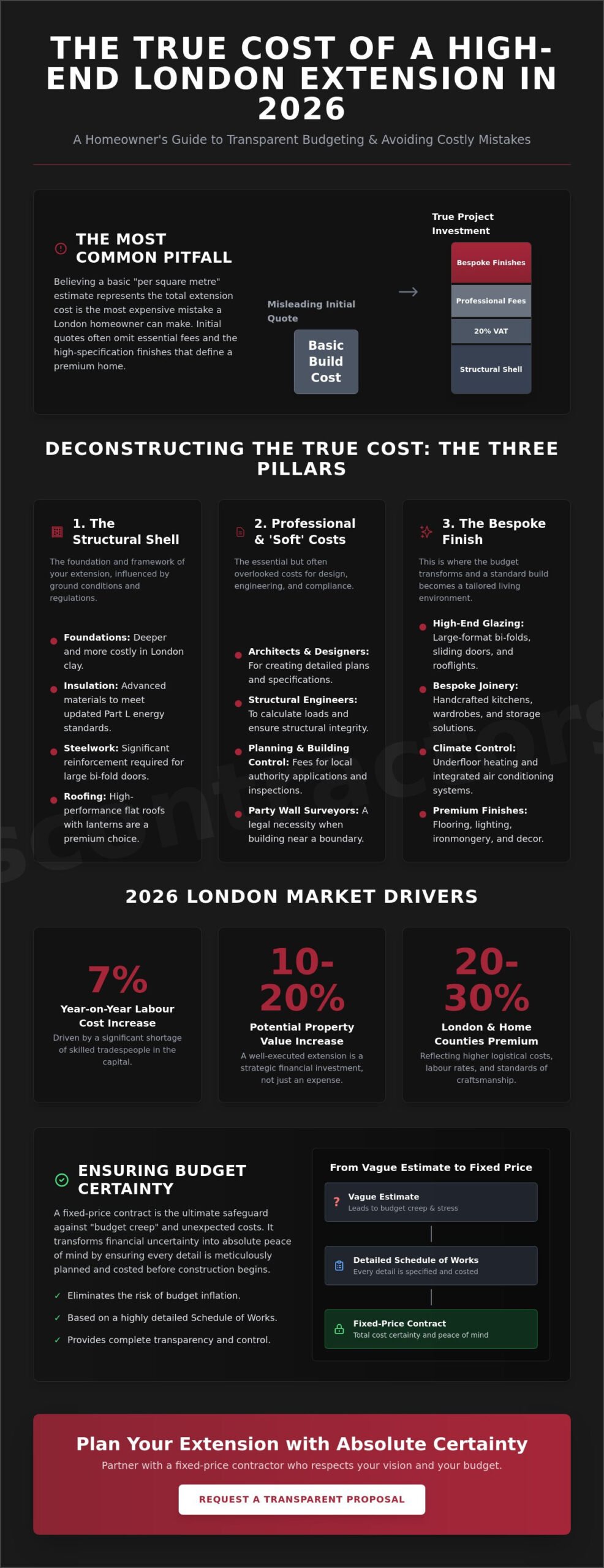
The most expensive mistake a London homeowner can make in 2026 is believing that a basic “per square metre” estimate represents the total extension cost. You’ve likely encountered quotes that seem manageable at first, only to find they omit essential professional fees or the high-specification finishes that define a premium home. It’s a common frustration to feel that your project’s budget is inflating whilst the actual scope remains unclear, leaving you uncertain about the final investment required.
We understand that you value transparency and precision over vague estimates. This guide provides a clear, honest breakdown of what it takes to deliver a high-end extension in today’s market, considering the 7% year-on-year increase in labour costs and the latest building regulations. You’ll discover how to distinguish between a basic structural shell and a bespoke turnkey result so you can plan your investment with absolute certainty. We’ll explore the primary cost drivers for the current year and provide a reliable framework for choosing a fixed-price contractor who respects your vision and your peace of mind.
Key Takeaways
- Identify the true components of an extension cost by integrating structural builds, professional fees, and bespoke interior finishes into your initial budget.
- Recognise why standard “per square metre” rates often fail to account for the complexities of high-end London projects and turnkey delivery.
- Account for essential “soft costs” and the 20% VAT requirement to ensure your financial planning remains robust and transparent.
- Discover how fixed-price contracts and meticulous project management eliminate the risk of unexpected budget inflation during construction.
Understanding Extension Cost in the 2026 London Market
Calculating a realistic extension cost requires looking far beyond the initial structural build. In the current market, a truly transparent budget is composed of three distinct pillars: the structural shell, professional fees, and the interior finishing. Whilst it’s tempting to focus solely on the bricks and mortar, the “soft costs” and high-end specifications often define the final investment. Homeowners in London and the Home Counties should anticipate a 20-30% premium over national averages, reflecting the unique logistical demands and the higher standard of craftsmanship required in the capital.
The 2026 landscape presents a shift in construction dynamics. Whilst material prices have found a steady rhythm after years of volatility, the industry faces a significant shortage of skilled tradespeople. This scarcity has driven a 7% year-on-year increase in labour costs, contributing to an overall 3-4% rise in project totals since 2025. Viewing these figures as an investment rather than a simple expense is vital. A well-executed project can add between 10% and 20% to your property’s value, making the process of commissioning a bespoke home extension a strategic financial move for the long term.
The 2026 Economic Landscape for Homeowners
High interest rates and the substantial costs associated with moving have solidified the “improve, don’t move” trend amongst London residents. This shift has placed a premium on sustainable building practices. The updated Part L of the Building Regulations now mandates higher energy efficiency standards, requiring advanced insulation and heat pump integration. Whilst these “green premiums” increase the initial capital outlay, they provide essential future-proofing and lower operational costs, ensuring your extension cost delivers value for decades.
Regional Cost Variances: London vs. Surrey and Essex
Logistical complexities play a decisive role in regional pricing. A project in Central London often involves narrow access, expensive skip permits, and the constant challenge of parking for tradespeople. These frictions inevitably inflate the budget. In contrast, projects in Surrey or Essex often offer more “space for your pound” structurally, as easier site access allows for more efficient workflows. However, local borough planning departments in these areas can be more stringent regarding aesthetic harmony, which may influence the duration and complexity of the design phase. Homeowners in these areas should consider working with bespoke builders Surrey residents trust to navigate these local planning nuances with confidence.
The “Per Square Metre” Myth: Shell vs. Bespoke Finish
Precision in the early stages prevents unexpected budget inflation. A detailed Schedule of Works acts as your financial roadmap, preventing the “budget creep” that often plagues less organised projects. This document should specify everything from the exact floor finish to the internal door ironmongery. Our team at Daniels Contractors provides a meticulous Design service to ensure every detail is costed with absolute precision before the first brick is laid. This methodical approach provides the peace of mind that your vision will be delivered without compromise.
The Structural Shell: Foundations to Roof
The ground beneath your property dictates the first major variable. London clay often necessitates deeper, more expensive foundations compared to the more forgiving Surrey soil types. For 2026 compliance, wall construction must now incorporate advanced insulation materials to meet stringent thermal performance standards. Your choice of roofing also plays a pivotal role. Whilst standard tiles offer a traditional look, high-performance flat-roof systems with integrated roof lanterns provide the aesthetic and functional value expected in a modern transformation.
The Bespoke Finish: Where the Budget Transforms
This is where the budget truly transforms. High-end glazing systems, handcrafted bespoke joinery, and integrated climate control represent significant investments that elevate a space from a simple room to a tailored living environment. It is helpful to reference the legal definition of self-build and custom-build projects, as many premium extensions fall into this category of commissioned excellence. In many instances, the investment in these bespoke finishes can double the initial structural extension cost of the project.
Cost Drivers by Extension Type: Side Returns to Double Storeys
The architectural format you select dictates more than just the floor plan; it is the primary factor in determining your total extension cost. In the dense urban landscape of London and the Home Counties, homeowners must weigh the structural complexity of a build against its potential value uplift. While rear extensions are common, the most transformative results often come from more intricate configurations that require a higher level of craftsmanship and structural engineering. The premium nature of wraparound extensions, which combine both side and rear additions, makes them a popular choice for those seeking a dramatic lifestyle change. These projects often require complex steel frameworks to support the existing house, yet they offer unparalleled open-plan living.
According to recent statistics on the self-build sector, the demand for custom, high-quality residential modifications continues to grow as owners seek to maximise their property’s potential. For those planning bespoke house extensions London, the focus shifts from simply adding area to creating a tailored environment that complements the existing period architecture whilst introducing modern functionality.
Side Return Extensions: The London Favourite
For owners of Victorian and Edwardian terraced homes, the side return extension is an elegant solution for reclaiming the “dead space” typically found alongside the rear outrigger. Although these projects cover a smaller footprint, usually between 8 and 15 square metres, they are structurally intensive. Supporting the existing flank wall whilst opening the interior requires precision and care. Glazing becomes a critical investment here; roof lights and slim-frame sliding doors are essential to ensure natural light penetrates deep into the original rooms of the house. You’ll find that whilst the total extension cost is lower than a full wraparound, the price per square metre is often higher due to these structural requirements.
Double Storey and Multi-Level Additions
A double-storey extension often provides the best “cost per bedroom” ratio of any project type. This efficiency exists because the most expensive elements, the foundations and the roof, are shared across two levels. Adding a second storey typically increases the construction budget by only 50% to 70% rather than doubling it, making it a financially savvy way to add significant square footage. However, these additions carry greater planning complexities, particularly in conservation areas where the new structure must integrate seamlessly with the original building. Navigating these requirements demands an expert eye to ensure the transition between old and new is both beautiful and compliant.
Beyond the Build: Professional Fees and Hidden Costs
A common oversight in the planning phase is the failure to account for the “soft costs” that surround the physical construction. Whilst your primary focus may be on the extension cost of materials and labour, these ancillary expenses are non-negotiable for a compliant, high-specification build. The most significant of these is Value Added Tax (VAT). It is standard for VAT on extensions to be 20% for most residential work, and omitting this from your initial calculations can lead to a sudden and stressful 20% shortfall in your available funds.
The Professional Team: Architects to Surveyors
Assembling the right expertise is essential for navigating the complex regulatory environment of the capital. You should budget for a range of professional fees that typically include:
- Architectural Fees: Expect to invest between 8% and 15% of the construction cost for a comprehensive design and management service. Understanding how your architect structures their work across each stage is made significantly clearer by following the RIBA Plan of Work, which defines exactly when key decisions and payments should occur throughout your project.
- Structural Engineering: Essential for any structural opening, with fees ranging from £500 to £1,200 for standard projects.
- Party Wall Surveyors: In dense London neighbourhoods, this is often mandatory. Costs can range from £1,500 to £3,000 per neighbour.
- Planning and Building Control: A householder application currently costs £548, whilst local authority inspection fees typically range from £800 to £1,500.
Site Logistics and Compliance
The physical constraints of London sites introduce logistical costs that are often absent in more spacious regions. Skip hire and parking permits for tradespeople are daily expenses that accumulate over the duration of a project. Scaffolding for restricted sites also requires careful budgeting, especially if it needs to bridge over public footpaths. To protect your investment, ensure you use a JCT (Joint Contracts Tribunal) contract and secure a structural warranty. These documents provide the legal framework for accountability and quality. If you are ready to begin your journey with a team that values total transparency, we invite you to explore our Design and Build services to see how we manage these complexities on your behalf.
Ensuring Certainty: The Value of Fixed-Price Contracts
The Daniels Contractors Approach to Transparency
We believe that clarity is the foundation of trust. Our team provides meticulously detailed quotes that eliminate “grey areas” and ensure you understand exactly where your investment is directed. This transparency is backed by dedicated project managers who are responsible for maintaining our 2026 delivery schedules, ensuring that your home is returned to you on time and to our exacting standards. Our expertise extends beyond traditional additions; we are also specialists in luxury basement conversion London, handling the extreme structural complexities of subterranean living with the same precision we apply to our surface extensions.
Your Next Steps: From Vision to Valuation
Turning a vision into a reality requires a methodical transition from broad ideas to specific requirements. An initial consultation is the most effective way to refine your bespoke needs and assess the feasibility of your project against your desired outcome. To facilitate an accurate, fixed-price quote, we recommend preparing a brief that outlines your aesthetic preferences and functional priorities. This allows us to provide a comprehensive breakdown that respects your budget and your ambition. If you are ready to secure your property’s future with a partner who values integrity as much as you do, enquire with Daniels Contractors for a bespoke extension consultation today.
Transform Your Home with Absolute Financial Confidence
Navigating the complexities of a premium London build requires a fundamental shift from viewing your project as a simple square-metre calculation to understanding it as a bespoke investment. By clearly distinguishing between the structural shell and the high-specification finishes that define luxury living, you gain a realistic and sophisticated perspective on your total extension cost. Factoring in essential professional fees and the mandatory 20% VAT from the outset ensures your budget remains robust, transparent, and entirely manageable.
Since 2001, we’ve dedicated ourselves to delivering luxury developments across the capital with a focus on structural precision and meticulous craftsmanship. Our fixed-price contracts are specifically designed to provide total financial peace of mind, effectively eliminating the risk of mid-project budget inflation. We’re ready to help you realise the full potential of your property with a methodical approach rooted in integrity and technical expertise. Begin your bespoke extension journey with a professional consultation and take the first step toward a seamless, high-end transformation that respects both your vision and your investment.
Frequently Asked Questions
How much does a 3-metre rear extension cost in London in 2026?
A 3-metre rear extension in London generally ranges from £60,000 to £135,000 depending on the level of interior specification and structural complexity. While this represents a significant investment, the final figure is dictated by your choice of finishes and glazing systems. It’s essential to look beyond the base construction to understand the total extension cost, including the bespoke elements that turn a structural shell into a tailored living space.
Do I need an architect for a small house extension?
Whilst you aren’t legally required to hire an architect for smaller projects, their involvement is vital for achieving a high-end finish and navigating complex building regulations. An architect provides the technical precision needed to maximise light and space in narrow London plots. Their detailed drawings also serve as the foundation for a fixed-price contract, ensuring that every element of your vision is accurately costed and executed with integrity.
Is a double-storey extension more cost-effective than a single-storey?
A double-storey extension is often the most financially efficient way to add space because the expensive groundwork and roofing costs are shared across two floors. You’ll typically find that adding a second level increases the budget by only 50% to 70% rather than doubling it. This makes the cost per bedroom significantly lower than a single-storey addition, providing excellent long-term value for growing families in London and the Home Counties.
How much should I budget for professional fees and VAT?
You should allocate approximately 10% to 15% of your construction budget for professional fees, plus the mandatory 20% VAT on all labour and materials. Professional costs include architects, structural engineers, and party wall surveyors, all of whom are essential for a compliant build. Factoring these “soft costs” into your initial financial planning is the only way to budget with absolute confidence and avoid mid-project shortfalls.
What are the most common hidden costs in London extensions?
The most frequent hidden costs in London involve party wall agreements, local authority permits for skips, and structural remedial work in period properties. Older Victorian and Edwardian homes often hide historical issues like shallow foundations or aged drainage systems that only appear once work starts. Maintaining a 10% to 15% contingency fund allows our team to address these complexities without compromising the momentum or quality of your bespoke transformation.
How can I ensure my extension stays within the agreed budget?
The most reliable way to maintain your budget is to secure a detailed, fixed-price construction contract based on a comprehensive schedule of works. This document eliminates “grey areas” by defining every material and finish before the first brick is laid. By partnering with a main contractor who manages all trades under one point of accountability, you protect yourself from the price fluctuations and hidden surcharges common in estimate-based billing.
Does an extension always add more value than it costs to build?
A well-executed extension typically adds between 10% and 20% to a London property’s value, often exceeding the initial extension cost. The true financial benefit depends on the quality of the finish and how well the new space integrates with the existing architecture. High-specification additions in sought-after neighbourhoods offer the strongest returns, as they appeal to buyers looking for turnkey, bespoke homes that require no further work.
How long does a typical high-end extension take to complete?
Most high-end extensions in London take between 12 and 20 weeks to complete, though this varies based on the project’s structural complexity. It’s also important to account for a lead time of 3 to 6 months for reputable builders to begin. A methodical pace ensures that every detail, from the structural steelwork to the bespoke joinery, is executed with the meticulous attention to detail your home deserves.