
Could a simple lack of structure be the silent thief of your renovation budget? Most homeowners embark on a high-end project with a clear vision of the aesthetic, yet they often feel a lingering anxiety about the “black box” of construction timelines and costs. It’s a common worry, but you deserve a process that treats your investment with the same level of precision as the bespoke finishes in your new home. Whether you’re planning a basement conversion or a sophisticated extension, the path to a successful build shouldn’t be a mystery.
By understanding the RIBA Plan of Work 2020, you gain a definitive roadmap to the design and build process UK professionals use to deliver excellence. This framework eliminates the confusion regarding when to involve specific experts and how to keep costs from spiralling during the creative phase. In this guide, we’ll walk you through each stage of the journey, from initial feasibility to the final handover. This steady, methodical approach ensures your luxury London renovation meets the highest standards of craftsmanship whilst maintaining complete transparency at every milestone.
Key Takeaways
- Learn how the RIBA Plan of Work acts as a transparent, eight-stage roadmap for your renovation, ensuring every professional is aligned from the first sketch to the final handover.
- Master the design and build process UK homeowners use to maintain architectural integrity whilst managing project costs through meticulous spatial coordination.
- Understand why Stage 4 Technical Design is the most critical phase for securing fixed-price certainty and detailed specifications before any work begins on-site.
- Identify the benefits of involving a master builder early in the framework to ensure technical buildability and to mitigate the unique structural risks of London projects.
- Gain confidence in the completion phase by mastering the formal handover process and understanding your protections during the defects liability period.
What is the RIBA Plan of Work and Why Does it Matter?
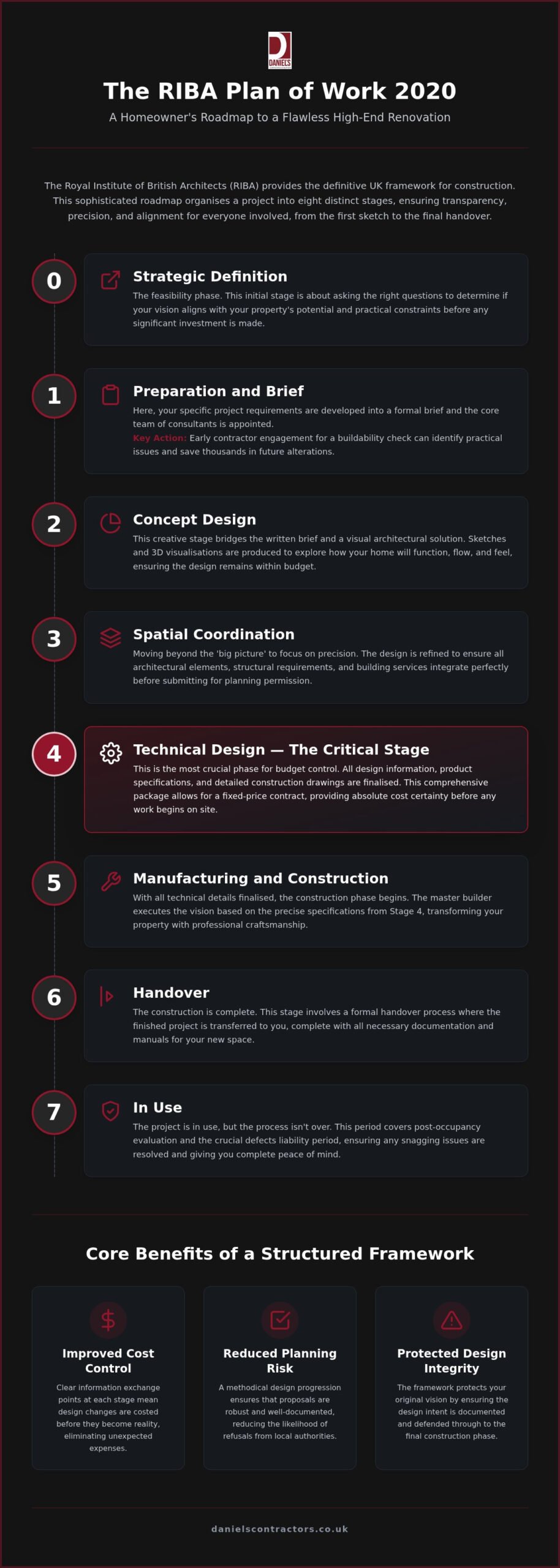
The Royal Institute of British Architects (RIBA) provides the definitive framework for managing construction in the United Kingdom. Known as the RIBA Plan of Work, it’s a sophisticated roadmap that organises the entire lifecycle of a building project into eight distinct stages, numbered 0 through 7. For a homeowner, this framework isn’t just a technical document for professionals; it’s your primary tool for transparency and precision. It ensures that every member of your team, from the initial designer to the lead contractor, follows the same sequence of information exchange.
Adopting this framework is essential for a successful design and build process UK. It prevents the common pitfalls of luxury renovations, such as missing critical structural assessments or discovering hidden costs once the builders are already on-site. By following a methodical progression, you maintain a clear line of sight over your project’s evolution from the first sketch to the final coat of paint.
Stage 0 and 1: Setting the Foundations
Stage 0, or Strategic Definition, is where you determine if your vision aligns with your property’s potential. It’s a feasibility phase that asks the hard questions before a single brick is moved. Following this, Stage 1 (Preparation and Brief) involves developing your specific requirements and appointing your core team of consultants.
Early contractor engagement during Stage 1 is a wise investment. Whilst many wait until Stage 4 to speak to a builder, involving a lead contractor early allows for a buildability check. This collaborative approach can save thousands of pounds in future structural alterations by identifying practical constraints while the design is still fluid. It bridges the gap between architectural vision and the realities of the site.
The Benefits of a Structured Framework
A structured framework offers more than just an organised schedule; it provides financial and legal security. This methodical approach transforms a complex construction project into a series of manageable, transparent milestones.
- Improved cost control: Clear information exchange points at each stage mean that design changes are costed before they become reality.
- Reduced planning risk: Methodical design progression ensures that your proposals are robust, reducing the likelihood of refusals from local authorities.
- Design integrity: The framework protects your original vision by ensuring the design intent is documented and defended through to the construction phase.
The Design Journey: From Concept to Spatial Coordination
The transition from abstract ideas to a defined architectural vision is the most inspiring phase of the design and build process UK. It is the period where your lifestyle requirements transform into a tangible layout through a series of iterative drawings and models. By adhering to the RIBA Plan of Work, this creative journey remains disciplined, ensuring that aesthetic ambition never outpaces practical reality. This phase solidifies the look and feel of your luxury home, providing a sense of certainty before the intensive technical work begins.
Stage 2: Bringing Your Vision to Life
Concept Design acts as the bridge between a written brief and a visual architectural solution. During this stage, your design team produces sketches and 3D visualisations that explore how your home will function and flow. In London, this requires a delicate balance. You must weigh modern luxury against the constraints of heritage conservation, overlooking issues, and the city’s unique property density. We provide detailed reviews of initial cost estimates during this phase. This ensures that your bespoke design remains within the agreed budget whilst still delivering the master craftsmanship you desire.
Stage 3: Navigating Planning and Spatial Layouts
Stage 3, known as Spatial Coordination, moves beyond the “big picture” to focus on precision. It is the moment where the design is refined to ensure all architectural elements, structural requirements, and building services fit together perfectly. This coordination is particularly vital for complex projects like a luxury basement conversion London. In these subterranean projects, the engineering must be invisible, supporting the home whilst allowing for the expansive, high-end living standards that define a premium renovation.
The successful completion of Stage 3 usually coincides with the submission of your planning application to the local borough. Your professional team will finalise a strategy that meets the rigorous requirements of London planning officers and heritage consultants. This methodical progression protects the design intent and minimises the risk of costly revisions during construction. If you are beginning to visualise your project’s potential, consulting with an experienced builder during these early stages can provide invaluable insights into the practicalities of your spatial layout.
Stage 4: The Crucial Role of Technical Design
Stage 4 represents the most intensive phase of the design and build process UK. It’s the moment where the aesthetic vision established in previous stages meets the rigorous reality of engineering. During this phase, your design team specifies every nut, bolt, and finish in exhaustive detail. This isn’t merely about aesthetics; it’s about creating a comprehensive technical blueprint that ensures your home is high-performing, safe, and built to last. By investing in this level of detail, you bridge the gap between a beautiful drawing and a buildable structure.
This commitment to structured planning reflects the standards found in The Construction Playbook, which provides the government’s official guidance on project success through thorough preparation. For a luxury renovation, Stage 4 is what transforms a creative concept into a professional tender package. It provides the clarity needed for contractors to offer fixed-price certainty, protecting you from the “black box” of spiralling costs once the physical work begins.
Creating a Robust Tender Package
A robust tender package is the foundation of a transparent relationship between a homeowner and their builder. It includes detailed specifications for every element of the project, from bespoke joinery and high-end bathroom finishes to complex structural steelwork. We ensure that Building Regulations compliance, including the latest requirements of the Building Safety Act 2022, is fully integrated into these construction drawings. This meticulous approach prevents on-site delays and reduces the need for “provisional sums.” At Daniels Contractors, we use this precise Stage 4 data to provide transparent and accurate project quotes, ensuring you know exactly where your investment is going before a single brick is laid.
The Transition to Construction
Once the technical design is complete, you must select the most appropriate procurement route to bring the vision to life. Many clients opt for a Design and Build contract, which can further streamline communication by providing a single point of accountability. Finalising the construction contract at this stage is essential for protecting your interests and establishing clear expectations for the build quality. Stage 4 is the final point of design before breaking ground occurs. By ensuring every detail is resolved on paper first, you move into the construction phase with the confidence that your project is grounded in technical excellence and master craftsmanship.
Stage 5 and 6: Construction and Professional Handover
Stage 5 is the physical manifestation of months of meticulous planning. This is the phase where the heavy lifting happens, yet it requires a delicate touch to ensure the technical design is followed precisely to the millimetre. In a complex high-end home refurbishment London, the lead contractor acts as the conductor of a sophisticated orchestra of specialist trades. Their role is to transform the technical drawings into a tangible, high-performance living space whilst maintaining the integrity of the original vision.
Regular site meetings and transparent progress reports are the heartbeat of this stage. They provide the reassurance that the construction programme remains on track. Quality control is paramount. Every structural element and service installation must meet rigorous standards before the decorative finishes begin. This methodical oversight ensures that the finished home meets your expectations for luxury and longevity.
Stage 5: Managing the Build on Site
Precision is the hallmark of a master craftsman. During the construction phase, we organise specialist trades to work in a seamless sequence, ensuring that structural work provides a perfect canvas for bespoke finishes. Managing the logistics of a London construction site is an art in itself. It requires efficient handling of restricted access, noise regulations, and stringent Health and Safety standards. By maintaining a disciplined and tidy site, we protect your investment and ensure the project moves forward with momentum and accountability. This rigour is what defines a professional design and build process UK.
Stage 6: Handover and Practical Completion
The transition from a construction site back to a private residence is a formal process known as Stage 6. This is the moment of practical completion. Before you move back in, we conduct a thorough snagging process. This involves identifying and rectifying any minor aesthetic issues to ensure the home is flawless. It is a period of refinement where the final details are polished to perfection.
Upon handover, you will receive a comprehensive Building Manual. This document contains all essential warranties, safety certificates, and maintenance guides for your home’s bespoke systems. Our commitment to your property continues through the defects liability period, which typically lasts twelve months. This period provides essential peace of mind, ensuring that any settling issues or minor adjustments are handled with the same level of care as the initial build. If you are ready to see your vision realised with this level of professional rigour, contact our team to discuss your project.
Why Professional Frameworks are Essential for London Projects
London’s architectural landscape is as challenging as it is beautiful. Whether you are planning bespoke house extensions London or a deep structural renovation, the density of the city introduces risks that general contractors often overlook. A professional framework like the RIBA Plan of Work acts as a vital safety net. It ensures that the design and build process UK homeowners follow is robust enough to handle subterranean complexities, shared boundaries, and stringent local authority demands.
For properties with historical significance, such as a Victorian house refurbishment London, the framework is even more critical. Heritage considerations shouldn’t be an afterthought; they must be managed from Stage 1. This early focus prevents the heartbreak of planning refusals or the discovery of structural decay mid-build. It separates master builders, who value technical integrity, from general contractors who might rush the delicate preparation required for period homes.
Mitigating Risk in High-Value Renovations
Urban construction requires more than just technical skill; it demands diplomacy and foresight. A structured framework allows you to manage party wall agreements and neighbourly relations during Stages 2 and 3, long before a shovel hits the ground. By identifying potential friction points early, you protect your investment and maintain the goodwill of those living around you. This methodical approach is the hallmark of a premium construction service.
Transparent project management delivers a stress-free experience. You aren’t just paying for bricks and mortar; you are investing in a process that protects your property’s long-term value in a competitive market. Knowing that your team has accounted for every urban variable gives you the confidence to enjoy the transformation of your home without the fear of spiralling costs or technical failures.
The Daniels Contractors Commitment to Excellence
At Daniels Contractors, we’ve refined our approach over 25 years of on-site expertise across London and Surrey. Since 2001, we’ve integrated the RIBA stages with our deep understanding of master craftsmanship. We place immense value on the technical detail of Stage 4. This rigour ensures that the Stage 5 construction phase is seamless, predictable, and executed to the highest standards. Our steady, methodical pace suggests a commitment to quality that does not cut corners.
Our passion for transformation is rooted in the practicalities of high-quality construction. We believe that a successful home is built twice: once in the meticulous technical drawings and once on the site itself. Ready to plan your next project? Speak with our expert team today to see how our structured approach can bring your vision to life with precision and transparency.
Building Your Vision with Professional Precision
Embracing a structured approach is the most effective way to protect your investment and ensure your architectural vision is realised without compromise. By following the stages of the RIBA Plan of Work, you transform a complex renovation into a transparent journey defined by clear milestones and technical excellence. This framework remains the gold standard for the design and build process UK homeowners trust, providing the security needed to navigate London’s unique structural and planning challenges with absolute confidence.
Since 2001, Daniels Contractors has combined this professional rigour with over 25 years of luxury construction experience across the capital. We are specialists in complex basement and loft conversions, bringing a master craftsman’s eye to every technical detail whilst expertly navigating stringent planning and heritage requirements. Our methodical approach ensures your home is delivered with the precision and care it deserves. If you are ready to begin your transformation, discuss your bespoke London project with Daniels Contractors. We look forward to bringing your vision to life with integrity and dedication to the craft.
Frequently Asked Questions
Do I need to follow all 8 RIBA stages for a small home extension?
Yes, the framework is scalable and applies to projects of all sizes. Whilst a small extension might move through Stages 0 and 1 more quickly, skipping them risks missing critical feasibility checks. Every successful design and build process UK homeowners undertake benefits from this structure. It ensures that even modest additions receive the same level of professional oversight and technical rigour as a multi-million-pound new build.
At what stage should I hire a builder like Daniels Contractors?
You should ideally involve your lead contractor during Stage 1 or 2 for early buildability advice. Whilst many wait until Stage 4, engaging a master builder early allows us to provide practical insights into structural constraints. This collaborative approach prevents expensive redesigns later in the project. It ensures that the architectural vision remains firmly rooted in the practicalities of high-quality construction and master craftsmanship from the very beginning.
What is the most important RIBA stage for controlling project costs?
Stage 4 (Technical Design) is the most critical phase for financial control. This is where every material and structural detail is specified, allowing for a fixed-price quote rather than vague estimates. By resolving technical challenges on paper, you eliminate the “provisional sums” that often lead to spiralling costs. A comprehensive technical package provides the transparency and cost certainty essential for any luxury London renovation project.
Can the RIBA Plan of Work be used for listed building refurbishments in London?
Absolutely, and it is highly recommended for heritage properties. The framework helps manage the complex requirements of heritage officers and conservation area constraints. In Stage 1 and 2, specific focus is placed on the building’s history and significance. This methodical progression ensures that bespoke solutions for your listed home are sympathetic to its character whilst meeting modern standards of performance and luxury.
What happens if we need to change the design during the construction stage?
Changes during Stage 5 are possible but often lead to delays and increased costs. If a variation is necessary, it must be formally documented and costed before work proceeds. This maintains the integrity of the contract and ensures transparency. Following a disciplined design and build process UK minimises these late changes by ensuring all spatial and technical requirements are fully coordinated before breaking ground on-site.
How long does a typical project take to move from Stage 0 to Stage 5?
For a high-end London renovation, this journey typically takes between six and twelve months. This duration accounts for the time needed for meticulous design development, complex structural engineering, and the statutory eight-week planning application window. Rushing through these preparatory stages often leads to complications during construction. A steady, methodical pace is the hallmark of a professional project that prioritises quality over speed.
What is the difference between a Concept Design and a Technical Design?
Concept Design (Stage 2) focuses on the “big picture,” including the architectural response to your brief and visual layouts. Technical Design (Stage 4) is the granular detail required for construction. It includes everything from structural calculations to the exact specification of bespoke joinery. Whilst the concept captures the vision, the technical design provides the blueprint that ensures your project is buildable, compliant, and durable.
Who is responsible for managing the information exchange between stages?
The lead consultant, often the architect or a dedicated project manager, typically oversees this exchange. Their role is to ensure that the “information requirements” for each stage are met before moving to the next. This disciplined coordination keeps the entire professional team aligned. It ensures that the design intent is protected and that the transition from architectural drawings to physical construction is seamless and transparent.