
Owning a grade 2 listed building isn’t a sentence to live in a museum; it’s an invitation to become a steward of history while crafting a home that meets modern standards of luxury. You likely feel a profound sense of responsibility for your property’s heritage, yet the fear of unauthorised works or the complexity of the curtilage rule can make even simple refurbishments feel like a legal minefield. It’s natural to worry about finding builders who truly respect the building’s fabric rather than just its facade.
This guide will help you master the intricacies of heritage regulations and the consent process, giving you the confidence to modernise your home without compromising its architectural soul. We’ll explore the legal landscape of 2026, from navigating the free Listed Building Consent application to executing high-end house extensions and sash windows repair with specialist craftsmanship. By the end, you’ll have a clear roadmap for a bespoke transformation that honours the past whilst embracing the future. You’ll move forward with the peace of mind that your project is handled with the meticulous attention to detail it deserves.
Key Takeaways
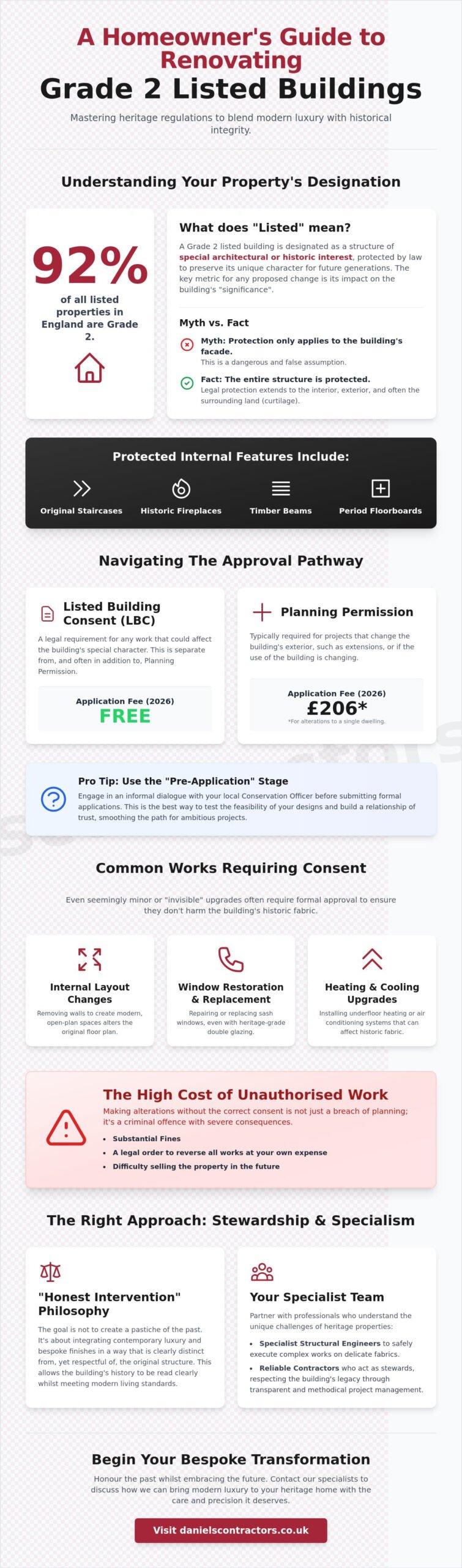
- Understand that a grade 2 listed building is protected for its special architectural interest, representing nearly 92% of all heritage properties in England.
- Learn to navigate the distinction between Listed Building Consent and Planning Permission to ensure your refurbishment project remains legally compliant.
- Discover the “honest intervention” philosophy, which allows you to integrate contemporary luxury and bespoke finishes without compromising historical integrity.
- Recognise the importance of partnering with specialist structural engineers who can safely execute complex works on delicate period fabrics.
- Identify the qualities of a reliable contractor who acts as a steward of your property’s legacy through transparent and methodical project management.
What is a Grade 2 Listed Building? Understanding the Legal Designation
A grade 2 listed building is more than just an old property; it’s a piece of national history held in trust. It carries a statutory designation as a building of special architectural or historic interest. This status means the property is protected by law to ensure its unique character survives for future generations. While many assume these buildings are rare relics, Grade 2 is actually the most common category. It accounts for approximately 92% of all listed structures in England. Understanding what is a listed building? is the first step toward successful ownership and thoughtful renovation. The metric that local authorities use to judge any proposed change is “significance.” This refers to the specific value a building holds, whether that’s its aesthetic beauty, its connection to a historical event, or its unique construction methods.
The National Heritage List for England (NHLE)
Searching the National Heritage List for England (NHLE) is essential for every owner. You can find your property’s specific entry to understand the “list description.” Be careful, though. Older entries from the 1970s or 80s are often incredibly brief. A short description doesn’t mean features aren’t protected. It simply reflects the administrative standards of the time. For modern refurbishments, a professional heritage statement is often required to fill these gaps. This document provides a detailed analysis of the building’s fabric, proving to planners that your proposed changes won’t harm its core character. It’s a vital tool for gaining peace of mind before you begin any design work.
The Myth of the “Only the Facade” Rule
One of the most persistent and dangerous myths is the “only the facade” rule. Many homeowners believe that as long as they don’t change the front of the house, they can do what they like inside. This is false. A grade 2 listed building designation protects the entire structure, including the interior and often the surrounding land, known as the curtilage. Original staircases, fireplaces, timber beams, and even floorboards are legally covered. Making unauthorised alterations isn’t just a breach of planning; it’s a criminal offence. The consequences are severe, ranging from heavy fines to a legal requirement to undo the work at your own expense. Respecting the entire fabric of the building is the only way to ensure its legacy remains intact whilst you create a space for modern living.
Listed Building Consent: Navigating Planning for Alterations
Listed Building Consent (LBC) is the essential legal gateway for any project involving a grade 2 listed building. It’s a separate requirement from standard Planning Permission. While LBC applications are free to submit in 2026, associated planning permissions for alterations to a single dwelling currently cost £206. You’ll likely need both if your project changes the building’s exterior or involves an extension. The local London borough’s Conservation Officer holds the most influence here. They evaluate every detail to ensure the property’s character remains uncompromised. This process ensures that any work is sympathetic to the building’s history.
We strongly advise clients to enter the “Pre-Application” stage for any significant refurbishment. This informal dialogue allows you to test the feasibility of luxury designs before committing to formal applications. It’s the best way to secure practical renovation advice directly from the decision-makers. Early engagement often smooths the path for more ambitious projects, as it builds a relationship of trust with the authorities from the outset.
Common Works Requiring Consent
Modernising a heritage home often involves structural or thermal upgrades that require formal approval. Internal layout changes, such as removing a wall to create a contemporary kitchen-diner, always require LBC because they alter the original floor plan. Restoration is equally scrutinised. Replacing or restoring sash windows with heritage-grade double glazing is a common request that demands precise craftsmanship to satisfy planning conditions. Even invisible upgrades, like underfloor heating or air conditioning, need approval because they can affect historic floorboards or the breathability of the masonry.
Understanding Curtilage and Outbuildings
The “curtilage” rule is a frequent source of confusion for homeowners. It means that any structure or land associated with the main building before July 1, 1948, is also protected by the listing. This includes garden walls, old stables, and even some mid-century additions. When planning bespoke house extensions, the design must respect the entire setting of the property, not just the main house. Partnering with a team that understands expert heritage design ensures your vision aligns with these stringent requirements whilst still achieving a high-end finish.
Refurbishing Period Properties: Balancing Heritage with Modern Luxury
Renovating a heritage property requires a shift in mindset. Instead of hiding the new, we embrace the “honest intervention” philosophy. This approach suggests that modern additions should be clearly contemporary whilst respecting the historic fabric. A high-end home refurbishment in London should celebrate this contrast, elevating the property’s value without erasing its narrative. This methodology aligns with the principles of the Planning (Listed Buildings and Conservation Areas) Act 1990, which seeks to preserve the significance of the property while allowing it to function as a modern home.
Technical integrity is the foundation of luxury. Old buildings must “breathe” to remain healthy. Unlike modern structures, a grade 2 listed building relies on moisture moving freely through its walls. Using non-breathable materials like gypsum plaster or cement can trap damp and cause structural decay. We utilise traditional lime plaster and mineral paints to prevent these issues. These materials allow the building to function as intended whilst providing a flawless, high-end finish that stands the test of time. Integrating 21st-century amenities, such as bespoke joinery or smart home systems, requires a master craftsman’s touch to ensure they sit comfortably within 18th or 19th-century shells. For those undertaking a luxury apartment refurbishment in London within a listed conversion, these breathability principles are equally critical to achieving a high-end finish that endures.
Sympathetic Interior Design
Selecting the right finishes is an exercise in restraint and respect. Georgian and Victorian homes possess distinct proportions that suit specific colour palettes and textures. Deep, muted tones often complement the generous volumes of Georgian rooms, whilst intricate Victorian details require a more layered approach. Restoring decorative plasterwork is a core part of the process. We use traditional moulding techniques to repair or recreate damaged cornicing. Sourcing reclaimed timber or stone ensures that new work blends seamlessly with the original fabric, maintaining the home’s soul throughout the transformation.
Upgrading Energy Efficiency in Listed Homes
Improving the thermal performance of a grade 2 listed building is a major trend in 2026, driven by “retrofit first” policies. Raising an EPC rating in a historic building is challenging but achievable through legal, discrete methods. Secondary glazing remains a popular choice for planners, yet heritage double glazing is increasingly accepted if the profile is slim enough to be unobtrusive. We focus on discrete insulation methods, such as wood fibre board, which provides significant thermal gain without compromising the masonry’s breathability or the building’s aesthetic profile.
Structural Challenges and Specialist Craftsmanship
A common objection amongst homeowners is that a grade 2 listed building is too fragile for significant structural intervention. This is a misconception. These buildings aren’t fragile; they are simply designed to move and breathe in ways that modern structures aren’t. Standard structural engineers often default to rigid solutions like heavy steel frames or concrete injections, which can cause catastrophic damage to a building designed to flex. You need a specialist engineer who understands the historical context of masonry and timber. They can design interventions that provide stability without stripping the property of its character.
The stakes are particularly high for luxury basement conversions beneath listed London terraces. Subterranean work requires a methodical approach to underpinning and water management that respects the original foundations. Preserving the value of your property also relies on the skills of a Master Craftsman. Skills such as stone masonry and leadwork are functional requirements that ensure the building remains watertight and structurally sound. These traditional techniques prevent the accelerated decay often seen when modern substitutes are used on period fabrics. Precision is non-negotiable.
Dealing with Damp and Timber Decay
Standard “damp-proofing” injections are often harmful to a grade 2 listed building. These chemicals create a non-breathable barrier that can trap moisture within the walls, leading to the decay of the very bricks they were meant to protect. We prefer a “gentle touch” approach to structural stabilisation. This involves identifying the root cause of moisture, such as blocked gutters or poor ventilation, before addressing timber issues like deathwatch beetle or dry rot. We aim to retain as much original timber as possible, using discrete resin repairs or traditional scarfed joints to maintain the integrity of the beams.
The Cost of Craftsmanship
Investing in specialist heritage skills requires a higher initial outlay, but it’s a strategy for long-term value retention. Poor-quality work or unsympathetic repairs often lead to what we call “heritage debt.” Heritage debt is the long-term financial burden of correcting non-compliant or damaging repairs. By choosing the right materials and methods from the start, you avoid future legal complications and the high cost of remedial work. It ensures your home remains an asset rather than a liability. If you’re planning a project that requires this level of care, consider a bespoke heritage refurbishment to protect your investment for the next generation.
Stewardship of History: Choosing the Right Contractor
Choosing a partner for your grade 2 listed building project is a decision that defines the property’s future. You aren’t simply hiring a builder; you’re appointing a steward of a historic legacy. This role requires a sophisticated blend of technical expertise and emotional intelligence. Old buildings are unpredictable. They reveal hidden structural issues or forgotten architectural details only once the work begins. A transparent project management style is essential to navigate these discoveries without losing momentum. When heritage is treated as an asset, it offers a level of prestige that modern builds simply cannot replicate.
A successful house renovation in London depends on a team that speaks the same language as local conservation officers. These officials aren’t barriers to progress; they are partners in preservation. A contractor who respects their perspective can often find creative solutions that satisfy both modern lifestyle needs and strict heritage guidelines. This collaborative approach turns a potentially adversarial process into a methodical, steady progression toward a high-end result. It ensures your project moves from vision to reality with quiet confidence.
What to Ask a Heritage Contractor
Vetting a contractor for a listed project requires specific questions that go beyond standard building practices. You need to know if they have experience with your specific London borough’s planning department, as interpretations of the rules can vary amongst different authorities. Ask for case studies of grade 2 listed building refurbishments they have delivered. It’s also vital to understand how they manage the delicate balance between fixed-price contracts and heritage discoveries. A reliable partner will have a clear communication strategy for when the building reveals “unknowns,” ensuring you remain in control of the budget and the timeline.
The Daniels Contractors Difference
Daniels Contractors brings over 25 years of experience to London’s most prestigious and sensitive postcodes. We understand that no two period homes are identical. Our bespoke approach ensures that your property’s unique history is integrated into a modern, luxurious living space without compromising its integrity. We pride ourselves on acting as a visionary partner, seeing the potential in your space whilst remaining firmly rooted in the practicalities of high-quality construction. Our team values the personal touch of a boutique service, providing peace of mind that your home is in the hands of those who value quality as much as you do.
Enquire about your listed building project with Daniels Contractors
Transforming Your Heritage Home for the Next Century
Owning a historic property is a rare privilege that requires a delicate touch and a long-term perspective. You’ve seen how navigating the consent process and respecting the building’s breathability are vital for preserving its value. By embracing the “honest intervention” philosophy, you can introduce contemporary luxury without erasing the historical narrative of your grade 2 listed building. The key is to treat every structural challenge as an opportunity for bespoke craftsmanship rather than a barrier to modern living.
Success lies in the meticulous details, from the precise restoration of period windows to the careful stabilisation of original timber frames. At Daniels Contractors, we bring 25 years of London heritage experience to every project we undertake. We specialise in period window and structural restoration, providing the transparent project management necessary for complex, high-end renovations. We understand the nuances of conservation and the expectations of a luxury finish.
Your home’s legacy deserves the care of a partner who values integrity and craftsmanship as much as you do. Discuss your Grade 2 listed project with our Master Craftsmen today. Let’s work together to create a space that honours its past whilst offering an unparalleled standard of comfort for the future.
Frequently Asked Questions
Can I paint the exterior of my Grade 2 listed building?
Am I allowed to install double glazing in a listed property?
Installation of double glazing is possible if you use specialist heritage units with an ultra-slim profile that mimics the look of single glazing. Many planners still prefer secondary glazing because it’s reversible and doesn’t alter the original windows. However, if your existing frames are beyond repair, you can often gain consent for high-quality replacements that match the original joinery whilst providing modern thermal efficiency.
What happens if I carry out work without Listed Building Consent?
Carrying out unauthorised work on a grade 2 listed building is a criminal offence, not just a breach of planning rules. You can face unlimited fines, a prison sentence, and a legal requirement to restore the building to its original state at your own expense. This process often devalues the property and makes it nearly impossible to sell until the issues are legally resolved.
Does Grade 2 listing affect the insurance premium of my London home?
Listing typically increases your insurance premiums because the rebuild cost is significantly higher than a standard property. Specialist materials and master craftsmen are required by law to restore heritage features, which standard policies don’t always cover. You’ll need a bespoke policy that understands the unique risks and high costs associated with authentic heritage restoration and structural repairs.
Can I build an extension on a Grade 2 listed building?
You can build an extension provided the design is sympathetic and doesn’t overwhelm the original structure. Modern additions are often favoured by conservation officers when they create a clear, high-quality distinction between the old and the new. Success depends on a design that respects the building’s setting and proves that the addition doesn’t harm the property’s overall historical significance.
Is the interior of a Grade 2 listed building always protected?
Yes, the entire grade 2 listed building is protected, including every internal room, staircase, and fireplace. Homeowners often mistakenly believe the listing only applies to the facade, but the law covers all internal features regardless of their condition. Even if a feature isn’t specifically mentioned in the National Heritage List for England entry, it’s still legally protected from unauthorised changes.
How long does it take to get Listed Building Consent in London?
The statutory period for a decision is usually eight weeks once your application is validated by the local council. In London, complex cases often take longer if the conservation officer requires additional heritage statements or detailed structural designs. You should allow at least three to four months for the entire process, including the vital pre-application stage where you can gauge the feasibility of your plans.
Can I change the internal layout of my listed home to open-plan?
Changing to an open-plan layout is challenging because the original room proportions are often central to the building’s significance. You’ll need to prove that the change doesn’t destroy the architectural narrative of the home. Planners may allow the removal of non-original partitions, but they often require original walls to be marked with “nibs” or ceiling downstands to preserve the memory of the historic floor plan.