
Did you know that over 20% of UK homeowners have faced disputes with neighbours over shared walls and boundaries? When you’re planning a bespoke transformation of your property, the legalities of shared structures can feel like a significant hurdle. You’ve likely spent months refining your vision for a luxury home, and the last thing you want is a legal injunction halting progress just as the first brick is laid. Securing a party wall agreement for house extension london is more than a mere box-ticking exercise; it’s a vital structural insurance policy that safeguards your investment and your relationships.
Key Takeaways
- Learn how to distinguish between a initial Party Wall Notice and a final Award to ensure your project remains legally compliant from the outset.
- Identify the specific structural triggers, such as the 3-metre and 6-metre excavation rules, that necessitate a party wall agreement for house extension london.
- Master the essential statutory timelines and the three distinct ways your neighbours can legally respond to your building proposal.
- Discover the “gentleman builder” approach to pre-notice communication, designed to maintain neighbourly harmony and prevent costly project delays.
- Explore how meticulous structural planning and collaboration with RICS surveyors can streamline your path to a successful bespoke extension.
What is a Party Wall Agreement and Why is it Essential for London Extensions?
The Party Wall etc. Act 1996 provides a robust legal framework designed to prevent and resolve disputes between neighbours. For homeowners in the capital, securing a party wall agreement for house extension london isn’t just a recommendation; it’s a statutory requirement that governs how you interact with shared structures. It’s a vital part of the planning process that ensures your project remains on the right side of the law while protecting your financial investment.
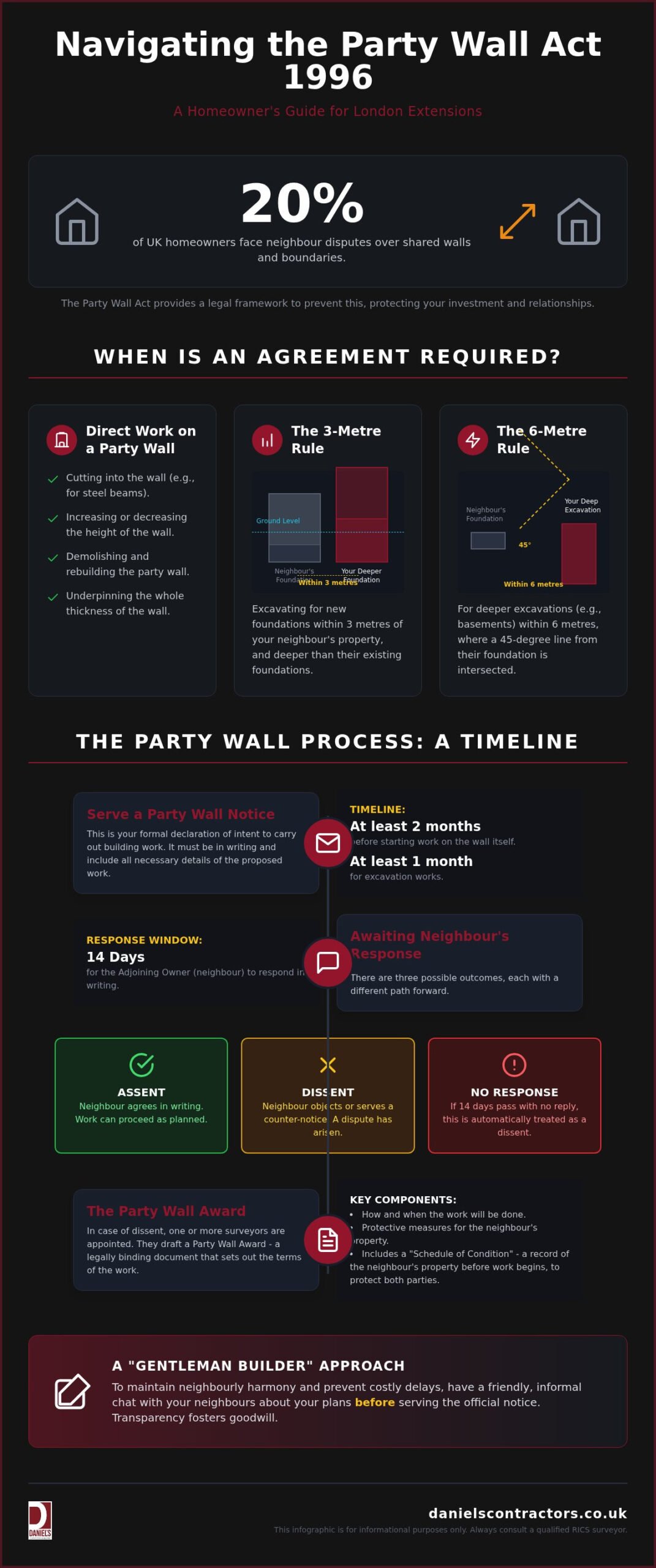
There’s often confusion between a Party Wall Notice and a Party Wall Award, yet the distinction is vital for your project’s timeline. A Notice is your formal declaration of intent, served to your neighbours at least two months before starting work on a shared wall. If they agree in writing, you’ve achieved “assent” and can proceed. If they don’t respond or they object, you move to a Party Wall Award. This is a legal document drafted by surveyors that outlines exactly how, when, and under what conditions the work will proceed, ensuring the structural integrity of both properties is maintained.
London’s architectural heritage, characterised by dense rows of Victorian and Edwardian terraces, means shared walls are almost universal. Proceeding with a party wall agreement for house extension london ensures you avoid high-risk strategies that rarely pay off in the city’s litigious property market. A neighbour can apply for a court injunction to stop your build immediately if you haven’t followed the correct procedure. This causes significant financial losses, potentially adding thousands to your budget in legal fees and contractor standby costs.
Identifying a Party Wall in London Properties
In the context of London properties, a party wall is usually the wall separating two terraced or semi-detached houses. However, it also includes “party fence walls,” which are shared masonry garden walls, though this definition excludes timber fences. In the case of London apartments or converted houses, the horizontal floors and ceilings are also considered party structures under the Act, requiring the same level of legal diligence as a vertical wall.
The Purpose of the Act: Protection for Both Sides
The Act acts as a shield for both parties, fostering a spirit of mutual respect and professionalism during construction. It ensures the neighbour, known as the Adjoining Owner, is protected against structural damage resulting from your build. Conversely, it protects you, the Building Owner, from being held responsible for cracks or issues that existed before your project began. A Schedule of Condition serves as the definitive baseline of the property’s state before any work commences. By documenting the existing condition of the neighbouring property, we create a transparent record that protects everyone’s investment and peace of mind.
The 3-Metre Rule and Other Structural Triggers for London Renovations
For more ambitious projects like luxury basement conversions, the “6-metre rule” comes into play. This is triggered if your excavation falls within six metres of a neighbouring structure and any part of it intersects a 45-degree plane drawn downwards from the bottom of their foundations. According to official government guidance, these proximity rules exist because deep digging can destabilise the subsoil supporting adjacent homes. It’s a complex calculation that requires professional oversight to ensure you don’t inadvertently bypass your legal obligations.
Beyond excavation, the Act is triggered by direct interventions. Inserting steel beams (RSJs) into a shared wall to support a new open-plan layout is a classic example. Similarly, removing or modifying internal chimney breasts on a party wall, a frequent requirement in Victorian London refurbishments, requires careful legal and structural handling. These features are often integral to the wall’s stability, and their removal must be managed with precision to ensure the shared masonry isn’t compromised.
Excavation and London’s Challenging Subsoil
London clay presents unique engineering challenges. It’s a highly “shrinkable” soil that expands and contracts with moisture levels, making foundation precision paramount. If your bespoke extension requires underpinning a shared wall to create head height or stability, you’ve reached the highest level of party wall complexity. At Daniels Contractors, we specialise in navigating these technical nuances, ensuring your house extension is built on a foundation of safety and legal clarity.
Work on the Wall Itself
Triggers aren’t limited to the ground. If you intend to increase the height of a party wall to accommodate a new storey or thicken it for better soundproofing, you must serve notice. This also applies to party fence walls. If you’re demolishing a shared garden wall to replace it with a more substantial masonry structure, the Act provides the framework for doing so without sparking a neighbour dispute. Even minor alterations, such as cutting in to flash a new roof or installing a damp-proof course, fall under the Act’s remit.
Navigating the Party Wall Process: Notices, Assent, and Dissent
Mastering the timeline is the first step toward ensuring your project remains on schedule. The statutory periods are non-negotiable. You must serve a formal notice at least two months before commencing work on a shared wall, or one month before beginning any excavation. For a party wall agreement for house extension london, these lead times are essential windows for professional dialogue. They allow your neighbours to digest the plans and seek their own advice, preventing the friction that often arises from last-minute surprises.
Once notice is served, your neighbour has 14 days to respond. Their choice dictates the next steps of your journey. They can assent, which allows work to proceed immediately, or they can dissent. It’s vital to view “dissent” not as a personal rejection, but as a technical safeguard. Many homeowners choose to dissent so that a surveyor can review the structural proposals and create a formal Award. This provides a clear, legal framework for the build, protecting both parties from future ambiguity. If a neighbour ignores the notice entirely, a 10-day follow-up letter is required. Should silence persist, you’re legally obliged to appoint a surveyor on their behalf to ensure the process moves forward.
The most efficient path for high-end projects is often the appointment of an “Agreed Surveyor.” This is a single professional who acts impartially for both you and your neighbour. This approach streamlines communication, reduces surveyor fees, and maintains a sense of shared purpose. It reflects the “gentleman builder” ethos, prioritising transparency and mutual respect over adversarial legal posturing.
Serving a Valid Party Wall Notice
Precision is your best ally when drafting a notice. To be legally valid, the document must include the full names of all legal owners, the correct date, and a meticulous description of the proposed works. Crucially, it should be accompanied by detailed architectural drawings and structural calculations. Omitting these details is a common mistake that can render a notice invalid, potentially forcing you to restart the statutory notice period and delaying your build by several weeks.
The Dispute Resolution Mechanism
When a dispute is deemed to have arisen, the surveyors work to draft the Party Wall Award. According to the RICS consumer guide on party walls, this document is the definitive resolution to any disagreements. In more complex London cases, a “Third Surveyor” is selected at the start of the process to act as an ultimate adjudicator if the two primary surveyors cannot agree. The final Award covers essential practicalities, including permitted working hours, rights of access for the builders, and the specific compensation due if any damage occurs, ensuring every detail is settled before the first shovel hits the ground.
Best Practices for a Seamless Party Wall Agreement in London
Achieving a successful party wall agreement for house extension london often begins long before the first legal document is served. We advocate for a “gentleman builder” approach, which prioritises personal connection and transparency over cold administrative procedure. An informal chat over coffee with your neighbour can dispel many of the anxieties that arise when a formal notice arrives in the post. By explaining your vision and listening to their concerns early, you transform a potentially adversarial legal process into a collaborative effort to improve the local streetscape.
Timing is everything when managing a luxury build. You should aim to have your agreement finalised well in advance of your bespoke house extensions London start date. A professional Schedule of Condition is the cornerstone of this preparation. We recommend using high-resolution photography and detailed written descriptions to document the current state of the shared wall and the neighbour’s property. This serves as a definitive baseline, ensuring that any claims regarding structural damage are based on fact rather than memory, providing immense peace of mind for both parties.
Managing access is another critical practical consideration. In London’s narrow plots, your contractor may need to place scaffolding on the neighbour’s land or use their garden for specific tasks. The Party Wall Act provides a right of access for such works, but the terms should be clearly outlined in your Award. Discussing these logistics early ensures your neighbours aren’t surprised by builders appearing outside their windows, maintaining the harmony of your close-knit community.
Neighbour Diplomacy and Communication
Reducing anxiety is often a matter of sharing information. Providing your neighbours with high-quality design visualisations helps them understand the scale and aesthetic of your extension, often making it feel less imposing. We also recommend sharing your contractor’s direct contact details. Knowing they can quickly resolve issues regarding noise, dust, or site behaviour gives neighbours a sense of control and significantly reduces friction during the construction phase.
Financial Considerations for 2026
Budgeting for party wall matters is essential. In 2026, London surveyor fees typically average around £200 per hour, with a single agreed surveyor for a standard extension costing between £1,200 and £1,500. Whilst it’s tempting to find the cheapest option, inexperienced surveyors can cause costly delays through administrative errors. For high-risk excavations, be aware of the “security for expenses” clause, where you may be required to place funds in escrow to cover potential damage. For a project managed with precision and care, contact our expert team today to discuss your extension plans.
How Daniels Contractors Manages Your Extension from Concept to Completion
At Daniels Contractors, we believe that a party wall agreement for house extension london should be a foundation for trust, not a source of friction. Since 2001, we’ve refined a methodical approach that integrates legal compliance with high-end craftsmanship. We don’t simply wait for an Award to be served; we actively shape the process through precise structural planning that anticipates the requirements of RICS surveyors. By providing technical clarity from the outset, we reduce the likelihood of neighbourly dissent and ensure your project moves from concept to completion without unnecessary pauses.
Precision Engineering for London Homes
Our 25 years of experience with luxury basement conversion London provides us with a deep understanding of subterranean structural risks. We apply this same rigour to every extension, utilising advanced structural monitoring to protect adjoining properties in real-time. Whether your project falls under permitted development rights or requires full planning consent, our engineering-first mindset ensures that every party wall trigger is handled with technical precision.
Your Partner in High-End Transformations
We view ourselves as your reliable partner in transforming your living space. From the initial serving of the notice to the final snagging list, we ensure a seamless experience that respects both your investment and your neighbours’ peace of mind. We build trust through professional conduct, maintaining tidy sites and open channels of communication amongst the local community. If you’re ready to enhance your property with a team that values integrity as much as aesthetic excellence, we invite you to Start your bespoke journey with Daniels Contractors today.
Securing Your Vision with Technical Precision
Navigating the complexities of the Party Wall Act 1996 is a fundamental step in protecting your high-end property investment. By understanding structural triggers like the 3-metre rule and respecting statutory timelines, you ensure your project remains legally sound and structurally secure. A party wall agreement for house extension london acts as more than just a permit; it represents a commitment to the long-term stability of your home and the continued harmony of your neighbourhood.
With over 25 years of luxury London building experience, our team at Daniels Contractors specialises in complex structural renovations. We provide transparent, milestone-based project management that prioritises precision and professional conduct at every stage. We’re here to ensure your vision is realised with the meticulous attention to detail it deserves. Discuss your London extension project with our expert team to begin your transformation with absolute peace of mind. Your bespoke home is in safe, expert hands.
Frequently Asked Questions
How much does a party wall agreement cost in London for 2026?
Costs in 2026 depend on the complexity of your project and whether your neighbours choose to appoint their own surveyors. For a standard extension using a single agreed surveyor, fees typically range between £1,200 and £1,500. If neighbours dissent and require separate representation, total costs can rise to between £2,400 and £3,000, with professional hourly rates in the capital averaging £200.
Can I start my extension work before the party wall agreement is signed?
You cannot legally commence any works covered by the Act until you have received written assent or a formal Award has been served. Starting work prematurely is a high-risk strategy that often leads to court injunctions and significant legal expenses. It’s essential to wait for the statutory notice periods to conclude to ensure your project remains compliant and your neighbourly relations remain intact.
Do I need a party wall agreement for a loft conversion in a London terrace?
Yes, a loft conversion in a terraced property almost always requires a party wall agreement for house extension london because it involves structural alterations to a shared wall. This usually includes the insertion of steel beams or the removal of internal chimney breasts. Even if you aren’t changing the external height of the wall, the act of cutting into the masonry triggers your legal obligations under the Act.
What happens if my neighbour refuses to sign the party wall notice?
If a neighbour refuses to sign or fails to respond within 14 days, the law deems that a “dispute” has arisen. You must then issue a 10-day follow-up letter. If they still remain silent, you’re required to appoint a surveyor to act on their behalf. This ensures the process moves forward to a formal Award, protecting both properties despite the lack of initial cooperation.
Can I prepare and serve a party wall notice myself without a surveyor?
You’re legally permitted to draft and serve your own notices, but they must be technically perfect to be valid. Any errors in the property descriptions, owner names, or the accompanying structural drawings can render the notice void. This often results in restarting the entire statutory period, which is why most homeowners rely on professionals to ensure the documentation is robust from the outset.
How long does the party wall process typically take for a house extension?
The process usually takes between one and three months from the point the first notice is served. Whilst the statutory notice periods are one or two months, the timeline can extend if surveyors need time to record a Schedule of Condition or negotiate the terms of an Award. Engaging with your neighbours early is the most effective way to ensure the legalities don’t delay your build.
Does a party wall agreement expire if I do not start the work immediately?
A Party Wall Award is valid for 12 months from the date it is served to the relevant parties. If you don’t begin the notified works within this one-year window, the agreement expires and the process must typically begin again. This ensures that the structural assessments and the Schedule of Condition remain accurate and relevant to the current state of the buildings.
Will I need an agreement for a side return extension under permitted development?
Yes, having permitted development rights does not exempt you from the requirements of the Party Wall etc. Act 1996. If your side return involves excavating for foundations within three metres of a neighbour’s structure, or if you’re building a new wall on the boundary, you must serve notice. The legal framework of the Act is entirely separate from planning permission and must be handled with equal care.