
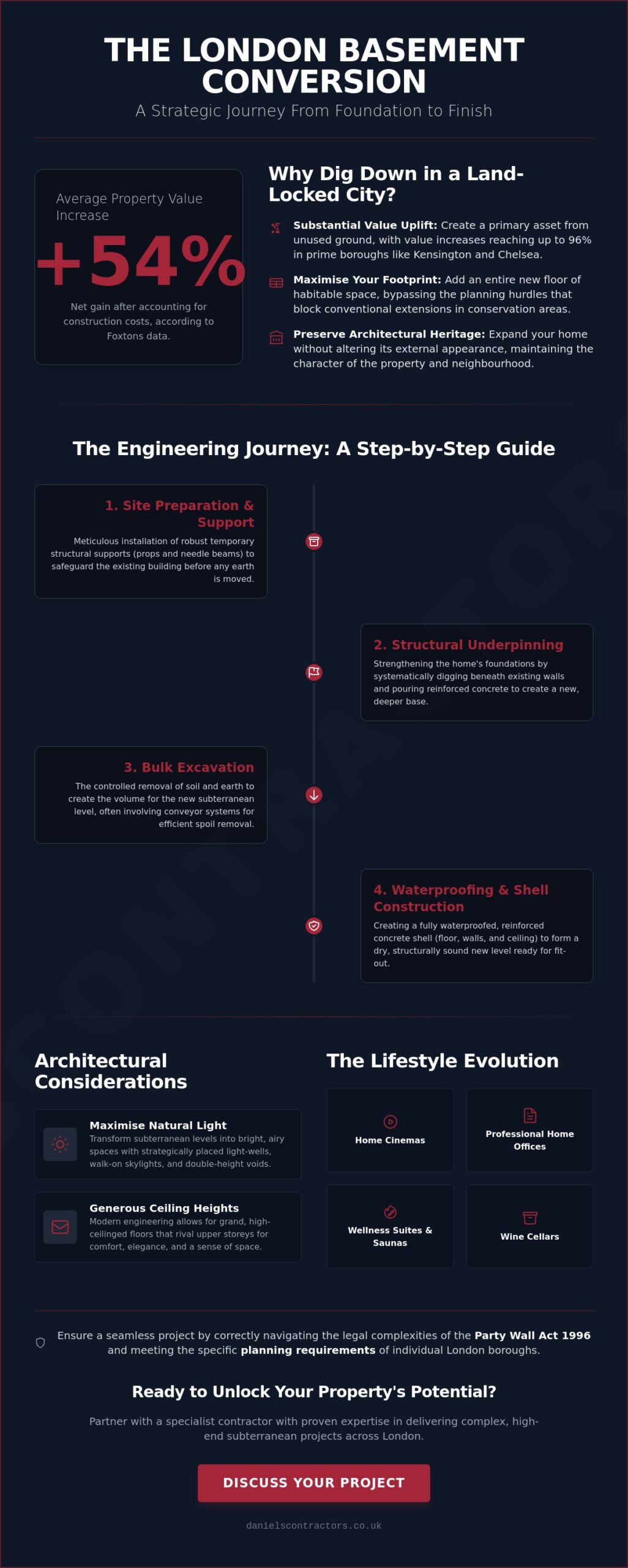
A basement conversion can increase a London property’s value by an average of 54% once construction costs are accounted for, according to Foxtons data. You likely recognise the incredible potential hidden beneath your floorboards, yet the prospect of basement excavation london often brings a heavy sense of trepidation. It’s natural to feel concerned about the structural integrity of your home or the intricacies of the Party Wall Act 1996. You want to expand your living space whilst maintaining the heritage of your property and the goodwill of your neighbours.
This guide provides the clarity you need to transform subterranean levels into light-filled, luxury environments with absolute confidence. We’ll walk you through the essential stages of a project, from ground investigation reports to the final bespoke finishes. You’ll learn how to secure the right structural engineering expertise and how to maximise natural light through intelligent architectural design. We’ll show you how to manage the technical risks to achieve a seamless extension that feels like a natural, high-end addition to your home.
Key Takeaways
- Understand why subterranean expansion is the premier choice for adding substantial value and floor space in London’s restricted conservation areas.
- Gain a clear, step-by-step understanding of the basement excavation london process, from initial site preparation to the precision of structural underpinning.
- Learn how to manage the legal complexities of the Party Wall Act 1996 and meet the specific planning requirements of individual London boroughs.
- Discover architectural strategies to transform lower levels into bright, airy living spaces by prioritising natural light and generous ceiling heights.
- Recognise the critical criteria for selecting a specialist contractor with the proven expertise to deliver a seamless, high-end subterranean project.
The Strategic Value of Basement Excavation in London’s Land-Locked Market
London’s property market is defined by its limitations. In many prime postcodes, the desire for more space is met with the rigid reality of conservation area rules and protected skylines. This is why basement excavation london has become the preferred choice for homeowners who refuse to compromise on their location. By expanding downwards, you bypass the planning hurdles that often block loft conversions or rear extensions. This strategy creates an entirely new floor of habitable space that remains invisible from the street, preserving the architectural heritage of the neighbourhood whilst significantly increasing the property’s footprint.
Maximising Space in High-Density Neighbourhoods
London’s Victorian and Georgian terraces are famously narrow, often leaving little room for traditional rear extensions without sacrificing precious garden space. Digging down offers a way to bypass these physical constraints. Under-garden excavations are particularly effective; they allow for a vast footprint that can house expansive open-plan entertaining zones or even leisure facilities without cluttering the site. Gaining a thorough understanding basement design is the first step in ensuring these subterranean levels integrate perfectly with the existing foundations of a narrow terrace plot.
The Lifestyle Evolution of Subterranean Living
The modern basement is no longer a dark storage area; it has evolved into a sanctuary for wellness and entertainment. We see a growing trend for bespoke wellness suites, featuring private saunas and steam rooms, alongside temperature-controlled wine cellars for serious collectors. These zones also provide practical solutions for modern families. They offer self-contained guest suites for nannies or visitors, and professional home offices that are physically removed from the bustle of the main house. High-quality finishes, bespoke joinery, and generous ceiling heights ensure these spaces feel aspirational, bright, and entirely permanent. For a closer look at the layouts defining this trend, explore our guide to bespoke basement cellar conversions and luxury layout ideas for 2026.
The Engineering Journey: A Step-by-Step Guide to the Excavation Process
The journey begins with meticulous site preparation. Before any earth is moved, your contractor must install robust temporary structural supports to protect the existing building. This stage is governed by strict HSE excavation safety guidance, ensuring that every prop and needle beam is positioned with mathematical precision. Once the structure is stabilised, the delicate work of underpinning begins. This involves strengthening the foundations of your home, typically by digging sections beneath the existing walls and filling them with reinforced concrete to create a new, deeper base.
Managing a successful basement excavation london requires more than just heavy machinery; it demands a deep respect for the city’s subterranean environment. This methodical process ensures that the transition from a standard cellar to a reinforced concrete shell is handled without compromising the safety of your home or neighbouring properties. It’s a sequence of cause and effect where each stage provides the stability required for the next.
Underpinning and Piling Techniques
Structural engineers choose between traditional mass concrete underpinning and modern piling based on your property’s specific load and soil conditions. Traditional underpinning is often used for Victorian terraces, where work is completed in small “pins” to maintain stability. For more complex basement excavation london projects, piling might be preferred. This involves boring deep columns into the ground to transfer the building’s weight to more stable strata. Specialists often employ pynford beams or needle beams to support masonry walls whilst these new foundations are established, providing a secure platform for the bulk excavation.
Managing the London Clay and Water Table
London’s unique geology presents a specific challenge: London Clay. This material is notoriously prone to shrinking and swelling depending on its moisture content. A comprehensive ground investigation report is essential before work starts to understand the local water table and soil composition. Without this data, you risk structural movement or moisture ingress. Effective waterproofing is non-negotiable, and we typically implement a multi-layered approach:
- Type A (Barrier): An external or internal waterproof membrane applied to the structure.
- Type B (Structurally Integral): The use of water-resistant concrete for the shell itself.
- Type C (Drained Cavity): An internal drainage system that collects and pumps away any moisture that bypasses the outer layers.
Methodical bulk excavation follows, where the clay is carefully removed to reveal the new subterranean footprint. This leads into the “shell and core” phase, where the reinforced concrete floor and walls are cast. Transitioning from a raw construction site to a luxury basement conversion requires a contractor who understands the bridge between heavy engineering and high-end interior fit-out.
Navigating the Regulatory Landscape: Planning and Party Wall Agreements
Securing the legal and regulatory foundations of a project is just as vital as the physical underpinning discussed in the previous section. Success in basement excavation london relies on a meticulous approach to planning and a deep respect for the legal rights of those living nearby. Navigating these requirements requires a blend of technical documentation and diplomatic communication. It’s about ensuring that every structural calculation is mirrored by a robust legal agreement, providing peace of mind for you and your neighbours alike.
Most London boroughs have tightened their grip on subterranean developments to manage the impact on local infrastructure and residential amenity. A simple planning application is no longer enough for these complex builds. You’ll likely need to provide a Basement Construction Method Statement (CMS) signed off by a chartered structural engineer. This document addresses potential risks to the water table and outlines how the project will handle the logistical challenges of a high-density area, such as soil removal and traffic management.
Securing Planning Permission in Conservation Areas
If your home is located within a conservation area, the level of scrutiny increases significantly. Local authorities often require detailed hydrogeology reports to prove that your dig won’t affect the local water table or drainage patterns. Citing the Kensington and Chelsea Basements SPD provides an excellent benchmark for the level of detail required, even if your property sits in a different borough. These guidelines often include Article 4 directions, which can restrict certain permitted development rights, making professional design guidance essential from the earliest stages.
The Party Wall Process for Subterranean Works
The Party Wall Act 1996 serves as the primary legal framework for any basement excavation london project. Since most London terraces share structural boundaries, you’re legally required to serve a Party Wall Notice to any “Adjoining Owners” at least two months before structural work begins. This process shouldn’t be viewed as a hurdle, but rather as a safeguard for all parties involved. A surveyor will document a Schedule of Condition for the neighbouring properties, creating a photographic record of their current state. This protects you from unfounded claims of damage whilst reassuring your neighbours that their home is being treated with the utmost care.
Transparent communication remains your best tool for minimising friction. Providing neighbours with a clear timeline and a designated point of contact can prevent minor concerns from escalating into formal disputes. It’s a professional courtesy that mirrors the high standards of the build itself, ensuring the project moves forward with mutual respect and collective confidence.
Architectural Considerations: Transforming Subterranean Spaces into Luxury Living
Completing the structural phase of a basement excavation london is a significant milestone, yet the true success of the project lies in the architectural vision that follows. The goal is to move beyond the concept of a “converted cellar” and instead create a primary floor that rivals the upper storeys for elegance and comfort. This transformation requires a “light-first” philosophy. By prioritising volume and brightness, we ensure your new subterranean level feels expansive, inviting, and entirely integrated with the rest of your home.
Maximising Natural Light and Ventilation
Natural light is the most valuable currency in basement design. Sunken courtyards and strategically placed light wells are essential tools for capturing daylight. They don’t just provide illumination; they offer a vital visual connection to the sky and outdoor greenery. Walk-on glass roof lights installed in the garden above allow sunlight to flood into the rooms below without sacrificing any outdoor floor space. For a more dramatic effect, double-height voids can be integrated into the layout. These openings create a vertical axis of light that draws the eye upwards, psychologically erasing the subterranean boundary.
To ensure the air feels as fresh as the rooms above ground, we integrate Mechanical Ventilation Heat Recovery (MVHR) systems. These units provide a constant supply of filtered, fresh air whilst recovering heat from the outgoing air. This creates a perfect, draught-free climate that is easy to control, regardless of the weather in the capital.
Structural Finishes and Bespoke Interiors
A common mistake is treating the staircase as a mere functional necessity. In a luxury basement excavation london, the staircase should be a central architectural feature. Using open treads or glass balustrades allows light to travel between floors, maintaining a sense of vertical continuity. This is also the stage where we address the sensory experience of the space. If you’re planning a home cinema or a private music studio, specialist acoustic engineering is integrated into the structural shell to ensure complete sound isolation.
The final layer of sophistication comes from smart home technology and bespoke lighting scenes. These systems allow you to adjust the ambiance to suit the time of day, further enhancing the mood of the space. If you’re ready to begin your journey, our team specialises in high-end basement conversions that combine precision engineering with visionary architectural design.
Ensuring Excellence: Choosing a Bespoke Contractor for Complex London Digs
The structural and architectural success of your project ultimately rests on the expertise of your main contractor. Given the technical risks involved in basement excavation london, selecting a partner with a proven portfolio within the city’s unique architectural landscape is paramount. You need a team that understands the nuances of Victorian foundations and the logistical constraints of narrow residential streets. A contractor with local experience will be familiar with the specific soil conditions of your borough and the expectations of local planning officers. To help you make this critical decision with confidence, our ultimate vetting checklist for selecting basement builders in London outlines the essential credentials and professional standards that separate true specialists from standard contractors.
Some homeowners opt for “shell and core” specialists who focus solely on the structural concrete box. However, a full-service design and build firm provides a more cohesive journey. By managing the project from the initial design phase through to the final luxury fit-out, you eliminate the risk of miscommunication between structural engineers and interior designers. This integrated approach ensures that every pipe, cable, and structural beam is positioned to support your final aesthetic vision, preventing costly adjustments during the later stages of the build.
Before signing a contract, verify that your chosen firm holds comprehensive Professional Indemnity insurance. Familiarity with standard JCT (Joint Contracts Tribunal) contracts is also essential. These documents provide a clear legal framework that protects your investment and ensures accountability throughout the construction timeline. It’s a professional standard that reflects a contractor’s commitment to transparency and high-level conduct.
The Value of Transparent Project Management
Peace of mind is built on clear communication and methodical organisation. We utilise regular reporting and milestone tracking to keep you informed at every stage of the build. A successful basement excavation london requires the seamless coordination of multiple specialists, from structural engineers to bespoke joiners. Managing site logistics is equally critical; we handle everything from skip permits to traffic management plans. This ensures the build proceeds with minimal disruption to your neighbours and the local community, preserving the goodwill you’ve built in your neighbourhood.
A Legacy of Craftsmanship Since 2001
Since 2001, our team has delivered bespoke transformations across London, Surrey, and Essex. This deep experience informs our technical approach, allowing us to solve complex engineering puzzles with quiet confidence. We remain committed to the highest standards of craftsmanship, ensuring that the final result is as durable as it is beautiful. If you are ready to unlock the potential of your property, you can discuss your London basement excavation with our expert team to begin the journey towards a masterfully crafted subterranean home.
Realising Your Subterranean Vision
Transforming your home through basement excavation london is a sophisticated undertaking that rewards meticulous planning and structural precision. You’ve now seen how integrating high-end engineering with visionary architecture can bypass the capital’s space constraints whilst adding significant long-term asset value. A successful build relies on navigating the legal intricacies of the Party Wall Act and choosing a partner who prioritises craftsmanship and transparency above all else.
Since 2001, Daniels Contractors has been a trusted partner for homeowners seeking bespoke luxury. We specialise in complex structural refurbishments and provide a level of care that only a boutique service provider can offer. Our approach is grounded in transparent project management and the certainty of fixed-price contracts; it’s a process designed to ensure your project remains a source of excitement. Begin your journey towards a luxury basement conversion with Daniels Contractors and unlock your property’s hidden potential with absolute confidence.
Frequently Asked Questions
How long does a typical basement excavation in London take?
A typical project usually spans six to twelve months, though the exact duration depends on the complexity and scale of the dig. The initial structural phase, including underpinning and bulk excavation, often takes three to five months. The subsequent fit-out and interior finishes add several more months to the schedule. We provide a detailed timeline at the start to ensure you can plan around the construction phases with absolute confidence.
Will a basement excavation damage my neighbours’ property?
Structural damage is extremely rare when the works are managed by specialist engineers and contractors using precise underpinning techniques. The Party Wall Act 1996 provides a legal framework to protect adjoining owners, including a mandatory Schedule of Condition. This photographic record ensures any pre-existing issues are documented; modern vibration monitoring systems are also used to provide real-time data and peace of mind for both you and your neighbours.
Do I need planning permission for a basement in London?
You will almost always require full planning permission for a new basement excavation london project. Whilst converting an existing cellar into a habitable room may fall under permitted development, digging a new subterranean level involves significant structural changes that councils must approve. Boroughs like Kensington and Chelsea or Westminster have specific, stringent policies that require detailed construction method statements and impact assessments before any work commences.
How do you get natural light into a London basement?
We introduce natural light through architectural features like sunken courtyards, external light wells, and “walk-on” glass roof lights. These elements draw sunlight deep into the floor plan, whilst internal glass balustrades and open-plan layouts help the light travel further. Intelligent lighting design and reflective finishes can also be used to enhance the brightness, ensuring the space feels as airy and welcoming as any upper floor in your home.
What is the difference between “shell and core” and a “fit-out”?
The “shell and core” refers to the structural phase, encompassing the excavation, underpinning, reinforced concrete walls, and waterproofing. It’s the watertight “box” of the extension. The “fit-out” is the subsequent stage where we install the electrics, plumbing, heating, and interior finishes like joinery and flooring. Choosing a full-service design and build firm ensures a seamless transition between these two critical phases, maintaining the integrity of the original vision.
Can you excavate a basement under a listed building in London?
Excavating under a listed building is possible, but it requires Listed Building Consent in addition to standard planning permission. Historic England and local conservation officers will scrutinise the proposal to ensure the historic fabric and character of the property remain protected. This usually involves a more delicate engineering approach and a higher level of documentation to prove that the subterranean expansion won’t compromise the heritage of the structure.
What happens if we hit the water table during excavation?
Encountering the water table is common in London and is managed through advanced waterproofing and drainage systems. We use a combination of Type A barrier membranes, Type B water-resistant concrete, and Type C drained cavity systems to keep the space dry. These systems include sump pumps that automatically remove any moisture that enters the cavity, ensuring your luxury living space remains perfectly protected regardless of external ground conditions.
How much value does a basement excavation add to a London home?
A well-executed basement excavation london can increase your property’s value by an average of 54% after construction costs are accounted for. In prime central London locations, this value uplift can be even higher, sometimes approaching 96% in boroughs like Kensington and Chelsea. Beyond the financial ROI, the addition of bespoke basement cellar conversions provides a significant lifestyle benefit, allowing you to expand your home without the need to relocate.