
What if the rattling timber frames in your Kensington townhouse aren’t a sign of decay, but a hidden asset waiting to be unlocked? You likely value the historic soul of your property but find yourself frustrated by biting London draughts and the persistent hum of city traffic. It’s a common dilemma amongst owners of heritage assets; you want to understand the sash window restoration cost london market in 2026 so you can achieve modern thermal efficiency without sacrificing the very character that defines your home.
This guide provides a transparent look at how meticulous craftsmanship can outperform total replacement in both ROI and thermal performance. We will explore the latest planning shifts for Grade II listed buildings, the evolution of vacuum-insulated glazing, and the specific factors driving restoration budgets this year. By the end, you will have the clarity needed to ensure your project is handled with the care, integrity, and technical precision it deserves, allowing you to preserve your property’s legacy whilst enjoying a quiet, energy-efficient interior.
Key Takeaways
- Understand the 2026 baseline for a sash window restoration cost london, distinguishing between minor repairs and the comprehensive heritage overhauls required for premium properties.
- Discover why the condition of your box frames and timber sills is the primary driver of project scale and long-term durability.
- Compare high-performance energy upgrades, such as draught-proofing and vacuum-insulated glazing, to achieve modern comfort without losing historic charm.
- Gain clarity on London’s stringent planning regulations and Grade II listing requirements to avoid legal complications during your restoration.
- Explore how integrating window repairs into a broader bespoke refurbishment ensures a cohesive aesthetic and superior return on investment.
Analysing Sash Window Restoration Costs in London (2026)
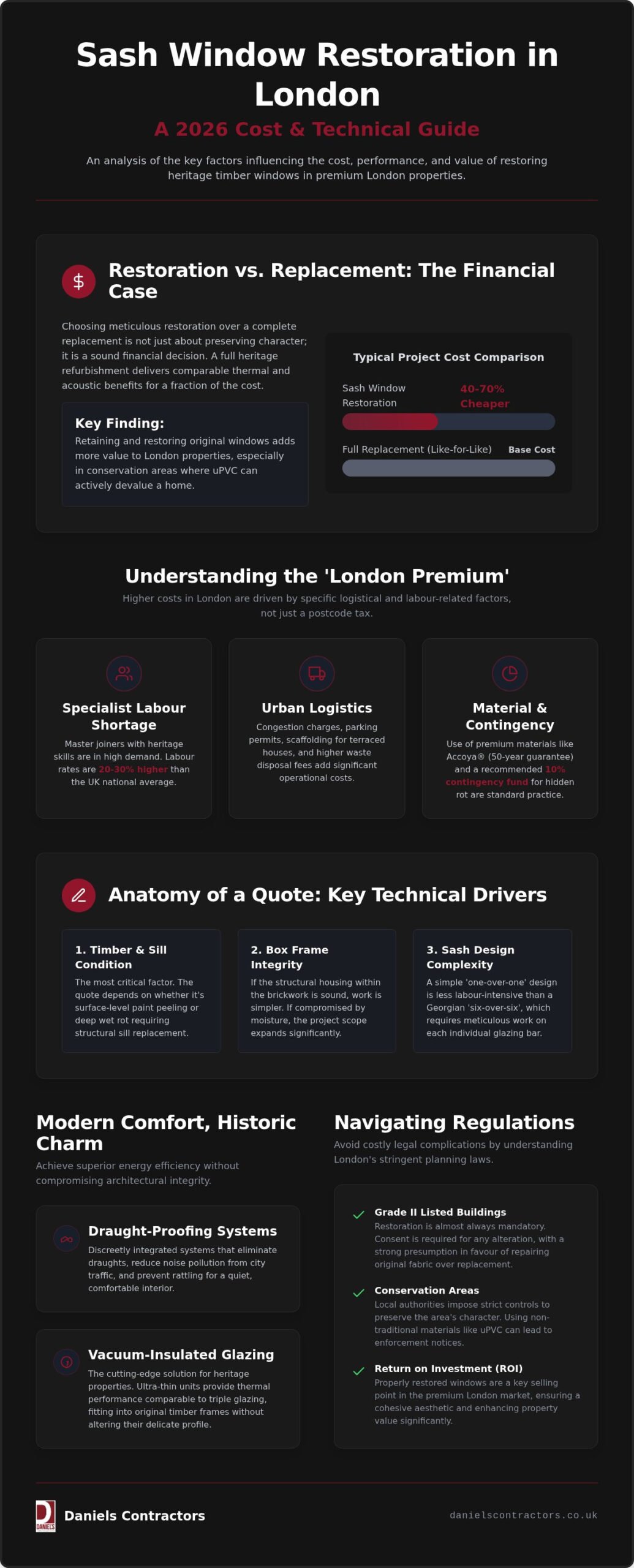
Understanding your sash window restoration cost london requires a shift in perspective. A simple repair might involve a quick draught-proofing strip or a cord replacement; however, a true restoration is a comprehensive revitalisation of the timber and mechanics. By 2026, the distinction has become even sharper. Restoration involves stripping back decades of paint, addressing structural rot, and recalibrating the internal weights to ensure effortless operation. It’s an investment in the building’s fabric, whereas a repair is merely a temporary solution. Choosing restoration over replacement is often a wiser financial move, as a full refurbishment is typically 40-70% cheaper than a full replacement whilst delivering comparable thermal benefits.
Why does London command a higher price? The “London Premium” isn’t just a postcode tax. It reflects the scarcity of master joiners who understand The Anatomy of a Sash Window and the logistical hurdles of working in dense urban environments. Restoring original timber windows adds significantly more value to a London terrace than uPVC. In conservation areas, uPVC can actually devalue a property or lead to enforcement notices. Retaining the original aesthetic is often the difference between a successful sale and a stagnant listing in prime postcodes like Chelsea or Marylebone.
The 2026 Labour and Material Landscape
The shortage of heritage joiners in the capital has pushed 2026 pricing upwards, as specialist skills remain in high demand. London labour rates for this niche work are approximately 20-30% higher than the UK national average, reflecting the expertise required to handle delicate period timber. Material choices also play a pivotal role. Whilst traditional hardwoods are still used, Accoya has become the 2026 gold standard due to its 50-year above-ground guarantee. It resists rot and swelling far better than standard timber. We always advise a 10% contingency fund. Victorian frames often hide structural rot that only reveals itself once the layers of lead paint are removed.
London vs Surrey and Essex: Pricing Nuances
Geography dictates the final quote more than many homeowners realise. A project in Kensington involves parking permits, congestion charges, and the logistical challenge of narrow streets. Scaffolding for a four-storey townhouse in Central London is a different beast compared to a detached home in Surrey or Essex. Local skip hire and waste disposal fees also fluctuate significantly between boroughs. Central London waste management often costs considerably more than in the home counties. These factors are why we often integrate window work into a wider Victorian house refurbishment London to streamline logistics and management fees.
The Anatomy of Restoration: Technical Drivers of Your Quote
Restoring a period sash window is a technical exercise in balance, precision, and preservation. When calculating a sash window restoration cost london, we look far beyond the visible glass and timber. The functionality of the window relies on a hidden system of sash cords, pulleys, and weights. If your windows feel heavy, stick, or drop unexpectedly, it’s often due to miscalibrated lead weights. In 2026, we find many London properties have had heavier glass installed in the past without the necessary adjustments to the internal counterbalance. Correcting this requires a master craftsman to recalibrate the weights, ensuring a smooth, silent operation that feels effortless to the touch.
The complexity of the sash itself also dictates the labour intensity. A simple “one-over-one” design is far less demanding than a traditional Georgian “six-over-six” pattern. Each individual pane, or light, requires meticulous hand-stripping, sanding, and glazing. The more intricate the timber work, the more time is required to ensure a flawless finish. The condition of the box frame is the ultimate decider of project scale; if the structural housing within the brickwork is sound, the restoration remains focused on the moving parts. However, if the box itself has succumbed to moisture, the scope of work naturally expands to include structural stabilisation. Many homeowners find that professional sash window repair provides the necessary peace of mind, ensuring these technical nuances are handled with expert care.
Timber Integrity and Sill Replacement
The bottom sill is the most vulnerable component of any sash window, constantly battling the British weather. We distinguish between surface-level paint peeling and deep-seated wet rot, which can compromise the entire frame. Rather than replacing the whole unit, we use a technical splicing method. This involves removing only the decayed section and meticulously bonding new, durable timber into the original frame. This approach preserves the historic character whilst providing a robust, long-lasting repair that is often the most critical cost driver in a restoration project.
Ironmongery and Aesthetic Finishes
The final flourish of a restoration lies in the ironmongery and paint finish. In 2026, there is a clear preference for high-end brass, polished chrome, or hand-forged blackened ironmongery that reflects the property’s era. Beyond aesthetics, we integrate modern, discreet security locks that meet insurance requirements without marring the window’s profile. For the finish, we often recommend professional hand-painting over spray-finishing. A hand-painted finish offers a depth of colour and a level of durability that allows the timber to breathe, ensuring the restoration stands the test of time in London’s urban environment.
Energy Efficiency Upgrades: Draught-Proofing and Glazing
Enhancing the thermal performance of a period property is often the primary motivation for seeking a sash window restoration cost london quote. Standard single-glazed windows can be responsible for as much as 72% of the heat lost through a window, according to July 2026 data from Grabex. For owners of expansive London residences, this inefficiency translates to substantial energy bills and a persistent lack of comfort. Modern restoration techniques allow us to integrate high-performance glazing and acoustic glass, which is particularly effective for homes situated near busy transport links or under the flight paths of West London.
The return on investment for these upgrades is twofold. Whilst simple draught-proofing offers an immediate boost to comfort at a lower entry point, retrofitting double glazing provides a more profound long-term financial benefit. In 2026, vacuum glazing has emerged as the gold standard for heritage assets. This technology offers the thermal profile of triple glazing whilst remaining thin enough to fit within original timber profiles. It allows you to maintain the delicate proportions of your windows whilst significantly reducing your home’s carbon footprint and noise ingress.
Draught-Proofing: The Cost-Effective Comfort Fix
Modern brush-pile systems are far superior to the basic foam strips of the past. We machine discreet grooves directly into your original sashes to house these systems, ensuring they remain invisible when the window is closed. This process can eliminate rattles and reduce heat loss by up to 30%, making it a staple requirement in any high-end home refurbishment London. It’s a methodical way to bring 19th-century joinery into the modern era without compromising its structural integrity.
Bespoke Double Glazing for Heritage Frames
For those seeking maximum efficiency, we specialise in ultra-slim “heritage” double-glazed units. These units are designed to sit within original 18mm or 22mm glazing bars, preserving the authentic sightlines that define Victorian and Edwardian architecture. Because double-glazed units are heavier than single panes, we always rebalance the internal lead weights to ensure the window remains easy to operate. In the context of 2026 UK building regulations, a U-value measures the rate of heat transfer through the window, where a lower number indicates superior thermal insulation and energy efficiency. Achieving a lower U-value is essential for meeting modern sustainability standards whilst protecting your property’s historic value.
Navigating Planning, Listing, and London Regulations
Navigating the legal landscape is as vital as the craftsmanship itself. In London, the line between a “repair” and an “alteration” is often thin. Repairs generally involve restoring the window to its original state, whilst alterations, such as changing the glazing type, may trigger a need for formal consent. Understanding these nuances is a key component of your total sash window restoration cost london. We often see homeowners caught out by Article 4 Directions. These directions remove permitted development rights in specific conservation areas, meaning even minor changes require a formal planning application to the local council.
By 2026, the regulatory stance has softened slightly regarding energy efficiency. Conservation officers increasingly permit slimline or vacuum-insulated double glazing on a case-by-case basis, provided the visual impact is negligible. It requires a methodical approach and clear technical drawings to prove that the historic character remains intact. If your project involves significant structural work to the frames within a shared wall, you must also consider the Party Wall Act. Whilst less common for windows, any work affecting the structural integrity of a shared boundary requires formal notice to your neighbours to prevent costly legal disputes.
Conservation Area Constraints
Different boroughs apply rules with varying degrees of strictness. Westminster planning officers might demand specific timber profiles that differ from those required in Hammersmith or Fulham. The goal is always to maintain the “street scene”, which is the collective aesthetic of the terrace. Improving internal comfort through better insulation must be balanced against this external appearance. You can find more detail on these limitations in our guide to Understanding Permitted Development Rights.
Grade II Listed Building Requirements
For the 91.7% of listed buildings that fall into Grade II, the requirements are stringent. You must use “like-for-like” timber species and glass types unless specifically granted an exception for modern alternatives. Unauthorised changes are a criminal offence, and the cost of rectifying a botched job far outweighs the initial investment in heritage-certified craftsmanship. Budgeting for the extra time required for these meticulous processes is essential for a successful outcome. If you are managing a heritage project, our team provides the expert sash window repair services needed to satisfy both conservation officers and your own high standards.
Maximising ROI: The Daniels Contractors Approach to Restoration
Choosing a partner for your heritage project requires more than just a quote; it demands a shared commitment to the property’s legacy. Since 2001, Daniels Contractors has refined a bespoke approach to London’s structural landscape, bringing 25 years of expertise to every timber frame we touch. We don’t view your windows as isolated repairs. Instead, we understand how they function as part of the building’s thermal envelope and aesthetic soul. When calculating the sash window restoration cost london, we provide a transparent, fixed-price reliability that eliminates the “hidden extras” so common in the industry. Our methodical process ensures that every project is delivered with the quiet confidence of a master craftsman.
For many clients, window work is the cornerstone of a much larger vision. We often integrate meticulous window revitalisation into a comprehensive Victorian house refurbishment London. This integrated design-build approach allows for seamless project management, ensuring that the scaffolding, waste disposal, and specialist joinery are all synchronised. A recent project in Chelsea serves as a prime example. We restored the original charm of a five-storey townhouse, saving 19th-century frames that others deemed beyond repair. By combining structural stabilisation with high-performance timber and acoustic glazing, we preserved the historic character whilst creating a sanctuary of silence amidst the city’s bustle.
The “Gentleman Builder” Philosophy
Our reputation is built on more than just joinery; it’s built on respect. We operate under a “Gentleman Builder” persona, where clear communication and meticulous site cleanliness are absolute requirements. We understand that we are working in your home, not just a construction site. Our team respects the history of your space, ensuring that the restoration process is as smooth and unobtrusive as possible. This dedication to quality and professional conduct is why we have remained a trusted name for Daniels Contractors: 25 Years of Quality Building across the capital’s most prestigious postcodes.
Securing Your Investment
Professional restoration is a strategic move to protect your property’s structural integrity. By addressing moisture ingress and timber decay early, you prevent the need for the far more invasive and expensive replacements discussed earlier. The long-term savings are significant, particularly when using premium materials like Accoya, which offers unparalleled stability and rot resistance. This investment not only enhances your daily comfort but also secures the market value of your heritage asset for decades to come. If you are ready to revitalise your home’s original features, enquire about your bespoke sash window restoration with Daniels Contractors today to discuss your project requirements.
Securing the Future of Your Heritage Asset
Restoring your period windows is more than a maintenance task; it’s a strategic investment in your property’s future. By choosing a methodical refurbishment over a full replacement, you retain the authentic soul of your home whilst achieving the thermal performance required for modern living. We’ve explored how the sash window restoration cost london is driven by technical precision, from the recalibration of lead weights to the integration of ultra-slim vacuum glazing. Navigating the stringent planning regulations of London’s conservation areas doesn’t have to be a source of confusion when you have the right partner at your side.
With 25 years of expertise in London’s structural landscape, Daniels Contractors specialises in Grade II listed and Conservation Area refurbishments. Our “Gentleman Builder” approach ensures meticulous attention to detail and transparent project management from start to finish. We invite you to Book a Heritage Restoration Consultation with Daniels Contractors to discuss how we can revitalise your property. Your home deserves the care of a master craftsman who values its history as much as you do.
Frequently Asked Questions
How much does sash window restoration cost in London compared to the rest of the UK?
Labour rates in the capital are approximately 20-30% higher than the national average due to the specialised nature of heritage joinery. Beyond labour, your sash window restoration cost london is influenced by logistical factors such as parking permits, congestion charges, and borough-specific waste disposal fees. These urban complexities mean London projects require a higher level of project management compared to rural restorations.
Is it cheaper to restore or replace my sash windows in 2026?
Restoring your windows is almost always more cost-effective, with a full refurbishment typically being 40-70% cheaper than a total replacement. Beyond the initial outlay, restoration preserves the building’s historic fabric, which often adds more value to a period property than modern alternatives. It’s a high-yield investment that delivers modern comfort whilst maintaining the character that defines London’s Victorian and Edwardian streets.
Do I need planning permission to draught-proof my windows in a Conservation Area?
Simple draught-proofing usually doesn’t require planning permission as it’s considered a repair that doesn’t alter the window’s appearance. However, you should always check if your borough has an Article 4 Direction in place, which can restrict even minor changes. For listed buildings, any work that could affect the character of the asset should be discussed with a conservation officer first to ensure compliance.
How long does a full sash window refurbishment typically take for a standard London home?
A comprehensive refurbishment of a single window typically takes between one and two days to complete to a master-craftsman standard. For a standard London townhouse with ten to twelve windows, you should anticipate the project lasting roughly two weeks. This timeline allows for meticulous paint removal, structural timber repairs, and the precise recalibration of the internal weight systems without rushing the essential drying phases.
Can I install double glazing in my original Victorian sash windows?
You can certainly install double glazing into original frames using ultra-slim heritage units or modern vacuum-insulated glass. These technologies are specifically designed to fit within the narrow 18mm or 22mm glazing bars found in Victorian sashes. Because these units are heavier than original single panes, our team will recalibrate the internal lead weights to ensure the window remains perfectly balanced and smooth to operate.
What are the most common hidden costs when restoring period timber windows?
Will restoring my sash windows help reduce London street noise?
Restoring your windows will significantly reduce street noise by eliminating the gaps that allow sound waves to enter your home. The draught-proofing process seals the perimeter of the sashes, which often provides an immediate acoustic improvement. For homes near busy transport links, we can also integrate specialist acoustic glass into the original frames to create a truly tranquil interior environment.
Are there specific VAT benefits for energy-efficient window restorations in 2026?
In 2026, many energy-efficient upgrades still benefit from reduced or zero-rated VAT schemes designed to improve the UK’s housing stock. Whilst the standard 20% rate applies to general repairs, the installation of energy-saving materials like high-performance glazing often qualifies for significant tax relief. It’s essential to verify the specific eligibility of your project with a specialist contractor to ensure you maximise these financial incentives.