
What if the most sophisticated transformation your London home could undergo isn’t a sprawling footprint expansion, but a precision-engineered three-metre addition? Many homeowners hesitate when considering a 3 meter house extension, fearing that the space won’t be enough to create a true impact or that the planning process will lead to a series of frustrating rejections. It’s a valid concern. However, when handled with architectural precision, three metres can be entirely transformative, providing the foundation for a light-filled, luxury kitchen or an elegant living space.
We understand that peace of mind is just as important as the final aesthetic. You’ll discover how to navigate the 2026 permitted development regulations with ease, ensuring your project moves forward without unnecessary delays. This guide provides a clear roadmap for executing a bespoke extension that maximises light and functional flow. We’ll examine the technical requirements, from party wall agreements to energy efficiency standards, whilst showing you how to turn a modest footprint into a high-value architectural statement.
Key Takeaways
- Understand why three metres is considered the architectural “sweet spot” for London properties, perfectly balancing internal expansion with the preservation of garden space.
- Navigate the 2026 Permitted Development rules to streamline your project, noting the specific allowances for terraced, semi-detached, and detached homes.
- Learn how to utilise “broken-plan” design and strategic zoning to ensure your 3 meter house extension feels spacious, light-filled, and luxuriously functional.
- Discover the critical structural considerations for London’s unique soil conditions, including why expert foundation work is essential for a lasting, high-quality build.
- Recognise how bespoke architectural solutions and premium materials protect your investment and offer superior returns compared to standard, off-the-shelf builds.
What is a 3 Metre House Extension and Why is it the London Standard?
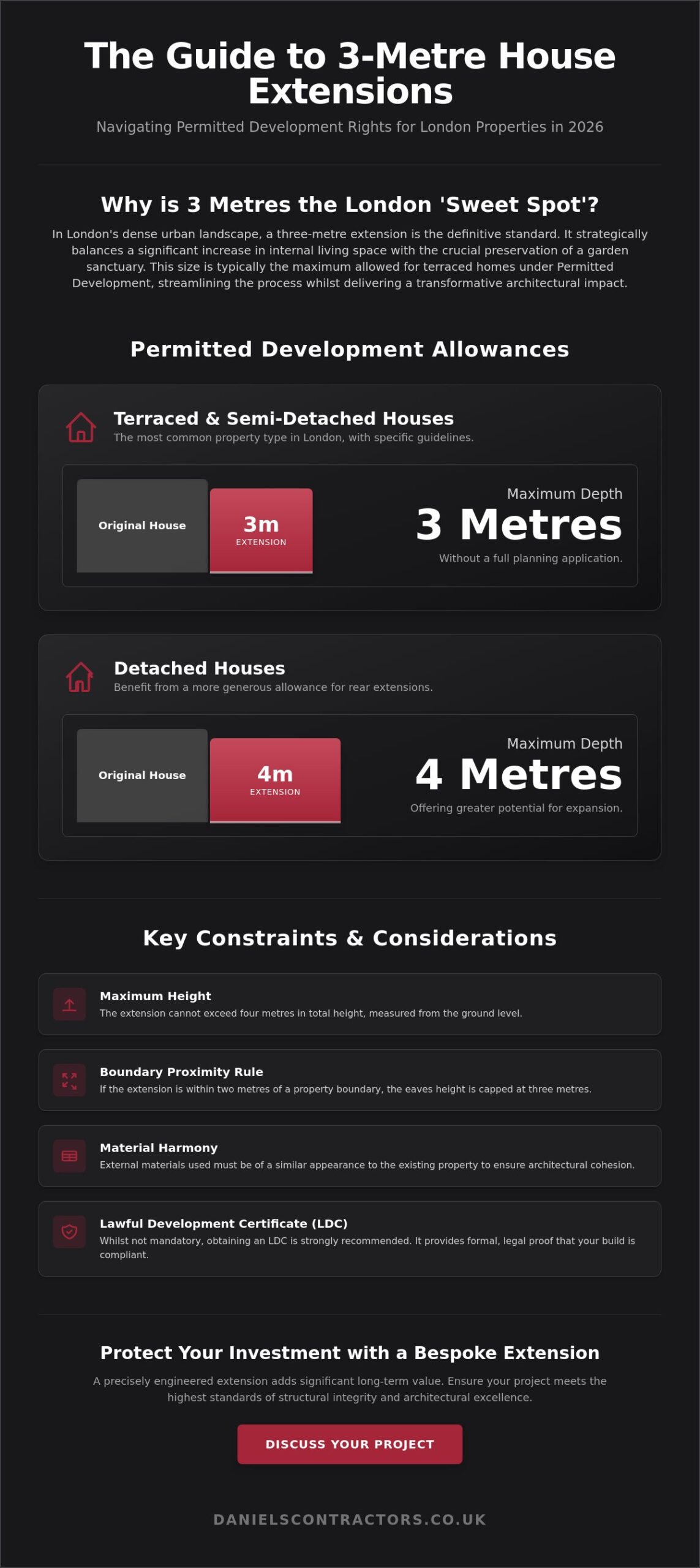
A 3 meter house extension isn’t just a measurement; it’s a strategic architectural decision. In London’s dense urban fabric, particularly amongst Victorian and Edwardian terraces, this size has become the definitive gold standard. It represents the maximum depth usually allowed under the General Permitted Development Order for terraced properties without requiring a full householder planning application. This efficiency makes it the most versatile choice for homeowners who want to transform their living space without the uncertainty of a lengthy planning battle.
Choosing a three-metre depth allows for a significant interior gain whilst preserving the integrity of the rear garden. It’s the “sweet spot” where you gain enough square footage to revolutionise your ground floor without sacrificing the outdoor sanctuary that is so precious in the capital. While some view this as a standard “box” addition, we approach it as a bespoke architectural opportunity. A well-designed extension of this scale isn’t just an extra room; it’s a structural evolution that harmonises with the original character of your home. The popularity of this size amongst Londoners seeking bespoke kitchen-diners stems from its ability to feel spacious without overwhelming the existing plot.
The Functional Benefits of a 3-Metre Footprint
The true magic of three metres lies in its ergonomics. It provides the exact depth required to house a luxury kitchen island with generous circulation space on either side. This allows for a natural dining flow that feels intuitive rather than forced. By using floor-to-ceiling glazing or slim-profile steel doors, a three-metre space becomes a conduit for natural light, pulling sunshine deep into the previously dark middle rooms of a traditional terrace. Because the span is relatively modest, it often avoids the need for the heavy, complex structural steelwork required by larger, deeper builds. This simplicity can streamline the construction phase and reduce logistical friction during the build.
Maximising Property Value in London and Surrey
Investing in a rear addition is one of the most reliable ways to increase property value in high-demand postcodes like Chelsea, Fulham, or Richmond. A seamless transition between a luxury kitchen and a landscaped garden acts as a powerful bridge between indoor and outdoor living. This lifestyle upgrade is highly sought after by modern buyers. When you choose the bespoke house extensions London homeowners trust, you ensure that every millimetre of that three-metre footprint is optimised for both daily utility and long-term capital growth. High-quality materials and thoughtful design prevent the extension from looking like an afterthought, protecting your investment for years to come.
Navigating Permitted Development Rights for 3 Metre Extensions in 2026
The legal framework surrounding a 3 meter house extension is designed to provide homeowners with a streamlined path to expansion, yet the details require meticulous attention. Under current Permitted Development (PD) rights, most terraced and semi-detached houses in London can extend by up to three metres without full planning permission. For detached properties, this allowance increases to four metres. These rights are outlined in the official government guidance, which serves as the technical benchmark for all domestic builds in the UK.
In 2026, the criteria for PD remain strict regarding the external appearance and physical dimensions. To qualify, the materials used must be of a similar appearance to the existing house. This means a bespoke brick match or specific render finish is often necessary to maintain architectural harmony. Height is equally critical; your extension cannot exceed four metres in total height. If it sits within two metres of a property boundary, the eaves height is capped at three metres. Even when your project falls within these parameters, we always recommend obtaining a Lawful Development Certificate (LDC). This document provides formal proof that your build was legal at the time of construction, which is vital when you eventually come to sell or refinance your home.
When Planning Permission is Still Required
PD rights are not universal. Approximately 60% of properties in London face restrictions because they’re in conservation areas or subject to Article 4 directions. If your property is situated within such an area or is a Grade II listed building, these rights are often restricted or removed entirely. In these instances, a full householder planning application is mandatory. Similarly, if you wish to go beyond the standard limits, the “Prior Approval” process allows for extensions up to six metres for terraced houses, provided neighbours don’t object during the consultation period. It is also worth noting that combining a rear addition with a side return can complicate matters, as side extension permitted development rules have their own specific constraints that may overlap with your rear extension plans.
Building Regulations and Compliance
While planning permission deals with the “if” and “where,” Building Regulations focus on the “how.” Every extension must comply with these non-negotiable standards. In 2026, there is a heightened focus on Part L, which mandates superior U-values for glazing and walls to ensure thermal efficiency. Building Control officers will conduct staged inspections of your foundations, drainage, and insulation to certify the build’s integrity. For those seeking a truly premium result, our team at Daniels Contractors ensures every structural detail exceeds these baseline requirements, providing a space that is as efficient as it is beautiful.
Designing Your 3 Metre Extension: Maximising Light, Space, and Flow
Designing a 3 meter house extension requires a shift in perspective. Rather than viewing the depth as a limitation, we treat it as a curated frame for high-end living. Successful design hinges on “zoning” the space to ensure it doesn’t feel like a mere corridor. By defining specific areas for cooking, dining, and relaxation, you create a sense of purpose and scale. Many homeowners now opt for “broken-plan” living, which uses internal glazing, floor level changes, or bespoke shelving to create distinct luxury areas whilst maintaining the visual connection and light flow of an open-plan layout. This approach provides the privacy of traditional rooms without sacrificing the airy feel of a modern addition.
The choice of glazing is perhaps the most significant aesthetic decision you’ll make. Crittall-style steel frames offer a timeless, industrial elegance that suits period London properties perfectly, whereas slimline sliding doors provide an uninterrupted view of the garden with minimal sightlines. To truly elevate the finish, ensure your floor levels are perfectly flush between the original house and the new addition. This creates a seamless transition that makes the entire ground floor feel unified and significantly larger. When the internal flooring continues out onto a matching terrace, the boundaries of the home effectively disappear, making the three-metre footprint feel vastly more expansive.
The Heart of the Home: Luxury Kitchen Extensions
Within a three-metre depth, every millimetre must be intentional. A bespoke kitchen layout often features a sleek island that doubles as a social hub, paired with custom cabinetry that reaches the ceiling to maximise storage. Integrating smart appliances behind matching veneers preserves the clean lines of the design. For more inspiration on tailoring these spaces, explore our kitchen extension ideas for luxury homes. Lighting design is the final touch; using dimmable perimeter LEDs and statement pendants over the island creates a sophisticated evening ambience that transforms the room from a workspace into a social sanctuary.
Architectural Features That Add “Wow” Factor
To combat the “dark middle” room often found in traditional terraces, we integrate oversized roof lanterns or frameless skylights. These features act as light wells, flooding the centre of the home with natural radiance even on overcast days. Whilst the official government guidance on permitted development dictates the external height, the internal ceiling can often be vaulted to create a sense of grandeur. Material choices also play a role; exposed London stock brickwork adds texture and character, whereas high-end plaster finishes provide a crisp, gallery-like backdrop for art. Bespoke joinery, such as built-in window seats or hidden media units, ensures the floor plan remains uncluttered and elegant.
The Construction Phase: Structural Precision in London’s Unique Landscape
Transitioning from architectural vision to physical reality requires a level of structural precision that’s particularly demanding in the capital. For a 3 meter house extension, the structural engineer is perhaps the most critical partner in the process. They calculate the exact steel specifications required to support your home once the original rear wall is removed, ensuring the structural integrity of the entire property remains uncompromised. In London, these calculations must account for the notorious “London Clay,” a soil type known for its high volume change potential. Standard foundations often fall short here; depending on the proximity of trees or the specific plasticity of the soil, deep trench foundations or even piling may be necessary to prevent future subsidence.
Navigating the legalities of shared boundaries is another essential phase of the build. The Party Wall Act 1996 dictates that you must notify your neighbours if you’re building on or near the boundary. This isn’t just a formality; it’s a vital protection for both parties that prevents disputes and provides a clear record of the property condition before work begins. To manage these technical and legal complexities, a dedicated project manager acts as the conductor of the build, synchronising trades and ensuring that standards never slip. Their presence is what separates a stressful construction site from a professional, well-ordered project.
Foundations and Groundworks
Project Management and Timeline
A typical three-metre addition usually follows a 12 to 16-week construction window. The initial weeks involve the most significant disruption, including demolition and groundworks, followed by the rapid ascent of the weather-tight shell. Managing deliveries and specialist trades in congested residential streets requires logistical expertise and constant communication. We pride ourselves on a “gentleman builder” approach, maintaining site cleanliness and professional conduct to minimise the impact on your daily life. If you’re ready to begin your transformation with a partner who values integrity as much as craftsmanship, contact Daniels Contractors to discuss your project requirements.
Investing in Excellence: How a Bespoke 3 Metre Extension Adds Long-Term Value
A 3 meter house extension represents a significant financial and emotional commitment. Viewing it as a mere “bolt-on” or a budget quick-fix is a missed opportunity that can actually compromise the market value of a premium property. Whilst some contractors advocate for standard, off-the-shelf components to lower initial costs, this approach often results in a jarring architectural mismatch. We believe true value is found in a bespoke execution that treats the extension as a natural evolution of the original building. By investing in high-performance materials such as natural stone, bespoke timber joinery, and high-specification structural glass, you protect your capital and ensure the addition ages with grace. For homeowners whose ambitions extend beyond the ground floor, a double storey extension offers a transformative structural metamorphosis that can deliver an even greater increase in both living space and property value.
Beyond the immediate aesthetic appeal, a luxury build focuses on performance. High-performance insulation and superior glazing don’t just meet 2026 building regulations; they provide substantial long-term energy savings. A well-insulated extension remains comfortable throughout the seasons, functioning as a true year-round living space rather than a seasonal room. The journey from the initial concept to the final, light-filled kitchen or living area is a process of refinement. Every material choice contributes to a unified sense of excellence, ensuring the finished space feels like a deliberate architectural statement.
The Aesthetic Integration with Your Original Home
Choosing Your Construction Partner
Selecting the right partner is the most critical decision in any residential project. Our 25 years of experience in the complex London landscape allows us to anticipate challenges before they arise, providing you with absolute peace of mind. We operate with total transparency, using fixed-price contracts and milestone-based payments to ensure the financial side of the project is as well-organised as the construction itself. This methodical approach ensures that your vision is delivered without compromise or unexpected costs. If you’re ready to transform your home with a partner who values craftsmanship and integrity, Contact Daniels Contractors for a bespoke consultation.
Realising Your Architectural Vision
A 3 meter house extension is far more than a simple addition; it’s a strategic architectural investment that, when executed with precision, redefines the flow and character of your London home. By navigating the 2026 Permitted Development landscape with expert guidance and prioritising high-end bespoke finishes, you ensure that your new space adds both immediate lifestyle benefits and long-term capital value. Success lies in the details, from the seamless transition of floor levels to the meticulous matching of period brickwork.
At Daniels Contractors, we bring 25 years of luxury London construction experience to every project. We specialise in high-end bespoke finishes that harmonise perfectly with your property’s original character. Our transparent, milestone-based project management ensures that your journey from initial concept to final handover is steady, reassuring, and completely transparent. We take pride in our “gentleman builder” approach, treating your home with the care and dedication it deserves.
Start your bespoke extension journey with Daniels Contractors today. We look forward to helping you transform your living environment into a space of enduring elegance and functional luxury.
Frequently Asked Questions
Do I need planning permission for a 3-metre rear extension in 2026?
In most cases, you won’t need full planning permission for a 3-metre rear extension in 2026 because it falls under Permitted Development rights. This allowance applies to terraced and semi-detached properties that aren’t located in conservation areas or subject to Article 4 directions. It’s always best to obtain a Lawful Development Certificate to provide formal proof that your build was legal at the time of construction.
Can I build a 3-metre extension on a semi-detached house under Permitted Development?
Yes, building a 3 meter house extension on a semi-detached property is a standard allowance under Permitted Development rights. The rules allow for a single-storey rear addition of up to three metres from the original rear wall of the house. You must ensure the total height doesn’t exceed four metres and that the external materials match the existing property to remain compliant with these regulations.
How much does a 3-metre house extension typically cost in London?
The investment required for a 3-metre extension in London is determined by the complexity of the structural groundworks and the quality of the internal finishes. High-end builds featuring bespoke cabinetry, structural glass, and premium stone flooring will command a different investment level than a basic shell. We recommend a detailed consultation to establish a fixed-price contract that reflects your specific architectural requirements and material choices.
How long does it take to build a 3-metre extension from start to finish?
A typical construction timeline for a project of this scale usually ranges from 12 to 16 weeks. This window covers everything from initial excavations and foundation work to the final plumbing and electrical fit-out. Factors like weather conditions and the lead times for specialist items, such as bespoke glazing or custom joinery, can influence the precise completion date of your project.
Will a 3-metre extension require a Party Wall Agreement?
You’ll likely require a Party Wall Agreement if your extension involves excavating within three or six metres of a neighbouring structure. This is a common requirement for London terraces where the new foundations sit close to shared boundaries. Serving the correct notices early in the planning phase ensures a smooth transition to the construction stage and maintains positive relationships with your neighbours.
What is the difference between a 3-metre and a 6-metre extension regarding planning?
The primary difference lies in the application process; a 3-metre extension is usually allowed under Permitted Development, whilst a 6-metre extension requires a Prior Approval application. The Prior Approval process involves the local council notifying your neighbours, who then have the right to raise objections. Many homeowners prefer the three-metre option for its simplicity and the reduced risk of planning delays.
Can I include a side-return as part of my 3-metre rear extension?
It’s possible to combine a rear addition with a side-return, though this often necessitates a full planning permission application. Combining these two elements can exceed the specific volume or footprint limits set by standard Permitted Development rights. This L-shaped approach is an excellent way to reclaim underutilised space, provided the architectural design remains sympathetic to the original building’s character.
How do I ensure my 3-metre extension adds the most value to my property?
Maximising property value is best achieved through high-quality architectural design and the strategic use of natural light. Prioritising bespoke finishes and seamless floor levels creates the “wow factor” that attracts premium buyers in the London market. A 3 meter house extension that successfully bridges the gap between indoor and outdoor living, such as through slimline sliding doors, consistently offers a superior return on investment. Homeowners looking to maximise their investment further may also wish to explore the possibilities of a double storey extension, which can unlock significant additional square footage and deliver a substantial uplift in property value.