
Did you know that roughly 60% of London properties now face restrictions from Article 4 directions or Conservation Area status? Despite these hurdles, a side extension permitted development project remains the most elegant shortcut to expanding your living space without the standard eight week wait for a planning decision. It’s natural to feel overwhelmed by the complexity of the General Permitted Development Order, whilst the fear of a costly demolition order often discourages homeowners from even starting their journey.
We believe that extending your home should be a refined experience defined by precision rather than paperwork. This guide clarifies the specific height limits and the essential 50% width rule that will dictate your design. By understanding these technical requirements, you can bypass the £258 householder application fee and move straight to the craft of construction. We will show you how to navigate London’s unique constraints to create a bespoke addition that enhances both your lifestyle and your property’s market value with absolute confidence.
Key Takeaways
- Master the fundamental 50% width restriction and height limits to ensure your project remains within the legal boundaries of a side extension permitted development.
- Identify the specific London constraints, such as Article 4 directions and Conservation Area status, that may override standard national rights for your property.
- Learn how to bypass the standard eight-week planning wait whilst maintaining full compliance with the latest 2026 GPDO regulations.
- Understand the vital role of a Certificate of Lawfulness in protecting your property’s future resale value and providing total peace of mind.
- Discover how to move beyond basic technical requirements to create a bespoke, high-end extension that reflects true craftsmanship and design excellence.
Understanding Side Extension Permitted Development Rights in 2026
Permitted Development functions as a streamlined national grant of planning permission, allowing homeowners to bypass the traditional application process for specific types of work. This system is primarily grounded in the Town and Country Planning Act 1990, which provides the legal foundation for our modern planning environment. In 2026, the General Permitted Development Order (GPDO) remains the definitive framework for these rights. A side extension permitted development project offers a level of certainty that many find reassuring, especially when compared to the often subjective nature of a full householder application.
For many residents across London, the side extension is a pragmatic and sophisticated choice for narrow, urban plots. It utilises underused space at the flank of the building whilst preserving the precious garden area at the rear. It’s vital to remember that whilst PD rights cover the planning aspect of your project, you must still adhere to Building Regulations. These are separate, mandatory standards that ensure the structural integrity, safety, and energy efficiency of your new living space. We view these regulations not as hurdles, but as essential benchmarks for a high-quality build.
The Concept of the Original House
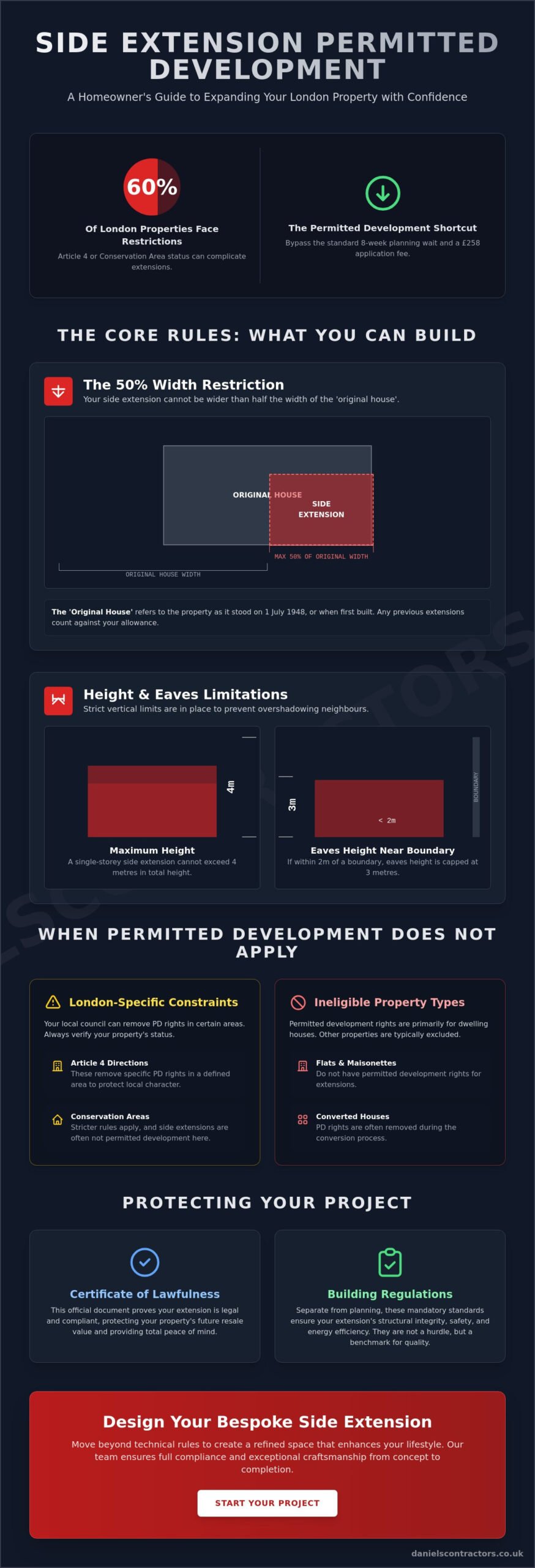
The legislation refers to the “original house” as the building as it stood on 1 July 1948, or as it was first constructed if built after that date. This is a critical distinction. Any extensions added by previous owners since 1948 are deducted from your total allowance. If a former resident already utilised the side plot for a garage or a small utility room, your current capacity for a side extension permitted development might be significantly reduced. Verifying the history of your London property is the first essential step in our process. We believe in total transparency, ensuring you understand exactly what is possible before any ground is broken.
Who Can Benefit from PD Rights?
These rights are generally reserved for houses and bungalows. Flats and maisonettes do not enjoy the same privileges. Any external expansion for these property types will almost certainly require a full planning application. Similarly, houses that were created through the conversion of other buildings often have their PD rights restricted or removed entirely. Whilst the Prior Approval process is commonly used for larger rear extensions, side additions usually rely on pure permitted development rules. If your project falls within the strict criteria of the GPDO, you can proceed with the quiet confidence that your build is lawful from the outset.
The 50% Rule and Key Dimensions: What You Can Actually Build
Designing a side extension requires a meticulous eye for detail to ensure the new structure sits in harmony with the existing plot. Precision is paramount. The most significant constraint for a side extension permitted development project is the width limit. According to the official government technical guidance, your addition must not exceed half the width of the original dwelling. This rule ensures that extensions remain subordinate to the main house, preserving the architectural balance of the neighbourhood whilst protecting the character of the street scene.
Width and Depth Restrictions
When calculating this 50% limit, we measure the widest part of the original house as it stood in 1948. It’s a specific, technical measurement that leaves little room for error. The extension must not sit forward of the principal elevation, which usually means it cannot protrude beyond the front wall. Additionally, the depth is typically measured against the rear wall of the original building. Exceeding these limits can invalidate your side extension permitted development status, turning a straightforward project into a legal complication. For homeowners considering a 3 meter house extension at the side of their property, understanding precisely how this width calculation applies to your specific plot is essential before commissioning any architectural drawings.
Height and Eaves Limitations
Vertical dimensions are strictly controlled to prevent overshadowing. A single-storey side extension cannot exceed a total height of 4 metres. This height is measured from the highest part of the adjacent ground to the highest point of the roof. However, proximity to your neighbours introduces further restrictions. If any part of the extension is within 2 metres of a boundary, the eaves height is capped at 3 metres. This maintains a sense of space and light amongst London’s dense residential streets, ensuring your project remains respectful of those nearby.
To maintain the aesthetic integrity of your home, the materials used for the exterior must have a similar appearance to those of the existing house. This includes the roof pitch, which should match the primary structure as closely as possible for a seamless visual transition. Our design team at Daniels Contractors excels at blending these technical mandates with bespoke architectural flourishes, ensuring your new space feels like a natural evolution of your home rather than an afterthought. By adhering to these dimensions, you secure a high-end result that respects both the law and the craft of building.
When Permitted Development Does Not Apply: London Pitfalls
Whilst the national framework provides a generous starting point, London’s planning landscape is a patchwork of heritage protections. Approximately 60% of properties across the capital face some form of restriction that can override standard rights. Even if your side extension permitted development project follows every dimension rule, local bylaws might still require a full planning application. We often see homeowners surprised by these nuances, particularly when they assume national rules apply universally to every postcode.
Conservation Areas and Article 4 Directions
Many London boroughs, from Islington to Wandsworth, utilise Article 4 directions to safeguard the architectural integrity of their streets. These directions effectively strip away specific permitted development rights, often targeting Victorian and Edwardian terraces. If your home sits on “Article 2(3) land”, which includes Conservation Areas and Areas of Outstanding Natural Beauty, your options are significantly narrower. The official government technical guidance notes that side extensions are generally not permitted on such designated land. In these instances, councils usually insist on a full householder application to ensure that materials, such as reclaimed London stock brick, perfectly match the existing character.
The Wraparound Extension Conflict
The “wraparound trap” is perhaps the most complex hurdle for homeowners seeking to maximise their ground floor. This occurs when you attempt to join a side extension with a rear extension to create a large, L-shaped living space. Whilst you might view these as two separate projects, the planning system treats them as a single enlargement. Because a side extension cannot exceed half the width of the original house, the point where it merges with a rear extension almost always violates this 50% width limit. As a result, bespoke side return extensions that turn the corner into the rear garden typically fall outside of permitted development and require full planning permission.
Listed buildings represent the final, most stringent category of restriction. If your property is Grade I or Grade II listed, permitted development rights are almost entirely removed. You’ll need both Planning Permission and Listed Building Consent for any structural change, no matter how small. We recommend checking your local borough’s planning portal as your very first step. Understanding whether your home is subject to these specific London pitfalls ensures you don’t invest in a design that the council will later reject. This methodical approach provides the peace of mind necessary for a successful, high-end transformation.
Securing Your Investment: The Certificate of Lawfulness
Even when a side extension permitted development project strictly adheres to every technical mandate, proceeding without formal documentation is a gamble we advise against for high-end London properties. A Lawful Development Certificate (LDC) is fundamentally different from planning permission. Whilst the latter is a request for approval to build, an LDC is a legal document confirming that your project was lawful at the time of construction. This distinction is vital for your peace of mind. It provides an immutable record that protects your investment from future changes in local planning policy or potential disputes with the council.
The true value of this certificate often becomes apparent during property valuations or the conveyancing process. London solicitors are notoriously meticulous; they will require absolute proof that any structural changes were authorised under the GPDO. Without an LDC, you may face significant delays or be forced to purchase indemnity insurance to satisfy a buyer’s lender. Securing this paperwork ensures a seamless transition for future owners and reinforces the professional integrity of your home’s transformation. We view this as an essential final step in any bespoke build.
Applying for a Lawful Development Certificate (LDC)
To obtain this “gold standard” of proof, you must submit a formal application to your local authority. This requires high-quality architectural drawings, precise site plans, and historical records that prove the status of the original house. In most London boroughs, the statutory determination period is eight weeks. Whilst this mirrors the timeline for a planning application, the focus here is purely on facts and legislation rather than subjective design opinions. It is a methodical verification process that confirms your extension meets the 50% width rule and height restrictions discussed earlier.
Building Regulations vs Planning
Planning rules dictate the size and location of your extension, but Building Regulations ensure its safety and performance. For 2026, these standards are more stringent than ever, with a heavy focus on structural integrity, fire safety, and advanced thermal efficiency. If you are currently exploring bespoke kitchen extension ideas, your design must incorporate high-performance insulation and airtightness to meet modern energy requirements. These regulations are mandatory regardless of whether you build under permitted development or full planning permission.
Professional site management and regular inspections are non-negotiable for a premium build. Building Control officers will visit your home at key milestones to verify that every detail, from the depth of the foundations to the fire-rating of the materials, adheres to the approved plans. This dual-layered approach of planning compliance and regulatory excellence ensures your new space is as safe as it is beautiful. If you are ready to begin your project with the support of a reliable construction partner, our team can manage these complex technical requirements on your behalf.
Designing Your Bespoke Side Extension with Daniels Contractors
Adhering to the technical constraints of a side extension permitted development project doesn’t mean you have to compromise on your vision for a luxury home. Whilst the GPDO sets the legal boundaries, the internal volume and aesthetic finish remain entirely within your control. We specialise in elevating these projects from mere additions to seamless architectural evolutions. By integrating bespoke glazing solutions and premium finishes, we ensure that every square inch of your new space feels intentional and refined. We don’t just build; we create environments that reflect the high standards of our clients.
The transition from the original house to the new extension should be imperceptible. Achieving this requires more than just technical knowledge; it demands the eye of a master craftsman. We focus on the nuances of the build, from the way light falls across a room to the tactile quality of the materials chosen. This commitment to excellence ensures that your project bypasses the standard aesthetic of a “typical” extension, resulting in a space that feels like a natural, high-end component of your property.
Architectural Integration and Materials
Our approach centres on a deep respect for London’s diverse architectural heritage. Whether your home is a Victorian terrace or an Edwardian semi-detached, we prioritise matching period brickwork and intricate sash window details to ensure a flawless finish. This meticulous attention to detail is what adds significant market value to a property. On London’s notoriously tight plots, we manage complex structural excavations with a steady hand, ensuring the integrity of both your home and the neighbouring structures remains uncompromised. We use only premium materials, ensuring that every element of the refurbishment meets our exacting standards.
The Daniels Contractors Commitment
With a 25-year history of delivering bespoke house extensions in London, we’ve refined a process that balances technical expertise with a personal, boutique service. We believe in transparent project management. This means providing you with a clear roadmap from the initial feasibility study to the final handover. Our “gentleman builder” ethos ensures that clear communication and mutual respect are at the heart of every interaction. We don’t cut corners. We curate an experience that provides total peace of mind, knowing that your project is in the hands of professionals who value quality as much as you do. The result is a transformation that is as dependable as it is beautiful.
Realising Your Vision for a Refined London Home
Successfully navigating a side extension permitted development project requires more than just following a checklist. It demands a deep understanding of the 50% width rule and a proactive approach to London’s specific heritage protections. By securing a Lawful Development Certificate, you ensure your investment is protected for the future, whilst choosing the right materials maintains the architectural integrity of your street. These technical foundations are the essential first steps toward a bespoke living space that truly enhances your property’s value.
With over 25 years of luxury construction experience across the capital, we bring structural precision and high-end finishes to every refurbishment we undertake. Our team provides full, transparent project management to ensure your journey is as steady and reassuring as the final result. We invite you to discuss your bespoke London extension project with our experts and discover how we can transform your space with quiet confidence. Your home deserves a partner who values craftsmanship and integrity as much as you do.
Frequently Asked Questions
How wide can a side extension be under permitted development?
Under current legislation, a side extension must not exceed half the width of the original dwelling as it stood in 1948 or when first built. This calculation is precise; if your house is 6 metres wide, your extension is capped at 3 metres. Exceeding this limit immediately requires a full householder planning application to ensure the addition remains subordinate to the primary structure.
Can I build a two-storey side extension without planning permission?
You cannot build a two-storey side extension under permitted development rights as these only apply to single-storey structures. Multi-storey additions at the side of a property almost always require a full planning application. This allows local authorities to assess the impact on neighbouring light and the overall street scene, which is particularly important in densely populated London boroughs. If you are considering a more ambitious vertical expansion, our comprehensive guide to double storey extension planning, design, and luxury construction covers the full process in detail.
Do I need a party wall agreement for a side extension built under PD?
A party wall agreement is often necessary if your extension involves excavating for foundations within 3 or 6 metres of a neighbouring structure. Whilst your project might be lawful under planning rules, the Party Wall Act 1996 is a separate legal requirement. We recommend serving notice to your neighbours early in the process to maintain professional relationships and avoid construction delays.
What is the maximum height for a side extension eaves?
The maximum eaves height is limited to 3 metres if any part of the extension is within 2 metres of a property boundary. If the structure is further than 2 metres from the boundary, the total height of a single-storey side addition cannot exceed 4 metres. These restrictions prevent the build from becoming overbearing for those living in adjacent properties.
Can I use different materials for my side extension under permitted development?
Standard permitted development rules require that the materials used for the exterior of the extension must be similar in appearance to those of the existing house. This ensures visual harmony and prevents jarring architectural contrasts. If you wish to use contemporary finishes like zinc cladding or large glass panels that differ significantly from the original brickwork, a full planning application is usually the safer route.
Does permitted development apply to side extensions in a Conservation Area?
Permitted development rights for side extensions are automatically removed for properties situated within Conservation Areas or on “Article 2(3) land”. In these sensitive locations, councils require a full planning application to ensure that any new work preserves or enhances the area’s character. We always advise checking your specific postcode on the local council’s planning portal before commissioning architectural drawings.
How does the 50% width rule apply to corner plots in London?
For corner plots, the 50% width rule still applies, but the definition of the “side” elevation can be more complex if the house faces two roads. A side extension permitted development project on a corner plot cannot extend beyond a wall that forms the principal elevation or fronts a highway. This often limits the footprint more strictly than on a standard mid-terrace or semi-detached plot.
Will a side extension built under PD affect my future rear extension rights?
Building a side extension can impact your future rights because the GPDO limits the total area of land covered by additions to 50% of the total curtilage. Every square metre utilised for a side extension permitted development reduces the remaining allowance for future projects. We suggest planning your long-term property strategy holistically to ensure your current build doesn’t inadvertently block a future 3 meter house extension or kitchen expansion.